Watching Extremism Without Consequence
Read Time:6 Minute, 1 Second
MOVIE REVIEW
Homegrown
 –
– 

Genre: Documentary
Year Released: 2024, GATHR DTA 2026
Runtime: 1h 49m
Director(s): Michael Premo
Where to Watch: from January 6 through President’s Day (February 16, 2026), Homegrown will be available exclusively for online rental through the film’s official website www.homegrown.film, powered by GATHR’s Direct To Audience℠ distribution technology.
RAVING REVIEW: HOMEGROWN is a documentary that asks its audience for patience, restraint, and open-mindedness. For some viewers, that request may feel noble, even necessary. For others, especially those who watched the events it depicts unfold in real time, it feels like a demand to suspend clarity in favor of proximity. That tension sits at the heart of the film, and it’s ultimately what makes HOMEGROWN both compelling and deeply frustrating.
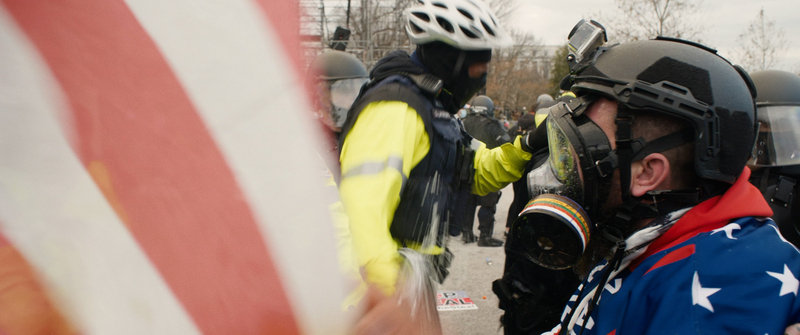
Directed by Michael Premo, the film offers prolonged, unusually intimate access to three men who would go on to participate in the movement that culminated in the January 6 attack on the U.S. Capitol. Premo embeds himself for years, capturing moments of grievance, camaraderie, doubt, and radicalization as these men campaign for Donald Trump and spiral deeper into conspiratorial thinking. The filmmaking is controlled and observational. The access is real. The problem isn’t what the film shows; it’s what it refuses to confront.
HOMEGROWN is clearly designed to resist any easy conclusions. January 6 is framed not as a climax, but as a waypoint in a longer ideological journey. The film’s updated footage, which extends beyond the attack itself, reinforces the idea that belief systems don’t collapse under the weight of reality. They adapt. They mutate. In theory, this is a valuable approach. In practice, the film’s refusal to push back creates a vacuum where accountability never quite arrives.
That absence is impossible to ignore. These aren’t just abstract figures. These are people who tried and failed to overturn a free and fair election. They didn’t suffer consequences proportionate to the damage they helped normalize, which isn’t the film's fault but the fault of a broken system. In some cases, they returned to the same political figure who had fueled their radicalization in the first place. The film observes this reality, but it doesn’t ask more of it. It watches hate curdle into grievance and then harden again into certainty, but it rarely asks what responsibility looks like when the cycle repeats.
Premo’s commitment to non-judgment is both the film’s defining strength and its most significant flaw. The camera sits close, often uncomfortably so, capturing private moments that reveal how easily victimhood narratives take root. You see how fear, masculinity, and media ecosystems intertwine. You understand how these men come to believe they’re under attack. But understanding how something happens isn’t the same as challenging whether it should be allowed to continue unchecked.
The film believes that proximity alone is enough. That by humanizing these men, viewers will reach their own conclusions. For some audiences, that may be true. For others, especially those already exhausted by years of gaslighting, the approach feels inadequate. There’s a difference between refusing to demonize and refusing to draw lines. HOMEGROWN frequently crosses into the latter.
What makes this especially difficult is the timing. This isn’t a distant historical event. This isn’t something viewers have had decades to metabolize. Many watched this unfold live on television. Many are still living with the consequences. When the film asks for empathy without reckoning, it risks recentering the very people who have continued to harm the democratic process, while offering little to those they target.
To be clear, HOMEGROWN isn’t propaganda. It doesn’t glorify violence or endorse ideology. Its intentions are sincere. The filmmaker had a vision. The access is undeniable. There’s value in seeing extremism up close rather than caricatured. But intention doesn’t negate impact. By refusing to press harder, the film sometimes feels like it’s asking viewers to do the moral labor the documentary itself avoids.
There are moments when the film hints at a deeper critique, when doubt flickers and contradictions surface. Some subjects express uncertainty. Some reckon, briefly, with the consequences of their actions. Those moments are compelling, but they’re fleeting. More often, the film returns to observation, letting statements hang without challenge. In doing so, it risks normalizing the language of grievance by treating it as just another perspective rather than a destabilizing force.
The updated footage, following the pardons and post-prison life, only sharpens this discomfort. The reality that some participants had limited long-term repercussions undermined the film’s claim to be grappling with consequences. Instead of clarifying the cost of extremism, these sequences highlight how easily accountability can evaporate. The film shows this, but it doesn’t fully reckon with what it means.
HOMEGROWN may play very differently in another decade. Time might create enough distance for viewers to approach it as a historical artifact rather than an open wound. Right now, though, that distance doesn’t exist. The scars are still fresh, the rhetoric still circulating, the same figures still empowered. In that context, the film’s restraint feels less like discipline and more like hesitation.
HOMEGROWN is a well-crafted documentary that stops short of the confrontation it gestures toward. It offers access without consequence, understanding without reckoning, and empathy without accountability. That makes it an important film to discuss, but a difficult one to embrace. It doesn’t fail because it’s poorly made. It struggles because it refuses to push the bar to where it needs to be. It asks viewers to endure discomfort, but it rarely challenges that discomfort. And in a moment where the stakes are still painfully real, that restraint feels less like neutrality and more like a missed opportunity.
Please visit https://linktr.ee/overlyhonestr for more reviews.
You can follow me on Letterboxd, Instagram, Twitter, and YouTube. My social media accounts can also be found on most platforms by searching for 'Overly Honest Reviews'.
I’m always happy to hear from my readers; please don't hesitate to say hello or send me any questions about movies.
[photo courtesy of DOC SOCIETY, STORYLINE, IMPACT PARTNERS, BIRD STREET PRODUCTIONS, FORD FOUNDATION – JUST FILMS]
DISCLAIMER:
At Overly Honest Movie Reviews, we value honesty and transparency. Occasionally, we receive complimentary items for review, including DVDs, Blu-rays, CDs, Vinyl Records, Books, and more. We assure you that these arrangements do not influence our reviews, as we are committed to providing unbiased and sincere evaluations. We aim to help you make informed entertainment choices regardless of our relationship with distributors or producers.
Amazon Affiliate Links:
Additionally, this site contains Amazon affiliate links. If you purchase through these links, we may receive a commission. This affiliate arrangement does not affect our commitment to honest reviews and helps support our site. We appreciate your trust and support in navigating these links.


Happy
0 %

Sad
0 %

Excited
0 %

Sleepy
0 %

Angry
0 %

Surprise
0 %
 0
0
 0
0


Average Rating