A Biography Made Out of Shattered Glass
Read Time:5 Minute, 22 Second
MOVIE REVIEW
Yes Repeat No
 –
– 

Genre: Drama, Experimental, Political
Year Released: 2023, 2025
Runtime: 1h 38m
Director(s): Michael Moshe Dahan
Writer(s): Michael Moshe Dahan
Cast: Salome Azizi, Mousa Hussein Kraish, Adam Meir, Karim Saleh
Where to Watch: available now on VOD platforms and DVD, watch here: https://amzn.to/4rI8pt8
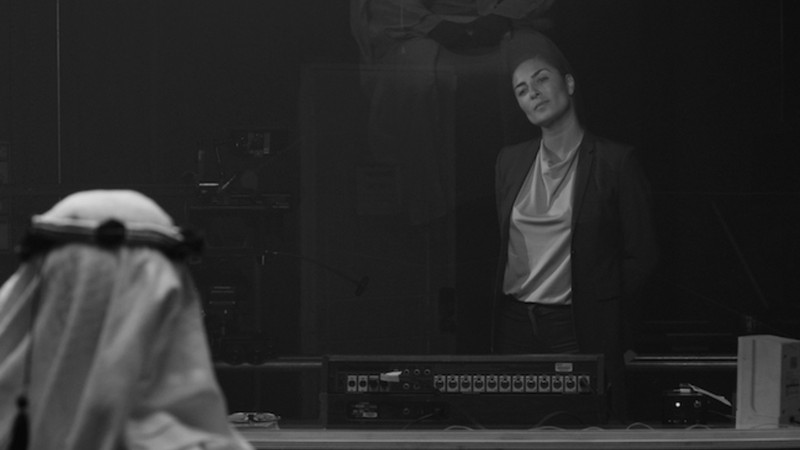
RAVING REVIEW: Stories about identity often pretend clarity exists. YES REPEAT NO doesn’t. It opens in a rehearsal space—blank walls, no escape—and immediately confronts you with the impossibility of its own assignment. Three actors arrive to audition for one role: Juliano Mer-Khamis, a Palestinian-Jewish actor, director, activist, and political contradiction who lived his life refusing to fit into a narrative easy to summarize. Instead of shaping a linear biopic, the film traps its cast in a room where identity becomes something volatile, argumentative, and agonizingly fragile. The goal isn’t to recreate Mer-Khamis; it’s to force each performer to collide with the truths he embodied.
This approach feels intentionally uncomfortable. The film commits to its locked-room structure as if the walls were tightening with each line of dialogue. But that pressure is the point. Michael Moshe Dahan constructs a film where the rehearsal becomes the battleground. Each actor serves not just as a performer but as a proxy for legacies, memories, histories, and ideological wounds passed down through generations. The rehearsal becomes an excavation, and the excavation becomes a fight.
The black-and-white visuals aren’t stylization for its own sake; they mirror the binaries Mer-Khamis spent his life rejecting. Instead of defining clear lines, the film uses the absence of color to fold identities into one another. As the actors rehearse, repeat, and break down, the lighting carves their faces like sculptures under interrogation. The room becomes a psychological trap, and every repetition of a line turns into an accusation about who has the right to embody a man whose very existence made people furious.
Michael Moshe Dahan’s direction is sharp: the camera lingers when the actors are most unsure of themselves. He allows conversations to derail, voices to overlap, and emotions to slip out in ways that undermine the sense of control the audition process is supposed to have. It’s extremely dialogue-heavy, but intentionally so, as if language itself is buckling under the enormity of what they’re trying to channel. This isn’t a film meant to provide comfort or resolution; it wants to leave the audience wrestling with the same discomfort that shaped Mer-Khamis’s life.
What grounds the film is its cast. Mousa Hussein Kraish, Adam Meir, Karim Saleh, and Salome Azizi all traverse wildly shifting emotional and ideological terrain. Kraish brings a lived-in weight to Arab Juliano, folding grief and anger into every line. Meir plays Public Juliano with a sense of fractured responsibility, as if constantly evaluating whether he’s even allowed to speak. Saleh, as Israeli Juliano, carries the burden of contradiction with a quiet defensiveness that erupts at unexpected moments. Azizi, directing the audition within the narrative, becomes the film’s conductor—pushing, provoking, controlling the tempo like someone trying to contain a wildfire.
The script digs into concepts that rarely make it into mainstream films about the Israeli-Palestinian conflict: inherited trauma, phantoms of past violence, contradictions that form identity rather than undermine it. Dahan’s own background in critical theory comes through in the film’s structure, but he avoids turning it into an educational lecture. Instead, the stakes drive the theory. When the actors push back against the script, the political becomes personal. When they grapple with the line between performance and lived identity, the film exposes how fragile representation can be.
The best aspect, though, is how the film refuses to be its own judge. There’s no attempt to present a definitive stance on Mer-Khamis or the conflict he lived inside. Instead, the film shows how impossible it is to tell his story through a single perspective. The audition becomes a metaphor for the way history itself becomes contested terrain. Who gets to speak? Who gets to define? Where does memory end and performance begin?
YES REPEAT NO succeeds most in its layering. Each repetition deepens the sense that Juliano’s life cannot be contained, translated, or simplified. The actors begin cracking under the weight of what they’re asked to embody, and the audience feels that strain with them. When the film finally breaks its own patterns, there’s a release, but not relief—just the awareness that some lives resist narrative because their contradictions were their truth.
As an experimental drama, it accomplishes exactly what it sets out to do. As a portrait of identity fractured by politics, history, faith, and legacy, it’s haunting. And as a commentary on performance itself—how actors take on trauma not their own, how stories distort people even when trying to honor them—it’s one of the most confrontational films released this year. It’s the kind of film that stays with you afterward, precisely because it refuses closure. That refusal becomes its final act of honesty.
Please visit https://linktr.ee/overlyhonestr for more reviews.
You can follow me on Letterboxd, Instagram, Twitter, and YouTube. My social media accounts can also be found on most platforms by searching for 'Overly Honest Reviews'.
I’m always happy to hear from my readers; please don't hesitate to say hello or send me any questions about movies.
[photo courtesy of FREESTYLE DIGITAL MEDIA]
DISCLAIMER:
At Overly Honest Movie Reviews, we value honesty and transparency. Occasionally, we receive complimentary items for review, including DVDs, Blu-rays, CDs, Vinyl Records, Books, and more. We assure you that these arrangements do not influence our reviews, as we are committed to providing unbiased and sincere evaluations. We aim to help you make informed entertainment choices regardless of our relationship with distributors or producers.
Amazon Affiliate Links:
Additionally, this site contains Amazon affiliate links. If you purchase through these links, we may receive a commission. This affiliate arrangement does not affect our commitment to honest reviews and helps support our site. We appreciate your trust and support as you navigate these links.


Happy
0 %

Sad
0 %

Excited
0 %

Sleepy
0 %

Angry
0 %

Surprise
0 %
 0
0
 0
0


Average Rating