Memory Haunting the Present Tense
Read Time:5 Minute, 50 Second
MOVIE REVIEW
In the Clouds
 –
– 

Genre: Drama, Short
Year Released: 2025
Runtime: 14m
Director(s): Alexandra Bahíyyih Wain
Writer(s): Alexandra Bahíyyih Wain
Cast: Nika Roufi, Sophia Akraminejad, Raha Rahbari, Reza Shademan
Where to Watch: shown at the Flickers’ Rhode Island International Film Festival and Raindance Film Festival
RAVING REVIEW: IN THE CLOUDS is an intimate, restrained, and observant; it's a story about displacement that stays focused on the lived reality within a home, not the version of migration audiences have been trained to expect. Even at fourteen minutes, it carries itself like an experience, because it understands exactly where to place the camera and when to let the audience sit with what is not being said.
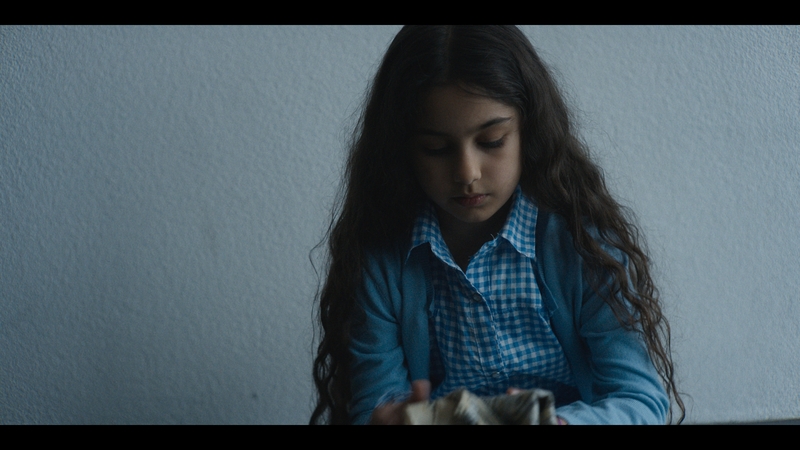
The film centers on Sara, a young Iranian refugee in London, and it immediately commits to her perspective without turning her into a symbol. That choice matters. When a story this heavy is filtered through a child’s view, the world becomes a collage of details, half-grasped adult conversations, unfamiliar moments, and the logic kids build to make sense of a life uprooted. Sara’s curiosity is necessary. It is how she explores control in a place where the adults around her are trying to keep it together.
One of the smartest decisions the film makes is how it approaches pressure. It treats it as atmosphere rather than a plot point; something that sits in the corners of rooms, in pauses between sentences, in the way a parent hesitates before answering a question. That approach lines up with what makes the premise feel honest. Many films about migration default to trauma as the primary core, building moments designed to shock. IN THE CLOUDS goes the other direction. The hardest part can be the ongoing, day-to-day strain of starting over in a world that rarely makes space for you, then expecting you to be grateful while you do it.
Nika Roufi’s performance as Sara is the heartbeat. The film asks for a genuine performance, and she delivers exactly what this story needed. She is present, alert, and quietly guarded; a child who is still a child, but who also seems to have learned which emotions to keep private. That is not an easy balance for an adult actor, let alone someone that young. The performance lands because it never feels like it is “performing” suffering. Instead, it captures the odd emotional mix that comes with upheaval; moments of playfulness, moments of discomfort, moments where she seems to be testing what kind of person she is allowed to be here.
Sophia Akraminejad, as Tala, brings a different kind of strength. The older-sibling role in stories like this can easily become either a second parent or a background character; here, Tala feels like someone carrying her own internal struggles while trying to stay strong for her sister. The dynamic between the two reads as lived-in, not manufactured for sentiment. When Tala is protective, it feels like instinct. When she pulls away, it feels like survival. The film uses that tension because it understands that closeness can be both comfort and burden when the adults are stretched thin.
Raha Rahbari’s mother, Layla, is positioned in that middle space between the past that will not loosen its grip and the future that demands constant forward motion. What stands out is the film’s refusal to simplify her. She is not framed as fragile or as heroic; she is framed as human. Rahbari plays her by letting the audience see how she tries to stay composed and how that composure keeps cracking anyway. There is a lot of character work happening in the smallest movements; the way she watches her children, the way she holds her face in certain moments, the way she seems to measure what she is about to say before she says it.
Reza Shademan’s father, Arash, adds another view. Here, he feels like someone trying to hold his family together through routine and forward-facing optimism, even when he is clearly carrying fear and grief that he doesn't have room to process. The film treats him with empathy while still letting the audience sense the tension beneath the surface. That matters because it keeps the family unit from collapsing into archetypes. These are people, not roles.
Alexandra Bahíyyih Wain’s writing and direction are defined by control and intent. The restraint is the point. The film’s emotion is not delivered through speeches or forced dialogue; it comes from the way the environment presses in and how the characters respond to that pressure in private. Wain also understands something many shorts struggle with: ending a film without making it feel like it simply stops.
Where the film earns its strongest praise is in its refusal to “sell” displacement as spectacle. It does not treat its characters as a lesson for the audience; it treats them as the audience, letting us step into their world. That choice is both ethical and smart. It is also a major reason the film resonates without turning into a lecture. It trusts the viewer to recognize the stakes without being spoon-fed a thesis.
IN THE CLOUDS succeeds because it stays grounded, confident, and attentive to character. It treats grief as something that lives inside routines, not something that only appears in dramatic eruptions. It treats migration as an ongoing condition, not a single moment of crisis. And it finds its power in tenderness, not manipulation. For a short film operating with this level of restraint, that impact is not easy to achieve. It is the kind of film that stays with you because it respects the reality it portrays and the audience it asks to witness it.
Please visit https://linktr.ee/overlyhonestr for more reviews.
You can follow me on Letterboxd, Instagram, Twitter, and YouTube. My social media accounts can also be found on most platforms by searching for 'Overly Honest Reviews'.
I’m always happy to hear from my readers; please don't hesitate to say hello or send me any questions about movies.
[photo courtesy of ONE PEOPLE PICTURES]
DISCLAIMER:
At Overly Honest Movie Reviews, we value honesty and transparency. Occasionally, we receive complimentary items for review, including DVDs, Blu-rays, CDs, Vinyl Records, Books, and more. We assure you that these arrangements do not influence our reviews, as we are committed to providing unbiased and sincere evaluations. We aim to help you make informed entertainment choices regardless of our relationship with distributors or producers.
Amazon Affiliate Links:
Additionally, this site contains Amazon affiliate links. If you purchase through these links, we may receive a commission. This affiliate arrangement does not affect our commitment to honest reviews and helps support our site. We appreciate your trust and support in navigating these links.


Happy
0 %

Sad
0 %

Excited
0 %

Sleepy
0 %

Angry
0 %

Surprise
0 %
 0
0
 0
0

Average Rating