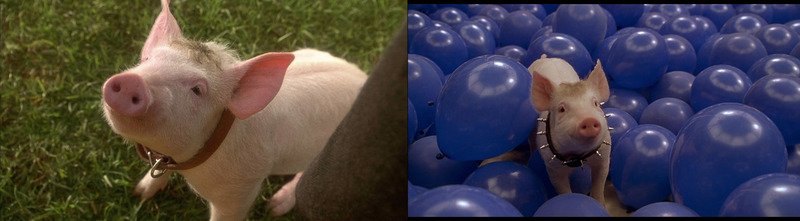
A Farmyard Fairy Tale That Earned Its Heart
Read Time:6 Minute, 47 Second
MOVIE REVIEW
Babe / Babe: Pig in the City (Double Feature) (Blu-ray)
G /  –
– 

Genre: Comedy, Drama, Family, Fantasy, Adventure
Year Released: 1995 / 1998, Kino Lorber Blu-ray (4K) 2026
Runtime: 1h 31m / 1h 37m
Director(s): Chris Noonan / George Miller
Writer(s): George Miller, Chris Noonan / George Miller, Judy Morris, Mark Lamprell
Cast: James Cromwell, Magda Szubanski, Christine Cavanaugh, Miriam Margolyes / Magda Szubanski, James Cromwell, Elizabeth Daily, Mickey Rooney
Where to Watch: available now, order your copy here: www.kinolorber.com or www.amazon.com
RAVING REVIEW: What does kindness look like when it’s treated not as sentiment, but as a disruptive force? BABE asks that question with a disarming calm, presenting gentleness not as weakness but as something radical. BABE: PIG IN THE CITY takes the same character and throws him into a world that doesn’t reward decency so easily. The resulting contrast makes this double feature far more interesting than its wholesome reputation might suggest.
The original BABE works because it understands the power of understatement. Chris Noonan’s direction keeps the audience grounded and the emotions unforced, allowing the film’s themes to emerge through behavior rather than a drawn-out declaration. Babe doesn’t change the farm by being the “tough guy.” He listens. He asks. He treats others with respect in a world structured around hierarchy and fear. That choice becomes the film’s emotional core. It’s a family film that trusts its audience to recognize decency without neon signposting, and that trust is a big reason it’s aged as well as it has. I’m sure it’s part nostalgia, but the trip is powerful nonetheless!
James Cromwell’s performance is central to that success. Farmer Hoggett is defined more by silence than dialogue, and Cromwell leans into the restraint that every small gesture carries weight. The now-iconic final line lands not because it’s so quotable, but because the film has earned it through discipline. BABE understands when to stop talking, a skill many family films never develop. The narration, the chapter structure, and the gentle humor all serve a larger goal: making the audience feel safe enough to engage emotionally without manipulation.
Technically, the film still holds together better than it has any right to. The blend of real animals, puppetry, and visual effects doesn’t aim for invisibility so much as believability, and that distinction matters. The animals feel present, expressive, and vulnerable, which allows the story to flirt with darker realities without breaking its tone. BABE doesn’t pretend farms are idyllic spaces; it acknowledges mortality and fear, then chooses compassion anyway. That choice is what gives the film its quiet confidence.
BABE: PIG IN THE CITY is something else entirely. Where the first film thrives on restraint, the sequel explodes with extremes, both visual and thematic. George Miller, now in the director’s chair after co-writing the first film, transforms the storybook setting into a nightmarish urban illusion, filled with exaggerated characters, danger, and relentless force. The city isn’t a neutral environment here; it’s hostile, chaotic, and unforgiving, a place where kindness feels endangered.
This tonal shift is the reason the sequel remains so divisive. For some, it’s a betrayal of what made BABE special. For others, it’s an evolution that refuses to repeat itself. Both reactions are understandable. PIG IN THE CITY is messy, loud, and often overwhelming. Still, it’s also driven by a clear creative impulse: to test whether Babe’s moral clarity can survive in a world that punishes vulnerability.
The film’s design leans into artificiality, creating a heightened, almost expressionistic cityscape that feels closer to a fever dream than a realistic city. Animals are injured, discarded, and threatened with a bluntness that feels shocking in a family film context. This isn’t accidental. Miller isn’t interested in comfort here; he’s interested in pressure. The question isn’t whether Babe can win, but whether goodness itself can endure when stripped of its support system.
The film often confuses chaos for momentum, and its episodic structure can feel exhausting rather than purposeful. Characters appear, vanish, and reappear with little continuity, making it harder to stay invested in the story beyond the central moral idea. Where the first film builds intimacy through repetition and routine, the sequel relies on escalation, and that difference is felt in every sequence.
Truth be told, something is fascinating about how uncompromising PIG IN THE CITY is. It refuses to soften its worldview or apologize for its darkness, and in doing so, it becomes one of the strangest studio family films of its era. Moments of slapstick coexist with genuine cruelty, and the whiplash is real. Yet beneath the excess, the film still argues for empathy in a world that doesn’t reward it. Babe doesn’t adapt by becoming harder; he survives by remaining himself.
As a double feature, these films function almost as a debate. BABE argues that kindness can transform a system if given time and space. BABE: PIG IN THE CITY counters that kindness may survive, but it won’t be protected, and it won’t always be enough. Watching them together sharpens both perspectives. The original’s gentleness feels more intentional, while the sequel’s aggression reads as a reaction rather than a miscalculation. Together, they form a compelling, uneven, and oddly courageous pairing, one that treats kindness not as a punchline, but as something worth examining.
As a double feature, this set isn’t just nostalgic comfort food. It’s a conversation about morality, environment, and whether decency can survive. That alone makes it worth revisiting, even when the answers are uncomfortable. In today’s political climate, a lot of people could use a viewing of these films!
Product Extras:
DISC 1 (BABE):
Brand New HD Master – From a 4K Scan of the 35mm Original Camera Negative
NEW Audio Commentary by Film Historian/Writer Julie Kirgo and Writer/Filmmaker Peter Hankoff
Audio Commentary by Writer/Producer George Miller
That’ll do, Pig: NEW Interview with Actor James Cromwell (18:17)
Making Pigs Talk: NEW Interview with George Miller
The Making of Babe: Featurette (3:56)
George Miller on Babe: Featurette (6:19)
Theatrical Trailer
5.1 Surround and Lossless 2.0 Audio
Dual-Layered BD50 Disc
Optional English Subtitles
DISC 2 (BABE: PIG IN THE CITY):
Brand New HD Master – From a 4K Scan of the 35mm Original Camera Negative
NEW Audio Commentary by Film Historian/Writer Julie Kirgo and Writer/Filmmaker Peter Hankoff
NEW Audio Commentary by Film Historian Eddy Von Mueller
A Darker World: NEW Interview with George Miller
Theatrical Trailer
5.1 Surround and Lossless 2.0 Audio
Dual-Layered BD50 Disc
Optional English Subtitles
Please visit https://linktr.ee/overlyhonestr for more reviews.
You can follow me on Letterboxd, Instagram, Twitter, and YouTube. My social media accounts can also be found on most platforms by searching for 'Overly Honest Reviews'.
I’m always happy to hear from my readers; please don't hesitate to say hello or send me any questions about movies.
[photo courtesy of KINO LORBER]
DISCLAIMER:
At Overly Honest Movie Reviews, we value honesty and transparency. Occasionally, we receive complimentary items for review, including DVDs, Blu-rays, CDs, Vinyl Records, Books, and more. We assure you that these arrangements do not influence our reviews, as we are committed to providing unbiased and sincere evaluations. We aim to help you make informed entertainment choices regardless of our relationship with distributors or producers.
Amazon Affiliate Links:
Additionally, this site contains Amazon affiliate links. If you purchase through these links, we may receive a commission. This affiliate arrangement does not affect our commitment to honest reviews and helps support our site. We appreciate your trust and support as you navigate these links.


Happy
0 %

Sad
0 %

Excited
0 %

Sleepy
0 %

Angry
0 %

Surprise
0 %
 0
0
 0
0

Average Rating