Time Travel As a Metaphor for Youth
Read Time:6 Minute, 20 Second
MOVIE REVIEWS
The Girl Who Leapt Through Time (2 Disc Edition)
 –
– 

Genre: Sci-Fi, Romance, Drama
Year Released: 1983, Cult Epics 4K 2026
Runtime: 1h 44m
Director(s): Nobuhiko Obayashi
Writer(s): Yasutaka Tsutsui, Wataru Kenmochi, Nobuhiko Obayashi
Cast: Tomoyo Harada, Ryōichi Takayanagi, Toshinori Omi, Toshie Negishi, Ittoku Kishibe
Where to Watch: available now, order your copy here: www.cultepics.com, www.mvdshop.com, or www.amazon.com
RAVING REVIEW: Before THE GIRL WHO LEAPT THROUGH TIME became internationally famous through its beloved 2006 anime adaptation, the story had already made a huge impact in Japan through Nobuhiko Obayashi’s 1983 live-action film. For many viewers discovering it decades later, the experience feels strangely familiar. The core premise is nearly identical, seeing a teenage girl who suddenly finds herself slipping backward and forward through time, reliving moments she can’t control. But the way Obayashi approaches that idea gives the film its own personality, rooted firmly in the emotional sincerity of early-1980s Japanese cinema.
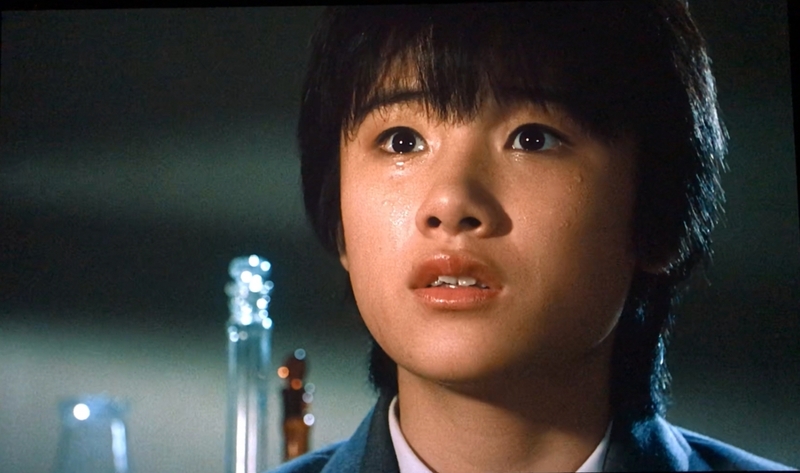
The story follows Kazuko Yoshiyama, played by Tomoyo Harada in her film debut. After fainting in her school’s science lab, she begins experiencing strange shifts in time. Days seem to repeat themselves. Moments appear out of order. Familiar routines start to feel like memories she’s already lived. What begins as confusion slowly turns into an awareness that something impossible is happening to her.
Time travel stories often lean heavily on rules and logic. Obayashi approaches the concept differently. Instead of turning the narrative into a puzzle box, the film treats time displacement more as a mystery and an emotion. Kazuko doesn’t spend the film analyzing paradoxes or building theories. She experiences time the way a teenager might experience life itself, a little confusing, overwhelming, and filled with emotions she doesn’t yet know how to explain. That focus is what separates the film from many time-travel stories. At its heart, THE GIRL WHO LEAPT THROUGH TIME is less about science fiction and more about the intensity of adolescence. Kazuko’s leaps through time mirror the feeling of youth slipping away too quickly. One moment, she’s living an ordinary life; next, she’s confronting the reality that everything around her is changing.
Harada carries the film with a performance that feels surprisingly natural for a first-time actor. At just fifteen years old during production, she brings an innocence to Kazuko that fits the character perfectly. Her reactions to the increasingly strange events around her never feel exaggerated. Instead, they capture the bewilderment of someone trying to understand something far bigger than themselves. Harada’s performance also explains why the film became such a cultural event in Japan. The movie launched her career as a pop idol, and her presence gives the story an unmistakable charm. Even when the film slows down, her presence keeps the narrative grounded.
Obayashi films the town of Onomichi with affection, turning locations into emotional landmarks. School hallways, streets, and seaside views become part of the film’s atmosphere. These spaces don’t feel stylized; they feel real, which helps the story maintain a sense of pragmatism even as time itself begins to bend.
Fans familiar with Obayashi’s earlier cult classic HOUSE might expect a similar explosion of surreal visuals. THE GIRL WHO LEAPT THROUGH TIME is far more restrained. The director still allows flashes of creativity to appear through editing tricks, dreamlike transitions, and playful visual experimentation, but the overall tone remains gentle rather than chaotic. Instead of overwhelming the audience, the film uses those moments sparingly, allowing them to punctuate the story's emotional beats.
What makes the film especially fascinating for modern audiences is how it fits within the story's broader legacy. Yasutaka Tsutsui’s original novel from 1967 had already been adapted several times, but Obayashi’s version became one of the most influential. It helped solidify the idea that the story worked best as a coming-of-age romance wrapped in science fiction. That legacy becomes even clearer when viewed alongside the famous 2006 anime directed by Mamoru Hosoda. Rather than retelling the same story, the anime functions like a spiritual continuation of the original premise. The connection between the two films is subtle but intentional, making the later adaptation feel closer to a generational sequel than a remake. Watching the 1983 version with that knowledge adds an extra layer of appreciation. The themes of memory, longing, and fleeting youth resonate more strongly when seen as the foundation for decades of later interpretations.
THE GIRL WHO LEAPT THROUGH TIME is so memorable because of its emotional precision. The story understands that time travel is most compelling when it reflects something human. Kazuko’s journey isn’t about mastering her powers or saving the world. It’s about understanding the weight of a single moment and realizing that time only moves in one direction for most of us. The film’s final act leans into that idea, transforming the narrative into something unexpectedly poignant. What begins as a whimsical science-fiction mystery gradually becomes a reflection on youth, love, and the painful awareness that some moments cannot be repeated.
For viewers who love the anime adaptation, discovering this earlier version can feel like uncovering a missing chapter in the story’s history. It may not have the polished animation or global recognition of the latter film, but it carries a sincerity that makes it deeply affecting in its own way. Seen today, THE GIRL WHO LEAPT THROUGH TIME stands as both a charming relic of early-80s Japanese cinema and an entry point for one of the most beloved time-travel stories ever told. Its influence stretches far beyond its production, quietly shaping decades of science-fiction storytelling that followed.
Bonus Materials:
4K Transfer & Restoration + HDR
Audio Commentary by Obayashi Scholar Alex Pratt
A Movie: Obayashi’s Cinematic Life – Visual essay by Max Robinson
Now and Then, Here and There: Onomichi Pt. 2 – Visual essay by Alex Pratt
A Conversation with Nobuhiko Obayashi (2015) Japan Society NY
Director Nobuhiko Obayashi Archival Interview
The Tomoyo Harada Story
Toki O Kakeru Shojo music video
Theatrical Trailers
New, improved English subtitles
New Slipcase art design by Sam Smith
Reversible sleeve with original Japanese poster art
First pressing includes a repro 24-page Japanese booklet
Please visit https://linktr.ee/overlyhonestr for more reviews.
You can follow me on Letterboxd, Instagram, Twitter, and YouTube. My social media accounts can also be found on most platforms by searching for 'Overly Honest Reviews'.
I’m always happy to hear from my readers; please don't hesitate to say hello or send me any questions about movies.
[photo courtesy of CULT EPICS, MVD ENTERTAINMENT]
DISCLAIMER:
At Overly Honest Movie Reviews, we value honesty and transparency. Occasionally, we receive complimentary items for review, including DVDs, Blu-rays, CDs, Vinyl Records, Books, and more. We assure you that these arrangements do not influence our reviews, as we are committed to providing unbiased and sincere evaluations. We aim to help you make informed entertainment choices regardless of our relationship with distributors or producers.
Amazon Affiliate Links:
Additionally, this site contains Amazon affiliate links. If you purchase through these links, we may receive a commission. This affiliate arrangement does not affect our commitment to honest reviews and helps support our site. We appreciate your trust and support as you navigate these links.


Happy
0 %

Sad
0 %

Excited
0 %

Sleepy
0 %

Angry
0 %

Surprise
0 %
 0
0
 0
0



Average Rating