A Bold Idea Buried in Excess
Read Time:6 Minute, 33 Second
MOVIE REVIEW
G.I. Samurai (Sengoku jieitai)
 –
– 

Genre: Sci-Fi, Action, War
Year Released: 1979, 2026 Arrow Video Blu-ray
Runtime: 2h 19m
Director(s): Kôsei Saitô
Writer(s): Ryô Hanmura, Toshio Kamata
Cast: Sonny Chiba, Jun Etô, Moeko Ezawa, Ryô Hayami, Noriko Honma, Shin Kishida, Asao Koike, Hiroyuki Sanada
Where to Watch: available now, order your copy here: www.arrowvideo.com, www.mvdshop.com, or www.amazon.com
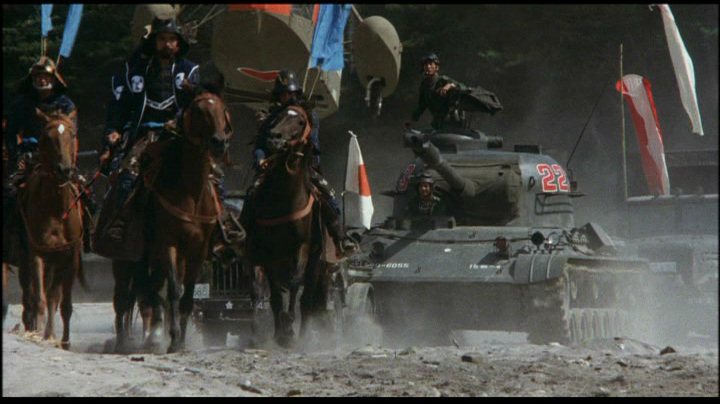
RAVING REVIEW: G.I. SAMURAI offers up an idea that’s more than a little compelling, so it almost feels like the film doesn’t need to do much more to win you over. A “modern” military unit dropped into feudal Japan, armed with tanks, machine guns, and helicopters, facing off against swords and arrows. This is the kind of concept that sells itself. The film understands that appeal, leans into it, and then reveals that it’s aiming for something more complicated than simply staging that clash.
What’s surprising is how quickly the film moves away from treating that premise as straightforward action. The early stretch plays like a disorientation exercise, with the soldiers struggling to understand where they are and what rules still apply. There’s no real interest in explaining the mechanics of the time travel, and the film is better for it, choosing instead to focus on how these characters react once the structure disappears. That decision shifts the tone away from science fiction and closer to something more psychological, even uncomfortable at times.
Sonny Chiba carries that with a commanding presence that never feels forced. His performance as Lieutenant Iba isn’t built on charm or heroism. Instead, there’s a sense of control that slowly erodes as the situation spirals out of control. Chiba gives the film a center, even as the narrative begins to scatter around him. He understands the impact of the scenario in a way the script doesn’t always, grounding scenes that might otherwise feel chaotic without direction. That chaos becomes one of the film’s defining traits.
Once the soldiers realize the same rules no longer bind them, the film leans into the darker implications of that freedom. Discipline breaks down, moral lines blur, and the story begins to explore how quickly structure can collapse when authority disappears. It’s not subtle about it, but there’s an intention behind it that separates it from more straightforward genre fare. The film isn’t just asking what would happen if modern weapons met samurai warfare, it’s asking what happens to people when they’re removed from consequence.
The narrative feels pulled in multiple directions, shifting between character-driven tension, large-scale battle sequences, and moments that border on exploitation. There are stretches where it feels like the film is building toward something, only to pivot back into spectacle without resolving the ideas it introduces. That inconsistency makes it hard to invest in any one direction, because the film itself doesn’t settle on what it wants to be.
At over two hours, G.I. SAMURAI struggles to justify its length. There’s a version of this story that moves with urgency, tightening its focus and sharpening its themes. You can feel where the story could have been condensed without losing impact, and that lack of discipline mirrors the unraveling happening within the film itself.
When the film does lean into action, it delivers in a way that holds attention. The large-scale battles, particularly in the latter half, carry an energy distinct from that of more polished productions. There’s a roughness to the choreography and execution that gives those moments a sense of unpredictability. Seeing modern weapons clash with traditional combat isn’t just striking; it creates a constant imbalance that keeps the action from feeling routine.
The shifts between serious, almost bleak material and moments that feel oddly playful or out of place create a disconnect that the film never resolves. At times, it feels like multiple versions of the same story competing for space, each one pulling the film in a slightly different direction. That becomes part of the experience, but it also keeps the film from reaching its full potential.
What keeps G.I. SAMURAI so engaging, even at its most frustrating, is its willingness to take risks. It doesn’t settle for being a simple genre exercise, even if that might have made for a focused, more consistent film. There’s an ambition here that pushes it beyond its premise, even when the execution can’t quite keep up. The film is constantly reaching for something bigger, whether that’s commentary, character exploration, or pure spectacle.
The Arrow Video restoration highlights both the film's strengths and a visual clarity that hadn’t been seen on screen before. The clarity brings out the scale of the production, the detail in the battle sequences, and the texture of the environments. It’s a presentation that respects the film’s ambition.
G.I. SAMURAI lands in a complicated space. It’s not the straightforward action spectacle its premise suggests, but it’s not focused enough to deliver on all of its deeper ideas either. What it offers instead is a disheveled, ambitious blend of both, held together by a strong central performance and a concept that remains compelling even when the execution struggles. It’s the kind of film that’s easier to admire than fully embrace, but it’s hard to ignore once you’ve seen it.
Bonus Materials:
LIMITED EDITION CONTENTS
High Definition Blu-ray (1080p) presentation
Original lossless Japanese mono and 4.0 stereo surround audio, and remixed 5.1 surround audio
Optional newly translated English subtitles
Two optional viewing modes via seamless branching: the original Japanese version or the uncut English-language version titled Time Slip, with lossless English mono audio
Brand new audio commentary by Samm Deighan and Tom Mes
The Good Fight, an introduction by Japanese film specialist Mark Schilling
Acting in Self Defense, an appreciation by Matt Alt, author of Pure Invention: How Japan’s Pop Culture Conquered the World
Back in Time, a discussion of the film by authors and film critics Masaaki Nomura and Tatsuya Masuto
Cast and crew interviews from 2005 with Sonny Chiba, Isao Natsuyagi, Hiromitsu Suzuki, Kamayatsu Monsieur, Jun Eto, and Isao Kuraishi
Original theatrical trailers
Image gallery
Reversible sleeve featuring original and newly commissioned artwork by Ilan Sheady
Collectors’ booklet featuring new writing on the film by Josh Slater-Williams
Please visit https://linktr.ee/overlyhonestr for more reviews.
You can follow me on Letterboxd, Instagram, Twitter, and YouTube. My social media accounts can also be found on most platforms by searching for 'Overly Honest Reviews'.
I’m always happy to hear from my readers; please don't hesitate to say hello or send me any questions about movies.
[photo courtesy of ARROW VIDEO, MVD ENTERTAINMENT]
DISCLAIMER:
At Overly Honest Movie Reviews, we value honesty and transparency. Occasionally, we receive complimentary items for review, including DVDs, Blu-rays, CDs, Vinyl Records, Books, and more. We assure you that these arrangements do not influence our reviews, as we are committed to providing unbiased and sincere evaluations. We aim to help you make informed entertainment choices regardless of our relationship with distributors or producers.
Amazon Affiliate Links:
Additionally, this site contains Amazon affiliate links. If you purchase through these links, we may receive a commission. This affiliate arrangement does not affect our commitment to honest reviews and helps support our site. We appreciate your trust and support as you navigate these links.


Happy
0 %

Sad
0 %

Excited
0 %

Sleepy
0 %

Angry
0 %

Surprise
100 %
 1
1
 0
0


Average Rating