
The Past Refuses to Stay Buried
Read Time:6 Minute, 11 Second
MOVIE REVIEW
The Boys From Brazil (1978) – Limited Edition Blu-ray – Imprint Collection #600
 –
– 


Genre: Thriller, Sci-Fi, Drama
Year Released: 1978, 2026 Imprint Limited Edition Blu-ray
Runtime: 2h 5m
Director: Franklin J. Schaffner
Writer: Heywood Gould
Cast: Gregory Peck, Laurence Olivier, James Mason, Lilli Palmer, Uta Hagen, Steve Guttenberg, Denholm Elliott, Rosemary Harris, John Dehner, John Rubinstein, Anne Meara, Bruno Ganz, Walter Gotell, David Hurst, Wolfgang Preiss, Michael Gough
Where to Watch: available now, order your copy here: www.viavision.com.au
RAVING REVIEW: THE BOYS FROM BRAZIL has the confidence of a thriller and the blood of something stranger. It walks into the room wearing prestigious clothing, carrying the names of Gregory Peck, Laurence Olivier, James Mason, Franklin J. Schaffner, Ira Levin, and Jerry Goldsmith, then reveals that its real interest lies closer to conspiracy, nightmares, and speculative horror. That tension between presentation and imagination is what keeps the film alive nearly five decades later. It’s too odd to be treated as a simple era thriller, too controlled to dismiss as pure exploitation, and too focused to let its wildest ideas collapse into cheap sensationalism.
The story follows Ezra Lieberman, an aging Nazi hunter played by Laurence Olivier, after he receives a warning from young investigator Barry Kohler about a gathering of escaped Nazi officers in Paraguay. Dr. Josef Mengele, played by Peck in one of the biggest departures from his own stereotyping, is at the center of the plot. The deaths of older civil servants begin to form a pattern, and Lieberman follows those threads into a conspiracy that ties guilt, possibility, fanaticism, and the fantasy of fascist resurrection into one package. The less a first-time viewer knows, the better, because the film’s enjoyment comes from watching a ludicrous idea become more troubling as the investigation narrows.
Schaffner directs with enough restraint to keep the material from tipping over. That’s no small achievement, because THE BOYS FROM BRAZIL is always one step away from becoming ridiculous in the wrong way. Schaffner understands the value of patience. He lets phone calls, documents, half-heard secrets, suspicious deaths, and older men in quiet rooms build pressure before the movie exposes everything. His control gives the film a chill that works especially well in the first half, where the mystery feels wider than the characters can grasp. This isn’t a thriller built on speed; it’s built on the unpleasant feeling that something rotten survived and learned how to operate in daylight.
Olivier gives the film its conscience without making Lieberman feel saintly. He plays him as tired, stubborn, prickly, brilliant, and worn down by decades of chasing men who escaped what they should’ve faced. There’s nothing polished about his heroism. Lieberman moves through the story like someone who has survived too much to be impressed by theatrics but not enough to stop being angry. Olivier’s performance lends the movie its emotional credibility, especially when the plot asks viewers to accept things that might otherwise seem absurd.
Gregory Peck’s Josef Mengele is theatrical, poisonous, and at times almost operatic in his rage. For an actor so strongly associated with morality, seeing Peck step into such a figure creates its own discomfort. The performance isn’t subtle, and that lack of will split viewers. Some moments push too hard, especially when Peck leans into fury rather than control, but that excess also fits the character’s monstrous vanity. Mengele isn’t frightening because he’s calm; he’s frightening because he believes history has wronged him by not obeying his fantasies.
James Mason gives the supporting Nazi circle a controlled menace, and the wider cast adds to that, even when the film can’t give everyone enough room. Steve Guttenberg brings urgency early on, which helps launch the mystery with an individual pulse. Bruno Ganz, Denholm Elliott, Uta Hagen, Lilli Palmer, Rosemary Harris, Michael Gough, and Anne Meara all contribute to the film’s slightly unreal but compelling atmosphere.
The film’s most noticeable weakness is that its ideas are more fascinating than its structure is graceful. THE BOYS FROM BRAZIL runs 125 minutes, and the middle act occasionally repeats the ideas of Lieberman chasing one clue to the next without ever adding tension. There are also accents, choices, and swerves that may pull some viewers out of the spell. The movie wants to be a warning, a thriller, a mad-science shocker, and a late-70s political paranoia piece all at once. It succeeds often enough to remain gripping, though not so completely that the seams disappear.
Jerry Goldsmith’s score helps bridge those identities. The music gives the film an elegant, sinister charge, turning the conspiracy into something almost ritualistic. The finale, without giving away too much, is one of the film’s most memorable achievements because it strips away much of the back-and-forth, leaving behind something raw, physical, and ugly. After all the records, theories, travel, and investigation, the evil at the heart of the story becomes carnal.
The Imprint Limited Edition Blu-ray makes sense for THE BOYS FROM BRAZIL because this is exactly the kind of title that benefits from refocused attention. It isn’t merely a thriller with famous actors, and it isn’t just a relic of 1970s anxiety or postwar Nazi-hunting cinema. It’s a strange meeting point between respectable and a premise that feels like it escaped from a darker, trashier shelf. That contradiction is the appeal. The movie is polished enough to take seriously and strange enough to remain fun to talk about after it ends.
THE BOYS FROM BRAZIL does something many thrillers don’t. It risks looking foolish in pursuit of an idea that’s genuinely unsettling. The performances, Schaffner’s discipline, Goldsmith’s score, and Levin’s hook keep it gripping even when it wobbles. This is prestige pulp with a long shadow, the kind of film that asks you to accept the impossible just long enough to realize the real horror isn’t the science fiction. It’s the human obsession behind it.
Please visit https://linktr.ee/overlyhonestr for more reviews.
You can follow me on Letterboxd, Instagram, Twitter, and YouTube. My social media accounts can also be found on most platforms by searching for 'Overly Honest Reviews'.
I’m always happy to hear from my readers; please don't hesitate to say hello or send me any questions about movies.
[photo courtesy of VIA VISION, IMPRINT FILMS]
DISCLAIMER:
At Overly Honest Movie Reviews, we value honesty and transparency. Occasionally, we receive complimentary items for review, including DVDs, Blu-rays, CDs, Vinyl Records, Books, and more. We assure you that these arrangements do not influence our reviews, as we are committed to providing unbiased and sincere evaluations. We aim to help you make informed entertainment choices regardless of our relationship with distributors or producers.
Amazon Affiliate Links:
Additionally, this site contains Amazon affiliate links. If you purchase through these links, we may receive a commission. This affiliate arrangement does not affect our commitment to honest reviews and helps support our site. We appreciate your trust and support as you navigate these links.


Happy
0 %

Sad
0 %

Excited
0 %

Sleepy
0 %

Angry
0 %

Surprise
0 %
 0
0
 0
0
The Past Refuses to Stay Buried
Read Time:5 Minute, 46 Second
MOVIE REVIEW
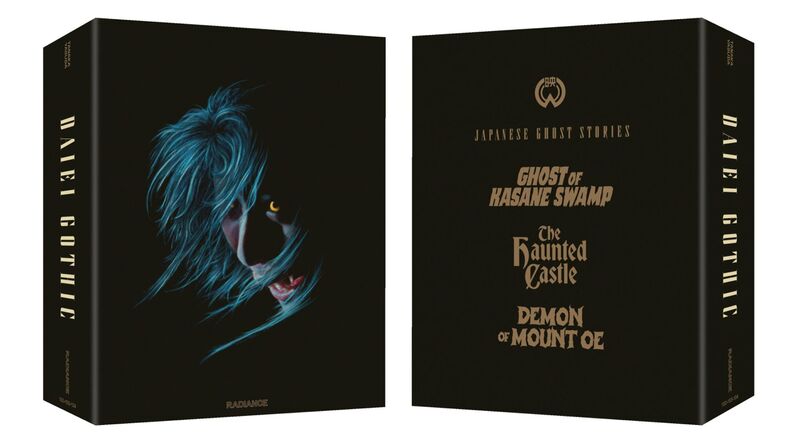
Daiei Gothic Vol 2: Japanese Ghost Stories
Genre: Horror, Folklore, Anthology
Year Released: 2025
Runtime: 4h 38m
Director(s): Tokuzō Tanaka / Kimiyoshi Yasuda / Kimiyoshi Yasuda
Writer(s): Fuji Yahiro / Tetsuro Yoshida / Yoshikata Yoda
Cast: Kazuo Hasegawa, Shintarō Katsu, Raizō Ichikawa / Kōjirō Hongo, Rokkō Tōra, Chieko Murata / Takashi Shimura, Hikaru Hoshi, Yatsuko Tanami
Where to Watch: available now, order your copy here: www.radiancefilms.co.uk, www.mvdshop.com, or www.amazon.com
RAVING REVIEW: DAIEI GOTHIC VOL. 2 hands us the quiet authority of films that treated ghost stories as grand morality plays rather than pulp diversions. There’s no need for spectacle or cheap thrills here — the unease comes from atmosphere, consequence, and the persistence of guilt. The collection of three restorations — THE DEMON OF MOUNT OE, THE HAUNTED CASTLE, and THE GHOST OF KASANE SWAMP — this second volume continues the mission of exploring Japan’s kaidan tradition with grace and gravity. These are stories of haunting, but also of humanity, where the supernatural acts as both punishment and mirror.
From the first moments, you can feel the intention. The set’s presentation is immaculate — restorations that preserve texture and grain, uncompressed mono tracks that breathe naturally, and an 80-page companion book that anchors each film within its historical and cultural lineage. The collection is designed to immerse. You’re meant to sit in the quiet, where every breath, every echo, and every reflection carries moral weight.
THE DEMON OF MOUNT OE begins like an epic of valor and ends as a parable about perception. What looks like a heroic quest to vanquish evil slowly dissolves into something more ambiguous, even tragic. The armored warriors, their trials, and the mountain’s mythic beasts initially evoke the adventurous spirit of Japanese folklore, but Tokuzō Tanaka guides the tale toward something more introspective. The “monsters” reveal themselves as casualties of human cruelty, and “demon” becomes a word that hides as much as it defines. Lanterns glow against misted hills, light carving through the darkness as if illuminating hidden truths. Tanaka doesn’t moralize the story — he lets the realization settle naturally, until what once looked like triumph begins to feel like regret.
Kimiyoshi Yasuda’s THE HAUNTED CASTLE takes that empathy and threads it through revenge. It’s a bakeneko tale, yes, but handled with the restraint of a courtroom drama. The murder of a monk and the tragic fate of his sister unleash a curse that slithers back into the castle. Yasuda’s direction turns architecture into tension — the sliding doors, corridors, and flickering candles become extensions of guilt. When the supernatural appears, it’s less a disruption than an inevitability. The ghosts are metaphors for corruption that has been hiding in plain sight. There’s elegance in how Yasuda stages retribution — slow, poised, and cruelly symmetrical.
Then comes THE GHOST OF KASANE SWAMP, the emotional anchor of the set. Where the first film examines perception and the second examines power, this one mourns inheritance — the sins passed down, the debts that rot into destiny. The story begins with betrayal and murder, but refuses to sensationalize either. Instead, it dwells on the residue: how pain echoes through families, how love becomes a kind of haunting when rooted in guilt. Yasuda’s palette turns pale and damp, the landscapes heavy with remorse. The swamp itself becomes a living presence — not a setting, but a memory that refuses to be buried.
Taken together, the set functions as more than an anthology — it’s a meditation on moral consequence. Every ghost, curse, and apparition feels earned. The horrors aren’t arbitrary; they’re the inevitable balancing of a cosmic ledger. When the dead return, it’s not because they can’t rest, but because the living haven’t learned. These stories see vengeance as less an act of violence and more an act of equilibrium. The result is haunting — less fear of the unknown, more fear of what justice might require.
From a visual standpoint, the set also reaffirms how Daiei weaponized space. Architecture becomes morality — walls, gates, and gardens shape human choices as much as characters do. The use of thresholds, whether literal or spiritual, defines the genre. Doors slide open to reveal not monsters, but the consequences of betrayal. The camera often lingers at the edge of rooms, observing rather than pushing in, allowing the audience to act as witnesses.
As a physical package, Radiance Film’s release shows deep respect for its material. Every element — from the chapter breakdowns to the on-disc menus — radiates care. This is how preservation should feel: reverent without being precious, accessible without compromise.
What ultimately sets DAIEI GOTHIC VOL. 2 apart is its consistency. Each film converses with the others, forming a connection about the moral afterlife of violence. THE DEMON OF MOUNT OE questions the human need for monsters. THE HAUNTED CASTLE exposes how social order disguises rot. THE GHOST OF KASANE SWAMP mourns the weight of inherited sin. Together, they chart the journey from confrontation to corruption to consequence.
In the end, what lingers isn’t fear — it’s sorrow. The ghosts of Daiei aren’t here to scare; they’re here to remind. They inhabit a world where justice costs everyone something, and where the living and the dead are bound by shared regret. Watching these films in such pristine form is less like revisiting old horror and more like attending a ritual. You leave moved, unsettled, and oddly grateful — as if the films have granted you not catharsis, but perspective.
Please visit https://linktr.ee/overlyhonestr for more reviews.
You can follow me on Letterboxd, Instagram, Twitter, and YouTube. My social media accounts can also be found on most platforms by searching for 'Overly Honest Reviews'.
I’m always happy to hear from my readers; please don't hesitate to say hello or send me any questions about movies.
[photo courtesy of RADIANCE FILMS, MVD ENTERTAINMENT]
DISCLAIMER:
At Overly Honest Movie Reviews, we value honesty and transparency. Occasionally, we receive complimentary items for review, including DVDs, Blu-rays, CDs, Vinyl Records, Books, and more. We assure you that these arrangements do not influence our reviews, as we are committed to providing unbiased and sincere evaluations. We aim to help you make informed entertainment choices regardless of our relationship with distributors or producers.
Amazon Affiliate Links:
Additionally, this site contains Amazon affiliate links. If you purchase through these links, we may receive a commission. This affiliate arrangement does not affect our commitment to honest reviews and helps support our site. We appreciate your trust and support in navigating these links.
Happy
0 %
Sad
0 %
Excited
100 %
Sleepy
0 %
Angry
0 %
Surprise
0 %
1
0


Average Rating