Fame Under State Control
Read Time:6 Minute, 36 Second
MOVIE REVIEW
Eagles of the Republic (Blu-ray)
 –
– 


Genre: Drama, Thriller, Action
Year Released: 2025, 2026 Blu-ray
Runtime: 2h 8m
Director(s): Tarik Saleh
Writer(s): Tarik Saleh, Magdi Abdelhadi
Cast: Fares Fares, Lyna Khoudri, Zineb Triki, Amr Waked, Cherien Dabis, Ahmed Khairi, Nael Ali, Sherwan Haji, Donia Massoud
Where to Watch: available now, order your copy here: www.kinolorber.com or www.amazon.com
RAVING REVIEW: Movie stars know how to survive a room, even when the room has already decided what they’re worth. They smile at people they don’t trust, accept praise that sounds like a warning, and pretend every invitation is harmless until the exit disappears behind them. EAGLES OF THE REPUBLIC understands that kind of performance, and its best moments come from watching an actor realize that the most dangerous role of his career isn’t being played in front of a camera.
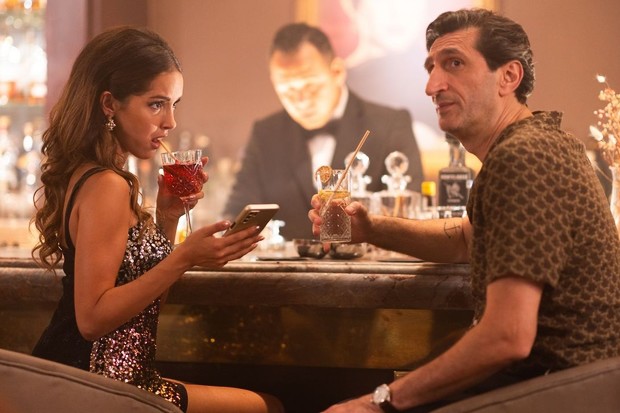
Fares Fares stars as George Fahmy, a beloved Egyptian screen icon whose public image has carried him further than his personal choices should have allowed. He’s charming, vain, wounded, reckless, and used to moving through life with the confidence of someone who assumes fame will cushion every fall. That confidence starts to collapse when George is pressured into starring in a government-approved film about Egypt’s sitting president. What begins as an unwanted career assignment quickly becomes a guided tour through the machinery of power, where cinema, politics, surveillance, loyalty, and self-preservation all blur into one suffocating system.
Director Tarik Saleh closes his Cairo trilogy with a film that’s both a political thriller and a show-business nightmare. That combination gives EAGLES OF THE REPUBLIC a strong identity. The film feels most alive when it treats propaganda not as some distant government tool, but as a production process. Meetings become traps. Compliments become threats. Costumes, makeup, scripts, blocking, and public appearances all turn into extensions of state control. George isn’t just asked to play a leader; he’s asked to surrender pieces of himself until the performance becomes useful to people who never cared whether he believed in it.
Saleh refuses to make George a generic, heroic figure. He isn’t dragged into corruption as an innocent man. He has ego, appetite, privilege, and a long history of assuming consequences are for other people. That makes his spiral more interesting. George can see the danger around him, but he’s also attracted to access. He likes being invited behind closed doors. He likes the way powerful people say his name. He likes the illusion that he can move among them without being owned by them.
Fares carries that contradiction with a performance that rarely begs for sympathy. He plays George as a man who’s always acting a little, even with family, lovers, colleagues, and enemies. Charm has become a reflex. In lighter scenes, the film takes on an almost comic vibe, especially when George’s vanity bumps up against the absurdity of the role he’s being asked to take. As the story darkens, Fares lets the confidence drain out of him without turning George into a different person. He remains self-involved, impulsive, and frustrating, but fear begins to disrupt his performance. That slow erosion is where the role lands hardest.
The surrounding cast gives the film a strong, uneasy atmosphere, even though some characters could’ve used more screen time. Amr Waked brings menace without overplaying it, giving Dr. Mansour the calm presence of someone who knows exactly how much pressure to apply. Zineb Triki’s Suzanne adds a more intimate danger, since her connection with George pulls the film away from public performance and into private compromise. Lyna Khoudri, Cherien Dabis, and Donia Massoud each add texture to George’s world, though the film sometimes moves past them before their relationships can gain the emotional weight they deserve.
That’s where EAGLES OF THE REPUBLIC begins to show the limits of its own ambition. Saleh has a lot he wants to say. Celebrity culture, authoritarian image-making, religious authority, state violence, artistic compromise, masculine vanity, family fracture, and the strange seduction of power. Most of those pieces are compelling on their own, but the film doesn’t always make them feel equally developed. Some ideas arrive with force, then fade. Others seem designed to deepen the world around George, but end up functioning more like pressure points than complete dramatic arcs.
Even with those issues, Saleh knows how to build a world where every room feels watched. The production has a controlled, expensive-looking finish, and that is part of the point. This isn’t a story about chaos in the streets as much as about control in offices, on film sets, in private gatherings, in hotel rooms, and at public ceremonies. The danger often comes dressed in order. People speak politely. Doors are open for George. Cars arrive when needed. The system doesn’t need to shout when it can simply rearrange his life around him.
The film’s movie-within-a-movie is especially strong because it gives Saleh a way to talk about art without turning the story into a lecture. George is surrounded by people who understand cinema, but not its soul. They know faces matter. They know images can soften brutality. They know audiences can be guided toward admiration if the lighting, music, and myth are arranged correctly. For a film critic, that angle is hard to ignore. EAGLES OF THE REPUBLIC isn’t only asking what happens when an actor compromises his principles. It’s asking what happens when storytelling itself becomes something else.
Saleh’s anger is clear, but the film is most effective when it lets that anger move through performance, vanity, fear, and compromise rather than direct declaration. George Fahmy may be a fictional movie star. The trap around him feels painfully recognizable! A world where power doesn’t just silence people, it hires them, flatters them, and asks them to smile while repeating the approved version of reality.
EAGLES OF THE REPUBLIC works best as a portrait of a man who realizes too late that fame isn’t protection when the people above him control the script. It’s uneven, sometimes overextended, and not every arc pays off with the same force. Even so, Fares Fares gives the film a wounded, slippery center, and Saleh finds enough danger in the collision between cinema and authoritarian politics to make the story linger. It’s a film with a strong concept, a commanding lead performance, and a chilling understanding of how easily performance can become obedience.
Please visit https://linktr.ee/overlyhonestr for more reviews.
You can follow me on Letterboxd, Instagram, Twitter, and YouTube. My social media accounts can also be found on most platforms by searching for 'Overly Honest Reviews'.
I’m always happy to hear from my readers; please don't hesitate to say hello or send me any questions about movies.
[photo courtesy of KINO LORBER, COHEN MEDIA GROUP]
DISCLAIMER:
At Overly Honest Movie Reviews, we value honesty and transparency. Occasionally, we receive complimentary items for review, including DVDs, Blu-rays, CDs, Vinyl Records, Books, and more. We assure you that these arrangements do not influence our reviews, as we are committed to providing unbiased and sincere evaluations. We aim to help you make informed entertainment choices regardless of our relationship with distributors or producers.
Amazon Affiliate Links:
Additionally, this site contains Amazon affiliate links. If you purchase through these links, we may receive a commission. This affiliate arrangement does not affect our commitment to honest reviews and helps support our site. We appreciate your trust and support as you navigate these links.


Happy
0 %

Sad
0 %

Excited
0 %

Sleepy
0 %

Angry
0 %

Surprise
0 %
 0
0
 0
0


Average Rating