Running From Someone Else’s War
Read Time:6 Minute, 36 Second
MOVIE REVIEW
Solo (LE)
 –
– 


Genre: Crime, Drama, Thriller
Year Released: 1970, 2026 Radiance Films Blu-ray
Runtime: 1h 23m
Director(s): Jean-Pierre Mocky
Writer(s): Jean-Pierre Mocky, Alain Moury
Cast: Jean-Pierre Mocky, Sylvie Bréal, Anne Deleuze, Denis Le Guillou, René-Jean Chauffard, Marcel Pérès, Henri Poirier, Dominique Zardi
Where to Watch: available now, order your copy here: www.radiancefilms.co.uk, www.mvdshop.com, or www.amazon.com
RAVING REVIEW: Some films about political violence feel like arguments preserved under glass. SOLO feels closer to a cigarette burn left in the upholstery after everyone has stormed out of the room. Jean-Pierre Mocky’s 1970 crime thriller comes from the aftershock of May 1968 rather than from its romance. It isn’t interested in turning a revolt into poster art or nostalgia. Instead, it watches anger curdle into murder, privilege respond with self-protection, and one man wander into the middle of it all with just enough conscience to ruin his own life. The result is messy, bitter, funny at times, and more alive than many films trying to make similar points.
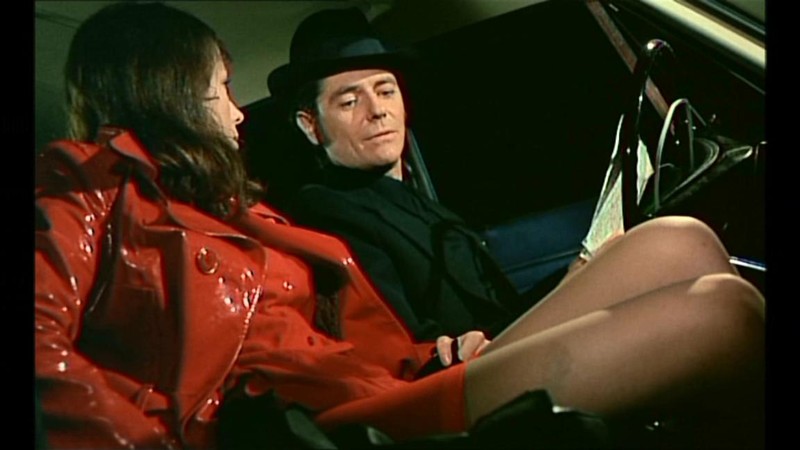
Mocky stars as Vincent Cabral, a violinist and jewel thief whose life seems built around hunger, action, and emotional distance. He steals from the wealthy, enjoys the company of women, avoids responsibility, and carries himself like a man who has already decided that society is rotten enough to make morality negotiable. His detachment gets tested when he learns that his younger brother Virgile is tied to a leftist revolutionary group responsible for killing powerful men. Vincent doesn’t suddenly become a believer, and that’s part of what makes the film interesting. He’s not trying to save a movement. He’s trying to reach his brother before the police, the state, the group, or the group’s own delusions finish the job.
That angle keeps SOLO from becoming a political statement. Mocky places Vincent between factions without giving him a side to stand on. The wealthy are repulsive, the authorities are brutal and absurd, and the young revolutionaries are both furious and terrifyingly certain. Vincent understands the rot they’re reacting to, but he can’t pretend their violence has purified anything. He lives by theft, not ideology, which makes him both compromised and strangely clear-eyed. He’s cynical enough to see through everyone, yet not cold enough to walk away.
The film’s opening discloses that this won’t be a tasteful political drama. Mocky begins with an act of violence against decadent elites, pushing the viewer into a world where disgust has already moved past debate. It’s blunt, ugly, and intentionally provocative, and that bluntness shapes the whole film. SOLO doesn’t try to bend its ideas into elegance. It throws class resentment, sexual hypocrisy, police pressure, revolutionary fantasy, and masculine self-regard into the same car and drives fast enough that you can feel the dents.
At 83 minutes, SOLO barely has time to sit down, and Mocky often seems proud of that. Scenes arrive, punch you in the face, and leave. Characters enter with enough personality to suggest a richer history, then vanish into the chase. The structure has a restless, almost improvised feeling that suits the material, especially when Vincent is trying to piece together where Virgile might be while everyone else is either hiding, hunting, or lying.
Anne Deleuze gives the film a counterweight as Annabel, a woman tied to Virgile and pulled into Vincent’s path. Her scenes with Mocky carry the film’s tension because neither character can reduce the other to a symbol. She’s not just the revolutionary. He’s not just the aging cynic. They push at each other’s assumptions, and the film briefly finds a more intimate version of its larger conflict. Their exchanges have the charge of people who know they’re running out of time but keep arguing because argument is the only honest thing left between them.
As a piece of political noir, SOLO is strongest when it lets absurdity and despair occupy the same frame. The police can seem ridiculous until they become lethal. Bourgeois rituals can look laughable until the film reminds you what those rituals protect. Revolutionary rhetoric can sound righteous until bodies start piling up. That instability gives SOLO its personality. It’s not a balanced debate; it’s a cracked mirror held up to a country that has learned how to absorb revolt and continue operating.
The low-budget roughness is impossible to miss, and it’s part of the conversation around the film rather than something that can be ignored. A more refined version of SOLO might have been smoother, but it also might have lost the agitation that makes this version work. Mocky’s film feels impatient with polish, as if polish itself might be another lie. That doesn’t excuse every awkward moment, though it does make the rough edges easier to accept as part of the film’s temperament.
The Radiance Blu-ray release gives SOLO a welcome chance to be seen outside the margins, and that matters for a film like this. It’s not only a rediscovery of a lesser-seen title; it’s a reminder that post-1968 cinema wasn’t limited to grand theoretical statements or fashionable radicalism. Mocky’s approach is stranger and more contradictory. He sees revolutionary anger as understandable, perhaps inevitable, but not automatically noble. He sees power as diseased, but not fragile. He sees Vincent as a man who rejects society’s rules while benefiting from the freedom to drift around them.
SOLO is jagged in the right ways, even when its flaws are easy to spot. The film can be uneven, occasionally thin in its emotional foundation, and too rushed to make every relationship land with the force it deserves. However, its anger has texture, its cynicism has purpose, and its collision of crime thriller momentum with post-revolutionary disillusionment gives it a distinct pulse. Mocky made a film that feels like it’s arguing with itself in real time, and that tension keeps it alive long after the chase is over.
Bonus Materials:
4K restoration by Éclair Classics supervised by Mocky Delicious Products
Archival interview with screenwriter and star Jean-Pierre Mocky (2018, 12 mins)
Interview with actor Anne Deleuze (2022, 16 mins)
Interview with Jean-Pierre Mocky’s assistant and friend Eric Le Roy (2022, xx min)
Optional English subtitles
Reversible sleeve featuring designs based on original posters
Limited edition booklet featuring archival interviews with Mocky
Please visit https://linktr.ee/overlyhonestr for more reviews.
You can follow me on Letterboxd, Instagram, Twitter, and YouTube. My social media accounts can also be found on most platforms by searching for 'Overly Honest Reviews'.
I’m always happy to hear from my readers; please don't hesitate to say hello or send me any questions about movies.
[photo courtesy of RADIANCE FILMS, MVD ENTERTAINMENT]
DISCLAIMER:
At Overly Honest Movie Reviews, we value honesty and transparency. Occasionally, we receive complimentary items for review, including DVDs, Blu-rays, CDs, Vinyl Records, Books, and more. We assure you that these arrangements do not influence our reviews, as we are committed to providing unbiased and sincere evaluations. We aim to help you make informed entertainment choices regardless of our relationship with distributors or producers.
Amazon Affiliate Links:
Additionally, this site contains Amazon affiliate links. If you purchase through these links, we may receive a commission. This affiliate arrangement does not affect our commitment to honest reviews and helps support our site. We appreciate your trust and support as you navigate these links.


Happy
0 %

Sad
0 %

Excited
0 %

Sleepy
0 %

Angry
0 %

Surprise
0 %
 0
0
 0
0

Average Rating