Silence Carries Farther Than Gunfire
Read Time:7 Minute, 44 Second
MOVIE REVIEW
Enemy at the Gates (Steelbook)
 –
– 


Genre: War, Drama, History
Year Released: 2001, 2026 Steelbook
Runtime: 2h 11m
Director: Jean-Jacques Annaud
Writers: Jean-Jacques Annaud, Alain Godard
Cast: Jude Law, Joseph Fiennes, Rachel Weisz, Ed Harris, Bob Hoskins, Ron Perlman
Where to Watch: available August 25, 2026, pre-order your copy here: www.moviesunlimited.com or www.amazon.com
RAVING REVIEW: ENEMY AT THE GATES takes place during the Battle of Stalingrad, but director/co-write Jean-Jacques Annaud is just as interested in the stories being told about the fighting; he’s looking at something deeper than just the fighting itself. Vasily Zaitsev’s skill as a sniper makes him valuable for reasons beyond the soldiers he kills, as the Soviet army turns his success into a symbol meant to give its people something to believe in.
That separates the film from just an account of two snipers hunting each other. Vasily’s skill matters, but so does the public version of him created by political officer Danilov. One man fires the bullets while the other decides what those bullets mean. Their partnership gives the film a genuinely compelling conflict because the legend quickly becomes larger and more worthwhile than the person standing behind it.
Annaud begins by stripping away any romantic view of combat. Soviet soldiers arrive packed into train cars, cross the Volga beneath German fire, and are pushed toward a battlefield where survival seems almost accidental. Some receive rifles while others receive ammunition and instructions to pick up a weapon after its owner dies. Retreat offers no protection. The sequence is violent, and deliberately difficult to process, capturing a military system willing to spend human lives faster than ammunition.
The scale contracts until the war is measured through windows, cracks, broken pipes, and movements among piles of debris. Stalingrad becomes a place where looking in the wrong direction can be fatal. Robert Fraisse’s cinematography finds layers within the destruction, allowing a doorway, a hanging sheet, or a corner to become a possible hiding place. The city rarely feels empty, even when nobody is there. Every moment of silence suggests that someone may already be watching.
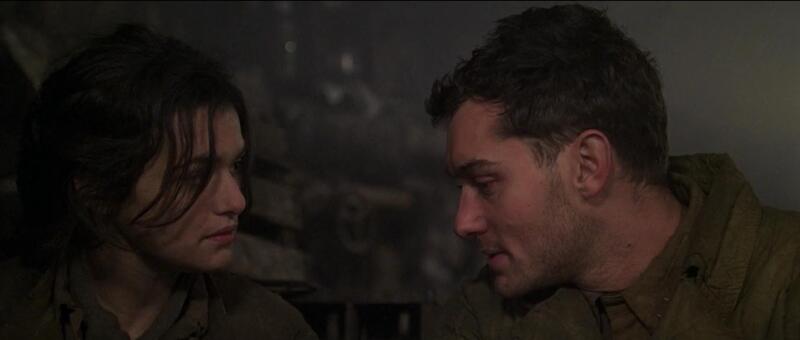
Jude Law plays Vasily without turning him into some sort of action hero. His confidence exists almost entirely through the rifle. Away from it, he’s reserved, uncertain, and uncomfortable with the heroic identity being built around him. Law’s restraint helps preserve the difference between a skilled soldier and the fearless symbol appearing in Danilov’s reports. Vasily knows how to wait, observe, and shoot, but being watched by an entire country places him under another kind of pressure that he wasn’t prepared for.
The film’s historical foundation is considerably less solid than its physical surroundings. Vasily Zaitsev was a celebrated Soviet sniper, although the famous duel with a German officer named König remains disputed and may have grown out of wartime propaganda. ENEMY AT THE GATES treats the story as sensational rather than a dependable historical record. That approach works better when the film is viewed as an examination of legend-making, especially since the screenplay openly shows how governments turn individuals into motivational stories.
Ed Harris gives Major König the controlled presence needed to make the actions of these men feel like they have a larger importance. He barely raises his voice or wastes a minute, approaching the hunt with the patience of someone who considers emotion an unnecessary risk. Harris doesn’t have much of a personal history to work with, and König often functions more as a force moving through the ruins than a deeply developed character. His composure nevertheless creates tension because Vasily isn’t facing a louder or more aggressive opponent. He’s facing someone who understands and functions by the same set of rules that he does.
Their encounters are built around waiting rather than constant gunfire. A helmet placed above cover, a reflection, marks in the dust, or an abandoned body can become part of a trap. Annaud lets these details matter, creating suspense through the possibility that one marksman has already anticipated the other’s decision. The movie sometimes inflates their back-and-forth until it appears to carry the weight of the entire battle, but its most potent sequences keep the stakes personal. Neither man wants to become the figure lying motionless in the other’s sights.
Rachel Weisz brings a heightened intelligence and conviction to Tania, a soldier whose understanding of German makes her useful beyond the front lines. Her grief and anger give her reasons to remain involved in the fight, and Weisz keeps Tania from feeling helpless within a story dominated by male rivalry. The screenplay unfortunately doesn’t return that favor. Once both Vasily and Danilov become interested in her, Tania is pulled into a love triangle that reduces a competent character to another measure of their growing conflict.
The romance isn’t entirely without purpose. It exposes Danilov’s resentment and forces him to confront the distance between his political ideals and his personal behavior. Even so, it occupies too much room inside a film that already has a stronger relationship to examine. The intimate encounter between Vasily and Tania is staged to emphasize how little privacy survives during war, though its placement interrupts the tension rather than deepening it.
Joseph Fiennes’ Danilov is both Vasily’s friend and the architect of his identity. He believes the Soviet cause requires heroes, then discovers that the hero he created can receive the admiration and affection he wants for himself. Fiennes allows bitterness to creep into the performance gradually. Danilov doesn’t suddenly become a different person; his jealousy exposes the possessiveness that had been hiding inside his generosity.
His political disillusionment gives the later portion of the film more substance than the romantic rivalry alone could provide. Danilov wants to believe that removing class will remove envy, selfishness, and competition. His own behavior becomes evidence against that faith. The movie doesn’t explore the idea as exhaustively as it could, but it recognizes that ideology can’t erase the weaknesses people carry into it.
Bob Hoskins attacks his scenes as Nikita Khrushchev with blunt, impatient energy. His performance is blunt, though that bluntness suits a leadership structure searching for somebody to inspire the troops before more punishment becomes necessary. Ron Perlman makes a memorable entrance as Koulikov, an experienced sniper whose humor briefly loosens the film’s grip without making the surroundings feel less dangerous. Both performances add personality to a story that occasionally turns its supporting characters into pieces positioned around Vasily.
The choice to let the actors speak English in their natural accents remains distracting. British voices represent the Soviets, while Harris retains his American accent as a German officer. The film never develops a logic strong enough to make those differences disappear. The performances remain effective, but the voices remind us that we’re watching an international production interpreting Soviet history for a Western audience.
ENEMY AT THE GATES loses some of its impact whenever the love triangle takes control, or the screenplay simplifies a complicated history into easily recognized slices. Its treatment of Soviet brutality also relies on images that have become heavily debated, making the movie far more convincing as a thriller than as an account of exactly how Stalingrad was fought. The storytelling has been shaped as deliberately as Danilov’s newspaper articles.
That comparison may be the reason the film continues to hold together. It’s a wartime legend that repeatedly shows how wartime legends are made. Vasily begins as one frightened soldier among thousands and becomes a name capable of influencing morale on both sides. Annaud may expand the duel beyond its historical importance, but he understands why such a story would spread. An army trapped among ruins doesn’t only need another rifle. It needs someone who can be printed on the front page.
Please visit https://linktr.ee/overlyhonestr for more reviews.
You can follow me on Letterboxd, Instagram, Twitter, and YouTube. My social media accounts can also be found on most platforms by searching for 'Overly Honest Reviews'.
I’m always happy to hear from my readers; please don't hesitate to say hello or send me any questions about movies.
[photo courtesy of PARAMOUNT, MOVIES UNLIMITED, ALLIANCE HOME ENTERTAINMENT]
DISCLAIMER:
At Overly Honest Movie Reviews, we value honesty and transparency. Occasionally, we receive complimentary items for review, including DVDs, Blu-rays, CDs, Vinyl Records, Books, and more. We assure you that these arrangements do not influence our reviews, as we are committed to providing unbiased and sincere evaluations. We aim to help you make informed entertainment choices regardless of our relationship with distributors or producers.
Amazon Affiliate Links:
Additionally, this site contains Amazon affiliate links. If you purchase through these links, we may receive a commission. This affiliate arrangement does not affect our commitment to honest reviews and helps support our site. We appreciate your trust and support as you navigate these links.


Happy
0 %

Sad
0 %

Excited
0 %

Sleepy
0 %

Angry
0 %

Surprise
0 %
 0
0
 0
0

Average Rating