Every Alias Leaves Something Behind
Read Time:7 Minute, 37 Second
MOVIE REVIEW
The Saint (Steelbook)
 –
– 

Genre: Action, Adventure, Romance, Thriller
Year Released: 1997, 2026 Steelbook
Runtime: 1h 56m
Director: Phillip Noyce
Writers: Jonathan Hensleigh, Wesley Strick
Cast: Val Kilmer, Elisabeth Shue, Rade Šerbedžija, Valery Nikolaev, Henry Goodman, Alun Armstrong
Where to Watch: available August 25, 2026, pre-order your copy here: www.moviesunlimited.com or www.amazon.com
RAVING REVIEW: Val Kilmer spends much of the runtime of THE SAINT disappearing into one identity after another, and the disguises are a big part of what makes his version of Simon Templar so entertaining. Phillip Noyce also gets some mileage out of the idea that changing his face, voice, and personality comes easier to Simon than letting anyone see who he actually is. That gives the movie a little more to work with than the elaborate cons and international intrigue surrounding him.
Kilmer commits to every transformation, whether the disguise is ridiculous, spot on, or somewhere between the two. Simon becomes a nervous academic, a swaggering artist, a Russian official, and several other personalities assembled for a particular room or target. Some would fall apart under casual scrutiny in real life, although realism isn’t really their primary function. They turn the assignment into a performance and give Kilmer room to be playful within a movie that frequently takes its political stakes too seriously.
The disguises also expose a weakness that runs beneath Simon’s confidence. He knows how other people talk, flirt, threaten, and occupy space, but he has no answer when someone asks who he actually is. An opening sequence set during his childhood establishes the religious institution that gave him the name Templar and taught him to associate his real identity with punishment and loss. The background is heavy-handed, yet it provides a useful explanation for the saintly aliases and emotional distance that define his adult life.
Once, Russian industrialist Ivan Tretiak hires him to steal a cold-fusion formula from Dr. Emma Russell, things take a turn. The assignment should be another controlled intrusion followed by a disappearance and a payday. Emma’s openness disrupts the routine. Simon approaches her through an invented persona, then discovers that the connection created through the lie doesn’t feel fake like it should.
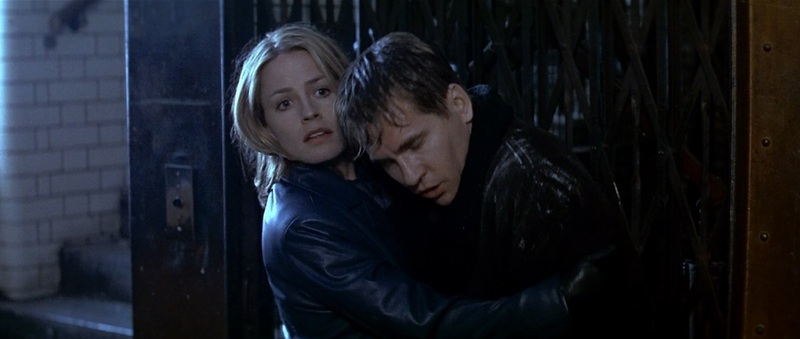
Elisabeth Shue gives Emma a brilliant enough mind to develop an answer to the world’s energy problems, but brilliance hasn’t made her assured. Shue plays her as enthusiastic, awkward, lonely, and sincere about the value of her work. The performance can appear almost generic when Emma stumbles through personal interactions, though that transparency creates an effective contrast with Simon’s endless concealment.
Their chemistry does more to hold THE SAINT together than the cold-fusion crisis. Kilmer’s theatricality might have overwhelmed a quieter costar, but Shue never tries to compete with it. Emma responds to the person Simon is pretending to be, then recognizes the uncertainty behind the performance. Their relationship isn’t convincing in every way, particularly when forgiveness arrives more easily than the deception deserves. It carries enough warmth to explain why a thief accustomed to leaving people behind might hesitate this time.
Tretiak’s scheme gives the story scale but not much credibility. He plans to exploit Russia’s energy crisis, control the cold-fusion breakthrough, undermine the government, and present himself as the country’s necessary savior. Rade Šerbedžija brings authority to the role without disguising the construction of the character. Tretiak starts the film running and already operating at maximum corruption, leaving little room for surprise beyond how far he’s willing to go.
Valery Nikolaev plays Tretiak’s son Ilya as a more immediate threat. Ilya has the impatience of a man who inherited access to power without learning the discipline required to maintain it. His pursuit of Simon and Emma supplies pressure whenever his father’s larger political strategy begins to stall. The father and son remain serviceable antagonists, although neither has the personality required to compete with Kilmer’s rotating collection of alter egos.
The Russian setting reflects a distinctly 1990s Western anxiety about what might fill the vacuum left by the Soviet Union. Government institutions appear fragile, ordinary citizens suffer through shortages, and a wealthy strongman waits to convert economic distress into political control (so basically 2026 in a nutshell).
Emma’s research is important because the screenplay declares that it could transform global energy, not because the science becomes persuasive. The terminology provides enough surface detail to move the characters from theft to pursuit and eventually toward a larger confrontation. Any attempt to examine the mechanics too closely would break the story faster than one of Simon’s accents.
Simon’s escape from a secured building, the pursuit through wintry Moscow, and several close encounters in confined spaces have a clear sense of the world this film occupies. The action rarely reaches the scale promised by the political stakes, but it keeps the characters vulnerable. Simon is resourceful rather than indestructible, relying on observation, preparation, and misdirection more often than brute force.
THE SAINT arrived between established versions of Simon Templar and the franchise Paramount hoped to create around him. Leslie Charteris’ gentleman thief had already passed through novels, films, and television, most famously with the 1960s series. This adaptation retains the name, imagery, criminal code, and taste for performance while rebuilding the character as a damaged high-tech character suited to the late 1990s. At different points, the movie wants to be a romantic adventure, a gadget-driven caper, a geopolitical thriller, and the beginning of a character-focused series. None of those receives enough attention to take control.
Phil Méheux photographs London, Oxford, and Moscow with the scale expected from an expensive studio thriller. Sleek apartments, academic halls, government chambers, underground passages, and frozen streets give Simon varied stages for his performances. Laptops, surveillance devices, digital transfers, and online searches belong completely to their moment, now adding charm to material once intended to look advanced.
The movie’s unevenness becomes most visible during its final act. Several possible conclusions seem to compete for space, and the resolution keeps adding political, scientific, romantic, and legal aspects after the main idea has already peaked. Characters who were separated must be repositioned, the formula must be addressed, Tretiak’s ambitions must become public, and Simon’s emotional decision must be confirmed.
Kilmer prevents that from flattening the experience. This role takes advantage of his ability to be strange, amused, distant, and unexpectedly vulnerable within the same performance. Not every persona lands, and some disguises invite laughter at moments when Simon expects admiration. Their excess is also the reason this version remains so memorable.
Shue provides the necessary balance. Emma doesn’t need another persona because she barely knows how to protect the feelings she already has. Her honesty gives Simon something he can’t steal nor reproduce. The movie understands that their attraction depends on the difference between them, even when the screenplay takes shortcuts in moving them closer.
THE SAINT never became the franchise starter it was designed to be, and its mix of tones explains why. The plot is too cumbersome for an airy caper, the villains are too generic for a serious political thriller, and the romance has to compete with too much to really land. Kilmer and Shue keep finding a lighter, more human film inside all that equipment.
Simon ends up with plenty of aliases but no definitive identity. That feels less like a failure now than a reflection of this particular movie. THE SAINT changes its voice, clothes, and intentions from scene to scene, hoping one of them will be convincing enough to carry the assignment. Some are better than others. For two hours, the act remains entertaining even when the disguise doesn’t quite do it.
Please visit https://linktr.ee/overlyhonestr for more reviews.
You can follow me on Letterboxd, Instagram, Twitter, and YouTube. My social media accounts can also be found on most platforms by searching for 'Overly Honest Reviews'.
I’m always happy to hear from my readers; please don't hesitate to say hello or send me any questions about movies.
[photo courtesy of PARAMOUNT, MOVIES UNLIMITED, ALLIANCE HOME ENTERTAINMENT]
DISCLAIMER:
At Overly Honest Movie Reviews, we value honesty and transparency. Occasionally, we receive complimentary items for review, including DVDs, Blu-rays, CDs, Vinyl Records, Books, and more. We assure you that these arrangements do not influence our reviews, as we are committed to providing unbiased and sincere evaluations. We aim to help you make informed entertainment choices regardless of our relationship with distributors or producers.
Amazon Affiliate Links:
Additionally, this site contains Amazon affiliate links. If you purchase through these links, we may receive a commission. This affiliate arrangement does not affect our commitment to honest reviews and helps support our site. We appreciate your trust and support as you navigate these links.


Happy
0 %

Sad
0 %

Excited
0 %

Sleepy
0 %

Angry
0 %

Surprise
0 %
 0
0
 0
0

Average Rating