A Remarkable Collection of Buried Horrors
Read Time:8 Minute, 34 Second
MOVIE REVIEWS
Danza Macabra Vol. Five: The Spanish Gothic Collection
 –
– 

Genre: Gothic Horror, Black Comedy, Psychological Horror, Vampire Horror
Year Released: 1964, 1971, 1973, 1985, 2026 Severin Films Boxset
Runtime: 6h 53m (primary versions; 8h 29m including alternate U.S. version)
Director(s): Fernando Fernán Gómez, Rafael Moreno Alba, León Klimovsky, Eloy de la Iglesia
Writer(s): Pedro Beltrán, Manuel Ruiz Castillo, Luis García Berlanga, Rafael Moreno Alba, Emilio Martínez Lázaro, Juan Tébar, Gonzalo Goicoechea, Ángel Sastre, Eloy de la Iglesia; based in part on the work of Henry James
Cast: Carlos Larrañaga, Tota Alba, Lina Canalejas, Rafaela Aparicio, Jesús Franco, Analía Gadé, Francisco Rabal, Espartaco Santoni, Helga Liné, Tina Sáinz, Tony Isbert, Narciso Ibáñez Menta, Pedro Mari Sánchez, Queta Claver, Asier Hernández, Cristina Goyanes
Where to Watch: available August 25, 2026, pre-order your copy here: www.severinfilms.com or www.amazon.com
RAVING REVIEW: The fifth DANZA MACABRA set is most definitely less interested in defining Spanish Gothic horror than in showing how difficult the genre is to contain. Across four films made over two decades, Gothic vibes collide with dark comedy, social repression, institutional cruelty, sexual anxiety and the mythology of Dracula. Some of these movies barely resemble one another, which turns out to be one of the most exciting aspects of the set. Severin hasn’t assembled four copy-and-paste trips through foggy cemeteries and old castles. The connection comes through the fears and frustrations that hide beneath them.
That also means DANZA MACABRA VOL. FIVE isn’t even across the board. A couple of these films are stronger than the others, and anyone coming strictly for traditional Gothic horror may wonder what STRANGE VOYAGE is doing here before realizing how naturally its cruelty and distorted humor fit the larger picture. The set becomes increasingly more interesting once the term “Gothic” is allowed to stretch beyond monsters and supernatural threats.
Fernando Fernán Gómez makes that more than apparent with 1964’s STRANGE VOYAGE. Its black-and-white cinematography, claustrophobic sets, and strange mixture of comedy and menace create something more unsettling than a conventional murder story. Rafaela Aparicio and Jesús Franco play siblings living under the thumb of the overbearing Tota Alba, and their almost childlike behavior could have been pushed too far. Instead, the humor gradually exposes an environment built around control, humiliation, and fear.
STRANGE VOYAGE is funny until it isn’t, and Fernando Fernán Gómez understands exactly how uncomfortable that should feel. The exaggerated personalities and small-town behavior never disguise the sadness underneath. Carlos Larrañaga and Lina Canalejas expand the story beyond the house, while the accumulating secrets give the picture an edge without losing its oddball personality. Of the four movies here, this is the one most likely to surprise viewers who enter expecting a what most would think of as a horror film. It’s also one of the collection’s best discoveries.
THE DRACULA SAGA sits much closer to what the history of this collection promises. León Klimovsky takes one of horror’s most fatigued legends and shifts attention toward an entire decaying bloodline, surrounding Narciso Ibáñez Menta’s aging Dracula with relatives whose continued existence has become its own family problem. Tina Sáinz arrives pregnant, giving the movie an amusingly literal investment in inheritance and whether this particular family should continue at all.
There’s plenty of familiar Euro-horror excess around, including blood, sex and a castle populated by people who couldn’t look less trustworthy if they tried. Helga Liné is especially suited to this, carrying a perilous presence that requires very little explanation. The production occasionally shows its limitations, and not every choice hits with the same force, but the movie has personality. Klimovsky isn’t trying to recreate another classic version of Dracula. He treats the mythology like an unhealthy family tradition that’s survived long enough to become miserable, distorted, and in some ways, strangely funny.
EXORCISM’S DAUGHTER is the messiest film in the collection and arguably the one that benefits most from the treatment Severin has given it. Rafael Moreno Alba’s movie was sold under titles that encourage expectations it was never created around. Strip away the sensational marketing and the movie is much closer to an institutional drama, with Analía Gadé at the center of a story concerned with mental illness, abuse, sexual exploitation, and people trapped within a system that claims to be treating them.
Its weaknesses don’t disappear simply because the history surrounding it is fascinating. Certain parts drag, the exploitation occasionally competes with the seriousness of Rafael Moreno Alba's intentions, and the movie can feel uncertain about how far it wants to push either. Analía Gadé keeps it grounded. Her performance gives the cruelty consequences beyond whatever provocative material was once used to sell the picture.
Having both the original Spanish version and the complete U.S. version matters because the differences reveal how aggressively a movie could be reshaped for different audiences. Watching them together turns something that might otherwise have remained a curiosity into one of the most valuable pieces of the collection. This is exactly why physical media can provide context that streaming a random version never could.
Then there’s THE TURN OF THE SCREW, which moves the collection into 1985 and makes another change in temperament. Eloy de la Iglesia takes Henry James’ story and rearranges the sexual and religious tensions around Pedro Mari Sánchez, a former seminarian who becomes tutor to two children at an isolated seaside estate. Changing the traditional female governess into a spiritually and sexually conflicted man alters the entire meaning of the material.
Pedro Mari Sánchez gives the movie a ton of unease because the question isn’t limited to whether something supernatural is in the house. His own repression stains what he sees and how the audience interprets it. Eloy de la Iglesia is less interested in the restrained ghost story associated with other adaptations than in digging through forbidden desire, guilt, and the damage caused when religious certainty collides with impulses.
Queta Claver, Asier Hernández and Cristina Goyanes help create a household where seemingly everyday exchanges carry the possibility of something deeply wrong beneath them. By the time the film reaches the darker stuff, the threat isn’t simply a ghost wandering the estate. It’s the inability to separate supernatural fear from human repression.
Putting these four films together creates a surprisingly coherent picture of horror developing under very different circumstances. STRANGE VOYAGE hides social vileness inside a distorted comedy. EXORCISM’S DAUGHTER turns institutional authority into a monster. THE DRACULA SAGA watches a legendary bloodline rot from within. THE TURN OF THE SCREW takes a familiar ghost story and filters it through religious and sexual conflict. Their methods may differ, but repression keeps resurfacing in one form or another.
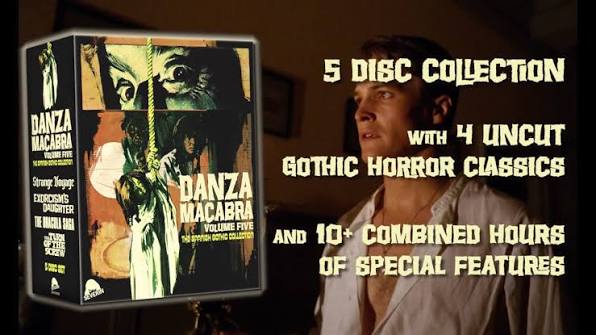
The restoration and supplements make the set feel equally interested in preserving the conditions around the creation of these movies. STRANGE VOYAGE and THE DRACULA SAGA come from 2K scans of their original camera negatives. In comparison, the Spanish version of EXORCISM’S DAUGHTER and THE TURN OF THE SCREW received 4K scans from their original negatives. The alternate U.S. version of EXORCISM’S DAUGHTER comes from an archival 35mm print. More than ten hours of commentary, interviews, and video essays give each movie room to breathe after the credits, rather than treating the supplements as filler around the main attraction. The historical material is especially worthwhile because several of these movies become so much deeper once their histories of production, censorship, and distribution are understood.
DANZA MACABRA VOL. FIVE may be my favorite of the five volumes yet, because Severin isn’t asking four films to justify themselves. There’s no need to pretend every title is equally accomplished or that obscurity somehow makes them all more important. THE DRACULA SAGA is messier than STRANGE VOYAGE, while EXORCISM’S DAUGHTER can frustrate as often as it fascinates. Those differences give the collection character.
Physical media is particularly valuable when it rescues movies that might otherwise survive as names buried in filmographies, censored versions, battered prints or poor transfers passed among fans. These four films get to stand beside one another with their contradictions intact. For anyone interested in Spanish horror, European genre filmmaking or the strange Gothic traditions during the second half of the twentieth century, DANZA MACABRA VOL. FIVE is an exceptional piece of preservation and one of those box sets where the discoveries matter as much as the movies you already came hoping to see.
Please visit https://linktr.ee/overlyhonestr for more reviews.
You can follow me on Letterboxd, Instagram, Twitter, and YouTube. My social media accounts can also be found on most platforms by searching for 'Overly Honest Reviews'.
I’m always happy to hear from my readers; please don't hesitate to say hello or send me any questions about movies.
[photo courtesy of SEVERIN FILMS]
DISCLAIMER:
At Overly Honest Movie Reviews, we value honesty and transparency. Occasionally, we receive complimentary items for review, including DVDs, Blu-rays, CDs, Vinyl Records, Books, and more. We assure you that these arrangements do not influence our reviews, as we are committed to providing unbiased and sincere evaluations. We aim to help you make informed entertainment choices regardless of our relationship with distributors or producers.
Amazon Affiliate Links:
Additionally, this site contains Amazon affiliate links. If you purchase through these links, we may receive a commission. This affiliate arrangement does not affect our commitment to honest reviews and helps support our site. We appreciate your trust and support as you navigate these links.


Happy
0 %

Sad
0 %

Excited
0 %

Sleepy
0 %

Angry
0 %

Surprise
0 %
 0
0
 0
0


Average Rating