Nobody Has Adulthood Figured Out
Read Time:9 Minute, 26 Second
MOVIE REVIEWS
Are You There, God? It's Me, Margaret.
 –
– 

Genre: Comedy, Drama, Coming-of-Age
Year Released: 2023, 2026
Runtime: 1h 45m
Director: Kelly Fremon Craig
Writer: Kelly Fremon Craig, based on the novel by Judy Blume
Cast: Abby Ryder Fortson, Rachel McAdams, Kathy Bates, Benny Safdie, Elle Graham, Amari Alexis Price, Katherine Mallen Kupferer
Where to Watch: available on Lionsgate 4K, digital release August 25, 2026, pre-order your copy here: www.moviezyng.com or www.amazon.com
RAVING REVIEW: ARE YOU THERE GOD? IT'S ME, MARGARET. wasn't made with someone like me in mind, but that doesn't make its coming-of-age story any harder to appreciate. I really wish more people could understand that even when a movie isn’t made for them, it can still be enjoyable. Kelly Fremon Craig keeps everything pretty straightforward, allowing Margaret's worries about menstruation, boys, religion, and whether she's developing at the "right" pace to feel as important as they would to an 11-year-old living through them. What gives the film a little more reach is that Margaret isn't the only one trying to figure out what comes next. Her mother, Barbara, is learning that adulthood, marriage, and motherhood haven't provided all the answers, while her grandmother, Sylvia, is adjusting to a new stage of life without any intention of fading into the background. Each generation is facing its own version of uncertainty, and the film treats those experiences with the same warmth and understanding.
That could easily have weakened Margaret's story. Instead, it helps explain why Judy Blume's 1970 novel has endured for more than half a century. The anxieties change with age; the uncomfortable feeling that everyone else received instructions you somehow missed does not. Abby Ryder Fortson makes Margaret feel authentic with such simplicity. She isn't played as unusually wise, sarcastic, or charming in the way movies sometimes write children for adult audiences. Margaret can be perceptive and thoughtless within minutes of each other. She copies her friends, judges people without understanding them, worries about her body, gets excited over the small victories, hurts people, feels ashamed, and asks questions. Fortson allows her to be 11 without turning 11 into a performance.
Moving from New York City to suburban New Jersey feels catastrophic to Margaret primarily because adults made the decision. Her father, Herb, has received a job opportunity; her parents see advantages to leaving the city; and Margaret mostly sees distance between herself, her friends, and Sylvia. Kathy Bates makes the grandmother's displeasure clear enough that Margaret hardly needs encouragement to resent New Jersey before she's even arrived there. Then Nancy Wheeler appears.
Elle Graham gives Nancy the confidence of a girl who has already decided what sixth grade is supposed to look like. She brings Margaret into a small group of friends with Janie and Gretchen, and friendship quickly becomes a combination of companionship, competition, misinformation, curiosity, and rules nobody remembers agreeing to. The girls talk about bras and periods with the seriousness of diplomats negotiating a treaty. Every development becomes evidence that someone is moving ahead while someone else is being left behind. Craig doesn't laugh at them for caring so much. That's crucial.
The comedy comes from recognizing that sincerity rather than mocking it. Margaret desperately wants to grow up because she has no way of knowing what it actually feels like. The film lets adults remember how immense these things once seemed without asking its young characters to understand how temporary some of their worries will become.
Religion presents a more difficult question because there is no biological clock waiting to provide the answer. Herb is Jewish. Barbara was raised Christian, and her parents effectively rejected her after she married outside their faith. Margaret has therefore grown up without being assigned a religion and decides to investigate the possibilities for a school project. Her conversations with God sit somewhere between prayer, a diary entry, a complaint department line, and a negotiation. Margaret isn't even sure the listener exists. She sends these messages anyway.
That uncertainty is handled with respect. The movie isn't leading her toward a predetermined conclusion, nor does it treat faith as foolish because Margaret struggles to identify where she belongs. She visits different places of worship looking for the feeling adults have led her to believe should be waiting for her. Sometimes she finds community. Sometimes she finds ceremony. What she doesn't receive is an answer.
The questions about God also provide Margaret with somewhere to speak without worrying about consequences. She can tell God she wants her period. She can complain about New Jersey. She can admit jealousy, confusion, anger, and fear. Whether she's praying or simply thinking about these becomes less important than the fact that she's learning to hear herself.
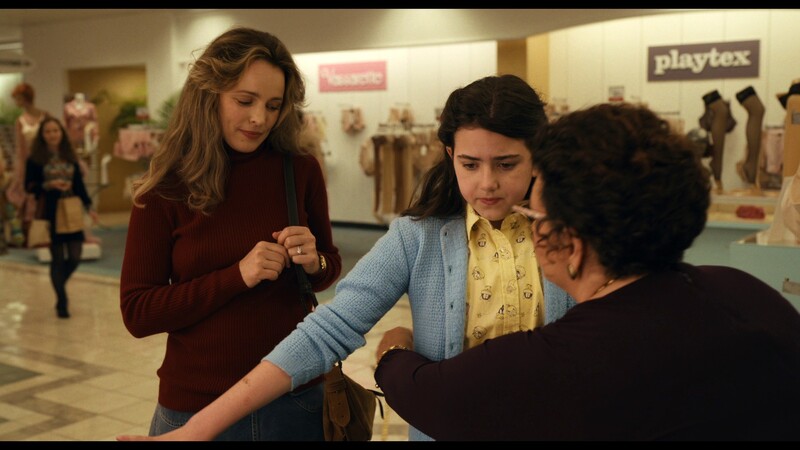
Rachel McAdams gives the movie another version of the same process. Barbara leaves her career as an art teacher after the move and imagines that suburban life will provide time for painting, parenting, volunteering, and some version of herself she hasn't actually met. Instead, other adults quickly begin claiming the hours she thought would belong to her. School committees and expectations pile up. Her art waits.
There are wonderful little moments when Barbara sees Margaret approaching womanhood and understands that guidance doesn't mean control. She can answer questions about bras and menstruation, but she can't prevent embarrassment, mistakes, romantic disappointment, or confusion about religion. McAdams brings humor to those scenes without losing the moments of sadness in realizing your child is entering experiences you can't control for her.
Benny Safdie's Herb is less complicated, though the performance gives the family warmth when they’re all together. Herb isn't the father who panics whenever the topic of female biology comes up. He loves Barbara, supports Margaret, and generally avoids becoming another problem they need to solve. The ordinariness is refreshing.
Kathy Bates gets to be considerably less restrained. Sylvia adores Margaret with the force of someone who considers this forced separation a personal attack. Bates can pull a laugh from a phone call or an irritated glance, but Sylvia isn't merely the loud grandmother brought in whenever the movie needs something else. Her attachment to Margaret reflects a genuine fear that the family's move means her place in their lives is shrinking. That makes Sylvia's own changes important. She has friendships, plans, romantic possibilities, and an existence beyond waiting for visits from her granddaughter. Watching Margaret slowly recognize that adults have lives she isn't part of fits right along with everything else she's learning.
The 1970 setting proves essential. Craig and Blume resisted updating the story, and the decision protects it from becoming trapped by modern technology or forced attempts at relevance. No group texts are telling each other who got a period first, no social media feeds accelerating body anxiety, and no internet to instantly settle every questionable claim Nancy makes. Information travels through friends, books, rumors, mothers, advertisements, and whatever somebody's older brother supposedly knows. That limited access makes the girls' confusion more believable while emphasizing how much of adolescence has survived anyway.
The friendship scenes are full of interruptions, awkward silences, laughter, and sudden shifts in attention, which keep the group from feeling rehearsed. The film becomes more pointed when those friendships expose their cruelty. Laura Danker develops earlier than the other girls, and Margaret accepts Nancy's assumptions about her without examining how little they actually know. It's an important part of Margaret's growth because the movie refuses to make her innocence synonymous with goodness. Children can hurt each other while barely understanding what they've done.
Isol Young doesn't need much screen time to make Laura's experience as important as it is. Margaret has spent so much time wishing her body would mature that she hasn't considered what it feels like when everyone else decides a girl's developing body says something about her character. The realization forces Margaret to see how easily insecurity becomes judgment when directed outward.
ARE YOU THERE GOD? IT'S ME, MARGARET. understands something coming-of-age movies regularly forget: growing up doesn't require a dramatic transformation. Margaret doesn't become a different person by the end. She's accumulated experiences. A friendship has become more complicated. Her parents have become more human. Her grandmother has become a person with her own life. Religion remains unresolved. Her body has begun doing things she spent months wishing it would, only for the reality to be less glamorous than anticipated. That's childhood giving way to adolescence in recognizable increments.
Fortson holds it all together without seeming aware that she's carrying an adaptation people have waited decades to see. That may be the performance's greatest benefit. Margaret doesn't know she's an iconic character from a landmark novel. She's just trying to get through sixth grade. The long delay in bringing Blume's book to the screen ultimately worked in its favor. A less confident adaptation might have modernized the setting, softened the conversations about puberty, simplified the religious questions, or turned Margaret into a mouthpiece for lessons the audience is expected to applaud. Craig trusts the material enough to leave its uncertainties intact.
Margaret spends much of the movie waiting for signs that she's finally becoming the person she's supposed to be. The adults around her are quietly doing the same thing. That's why the story never feels limited to an 11-year-old girl in 1970. Nobody reaches an age when uncertainty permanently stops. We just get better at pretending we weren't expecting instructions.
Please visit https://linktr.ee/overlyhonestr for more reviews.
You can follow me on Letterboxd, Instagram, Twitter, and YouTube. My social media accounts can also be found on most platforms by searching for 'Overly Honest Reviews'.
I’m always happy to hear from my readers; please don't hesitate to say hello or send me any questions about movies.
[photo courtesy of LIONSGATE, MOVIE ZYNG, AV ENTERTAINMENT]
DISCLAIMER:
At Overly Honest Movie Reviews, we value honesty and transparency. Occasionally, we receive complimentary items for review, including DVDs, Blu-rays, CDs, Vinyl Records, Books, and more. We assure you that these arrangements do not influence our reviews, as we are committed to providing unbiased and sincere evaluations. We aim to help you make informed entertainment choices regardless of our relationship with distributors or producers.
Amazon Affiliate Links:
Additionally, this site contains Amazon affiliate links. If you purchase through these links, we may receive a commission. This affiliate arrangement does not affect our commitment to honest reviews and helps support our site. We appreciate your trust and support as you navigate these links.


Happy
0 %

Sad
0 %

Excited
0 %

Sleepy
0 %

Angry
0 %

Surprise
0 %
 0
0
 0
0

Average Rating