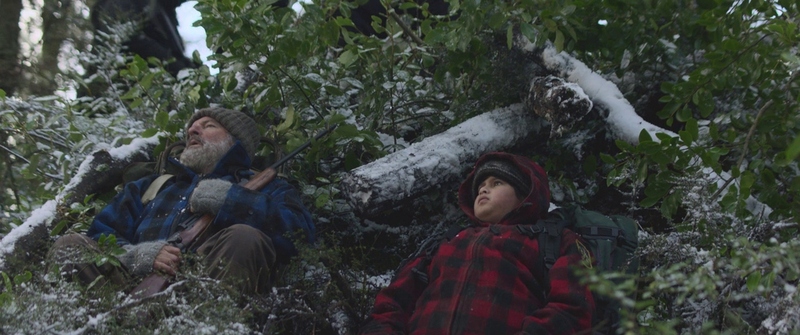
Running Away Becomes Something Else
Read Time:9 Minute, 1 Second
MOVIE REVIEWS
Hunt For The Wilderpeople
 –
– 

Genre: Adventure, Comedy, Drama
Year Released: 2016, 2026 4K Vertigo Releasing
Runtime: 1h 41m
Director(s): Taika Waititi
Writer(s): Taika Waititi, based on the novel by Barry Crump
Cast: Sam Neill, Julian Dennison, Rima Te Wiata, Rachel House, Tioreore Ngatai-Melbourne, Oscar Kightley, Rhys Darby
Where to Watch: available now, order your copy here: www.orbitdvd.com or www.valoriavideo.com
RAVING REVIEW: Rima Te Wiata isn’t in HUNT FOR THE WILDERPEOPLE for nearly as long as Sam Neill or Julian Dennison, but the entire movie depends on what Bella establishes early on. Ricky Baker arrives at another foster home expecting the same thing he has apparently learned to expect everywhere else. Adults already have an opinion of him; he’ll eventually disappoint them, and whatever temporary arrangement has been made will fall apart. Bella refuses to participate in that cycle. She feeds him, jokes with him, gives him a dog, and doesn’t treat every display of attitude as evidence that something is fundamentally wrong with him. The kindness is so uncomplicated that Ricky doesn’t quite know what to do with it.
That relationship explains a lot about why HUNT FOR THE WILDERPEOPLE remains so affecting ten years later. Taika Waititi made an enormously funny movie, but beneath the jokes is a kid who has spent so much time being passed around that he has started building his identity on what other people say about him. Social worker Paula lists Ricky’s offenses as though presenting evidence in a criminal prosecution. He’s a problem, a bad kid and, most memorably, a “very bad egg.” Julian Dennison lets Ricky wear that reputation proudly because pretending to be dangerous is easier than admitting how badly he wants somebody to keep him.
Bella sees through him immediately. Te Wiata plays her without making the character saintly or overly sentimental. She’s practical, funny and completely comfortable puncturing Ricky’s attempts at toughness. Her affection creates the first place where he begins behaving like a child instead of performing whatever version of himself he thinks might protect him. When the story changes and Ricky ends up in the New Zealand bush with Bella’s husband, Hec, what they have lost becomes the thing that connects two people who otherwise have very little interest in one another.
Sam Neill doesn’t soften Hec simply because the movie eventually needs him and Ricky to form a bond. He’s irritable, closed off and often genuinely bad at communicating. Hec doesn’t understand Ricky’s references, has no patience for his imagined gangster persona and would probably be perfectly happy traveling through the bush without conversation. Neill knows exactly how funny a long stare or exhausted reaction can be, especially opposite Dennison, whose Ricky can fill any available silence whether Hec wants him to or not.
Their chemistry grows from how little they initially give each other. Ricky desperately wants to be considered tougher and more experienced than he is. Hec has spent much of his life trying not to need anyone. Neither character gets transformed by a single heartfelt conversation. They travel, argue, eat, survive, get on each other’s nerves, and slowly become accustomed to the other person being there. By the time affection becomes obvious, Waititi doesn’t have to underline it because the relationship has already changed in dozens of smaller ways.
That patience is especially important because HUNT FOR THE WILDERPEOPLE becomes much bigger as it goes. What begins as a foster-care story eventually turns into a nationwide search involving police, hunters, news crews and Paula’s increasingly ridiculous determination to retrieve Ricky. Rachel House commits completely to Paula's absurdity, playing her as someone who seems to believe that child welfare requires the intensity of an action-movie cop. Her repeated insistence that no child will be left behind gets funnier every time precisely because House never treats the phrase as a joke.
The escalation could have destroyed the quieter movie underneath it. Instead, Waititi keeps returning to Ricky and Hec. Even when the search becomes openly ridiculous, their situation doesn’t stop mattering. Ricky is terrified of returning to a system where he expects to disappear into another placement. At the same time, Hec has his own reasons for distrusting authorities and keeping people at a distance. The comedy exaggerates the world around them without dismissing why they’re running from it.
Waititi adapted the film from Barry Crump’s 1986 novel WILD PORK AND WATERCRESS, and knowing the source material was considerably more serious makes the balance here even more interesting. The humor isn’t simply pasted over the darker material. It becomes the way Ricky processes much of what is happening. His haikus, pop-culture references, and exaggerated sense of his own criminal reputation allow the movie to approach grief, abandonment, and loneliness without letting those subjects overwhelm him.
Dennison is remarkable at maintaining that balance. Ricky can be hilarious because he believes things about himself that nobody else does, but the performance never turns him into a punchline. His confidence occasionally disappears for just long enough to remind us how young he is. The same kid who talks about the “skux life” is also carrying years of rejection around with him, and Dennison moves between those sides of Ricky without announcing the transition.
Neill works in the opposite direction. Hec initially seems emotionally immovable, so even relatively minor changes begin to carry enormous weight. A conversation that would barely register in another movie means something because Hec has previously avoided having it. He doesn’t suddenly become talkative or openly affectionate. He simply starts making room for Ricky. There’s something much more believable about that than having the character abandon the personality we met at the beginning.
The New Zealand landscape gives them plenty of literal room. Cinematographer Lachlan Milne photographs the bush as both a refuge and an obstacle, beautiful enough that disappearing into it has an understandable appeal, yet dangerous enough that Ricky’s urban confidence quickly proves useless. Wide views repeatedly reduce both characters to small figures moving through enormous stretches of wilderness. Their supposed life on the run often looks strangely peaceful compared with the systems waiting for them outside it.
The new 10th-anniversary 4K presentation makes those locations an even bigger part of the experience. Visions Home Video’s region-free UHD uses a new HDR grade with both Dolby Vision and HDR10, and this is exactly the kind of movie that benefits from the added range without looking artificially flashy. Greens have greater variation, skies feel more expansive, and the different textures running through the bush remain visible even when the frame is crowded with vegetation. The source ultimately passed through a 2K digital intermediate, so this isn’t a case of suddenly uncovering enormous amounts of native 4K information. The improvement comes from the overall presentation, especially the color, contrast, and encode.
The audio situation is slightly more disappointing. The original production received support to create an Atmos mix, with Waititi specifically interested in using the sounds of the bush to place audiences inside the environment. The Visions UHD instead provides DTS-HD Master Audio 5.1 and 2.0 options. The 5.1 presentation remains strong, particularly with environmental sound and the music by Lukasz Buda, Samuel Scott and Conrad Wedde. Still, the absence of the Atmos track feels like a missed opportunity on an anniversary edition.
Extras are respectable without making this an exhaustive retrospective. The commentary with Waititi, Neill and Dennison returns alongside the making-of featurette and bloopers, while a new 10th-anniversary Q&A gives the release something specifically created for the occasion. Considering how significant the movie became for New Zealand cinema, there was room for a deeper look at its production, adaptation and legacy. HUNT FOR THE WILDERPEOPLE broke local box-office records in 2016 and became a major international calling card for everyone involved, so a substantial documentary about what happened after its release would have made an already strong disc much more complete.
The film itself needs no such qualification. There are places where Waititi pushes a gag beyond its funniest point, and the increasingly oversized search occasionally pulls attention away from the relationship that matters most. Rhys Darby’s appearance as survivalist Psycho Sam is amusing. However, it belongs to the broader, more openly cartoonish half of the movie and temporarily shifts the tone away from the intimacy of Ricky and Hec.
Those excesses are easy to forgive because Waititi always finds his way back to the people. HUNT FOR THE WILDERPEOPLE understands that belonging doesn’t necessarily arrive in the form anyone expects. Ricky doesn’t find a conventional family, and Hec never becomes a conventional father figure. What they eventually offer one another is simpler and probably more useful: someone who knows exactly how difficult the other person can be and chooses not to leave.
Ten years haven’t made that any less meaningful. The comedy remains funny, Dennison and Neill are still wonderful together, and the scenery looks especially good in this new 4K presentation. What sticks with me, though, is still that kid who arrives at a remote farm convinced he knows how this arrangement will end. Bella proves him wrong first. Hec takes considerably longer. HUNT FOR THE WILDERPEOPLE understands why the second part matters just as much.
Please visit https://linktr.ee/overlyhonestr for more reviews.
You can follow me on Letterboxd, Instagram, Twitter, and YouTube. My social media accounts can also be found on most platforms by searching for 'Overly Honest Reviews'.
I’m always happy to hear from my readers; please don't hesitate to say hello or send me any questions about movies.
[photo courtesy of VERTIGO RELEASING, VISIONS HOME VIDEO]
DISCLAIMER:
At Overly Honest Movie Reviews, we value honesty and transparency. Occasionally, we receive complimentary items for review, including DVDs, Blu-rays, CDs, Vinyl Records, Books, and more. We assure you that these arrangements do not influence our reviews, as we are committed to providing unbiased and sincere evaluations. We aim to help you make informed entertainment choices regardless of our relationship with distributors or producers.
Amazon Affiliate Links:
Additionally, this site contains Amazon affiliate links. If you purchase through these links, we may receive a commission. This affiliate arrangement does not affect our commitment to honest reviews and helps support our site. We appreciate your trust and support as you navigate these links.


Happy
0 %

Sad
0 %

Excited
0 %

Sleepy
0 %

Angry
0 %

Surprise
0 %
 0
0
 0
0

Average Rating