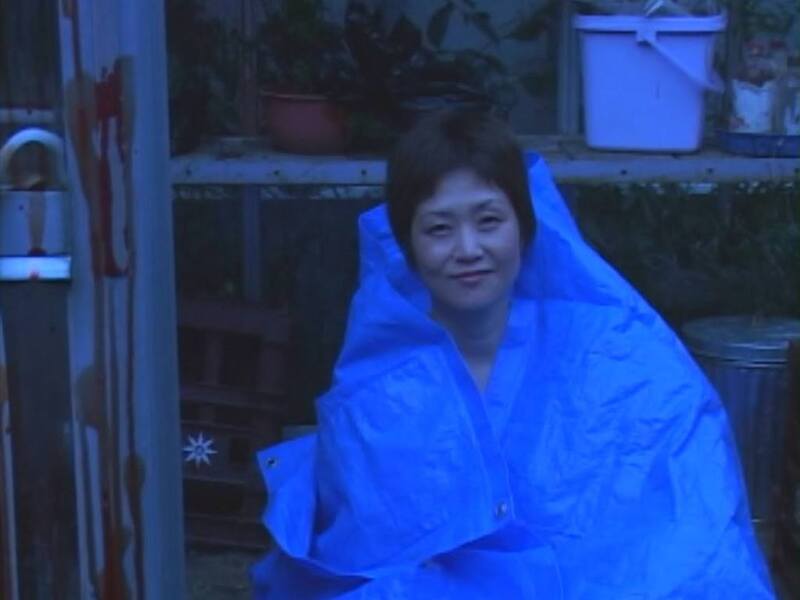
Dysfunction Taken to the Extreme
Read Time:9 Minute, 24 Second
MOVIE REVIEW
Visitor Q (Bijitâ Q)
 –


Genre: Horror, Black Comedy, Experimental Drama
Year Released: 2001, 2026 Blu-ray
Runtime: 1h 24m
Director(s): Takashi Miike
Writer(s): Itaru Era
Cast: Kenichi Endo, Shungiku Uchida, Kazushi Watanabe, Jun Mutô, Fujiko, Shôko Nakahara, Ikkô Suzuki
Where to Watch: available now; order your copy here: www.radiancefilms.co.uk, www.mvdshop.com, or www.amazon.com
RAVING REVIEW: Takashi Miike has never been a filmmaker I'd accuse of worrying too much about making audiences comfortable, but VISITOR Q feels like someone handed him a camcorder, removed every conceivable restriction, and encouraged him to see how much depravity he could squeeze into 84 minutes. Released in 2001, this notorious examination of family dysfunction, sexual exploitation, violence, and just about every taboo imaginable remains one of the more disturbing entries in his extensive filmography. It's disgusting, occasionally hilarious in ways that'll make you question your own sense of humor, and so committed to being unpleasant that even experienced horror fans might wonder what the hell they're watching. I can appreciate the audacity without pretending I enjoyed everything Miike decided to put on screen.
The Yamazaki family makes practically every dysfunctional household you've encountered in a movie look well-adjusted. Kiyoshi (Kenichi Endo) is a struggling television reporter whose desperation to produce provocative material has destroyed whatever professional integrity he once had. His estranged daughter, Miki (Fujiko), has entered prostitution, while his teenage son, Takuya (Jun Mutô), suffers severe bullying and takes his frustration out on his mother. Keiko (Shungiku Uchida), meanwhile, struggles with heroin addiction and prostitution while enduring the abuse surrounding her. Calling their situation a family crisis feels like a ridiculous understatement. These people passed their breaking point ages ago, and somehow things are still getting worse.
Enter Q (Kazushi Watanabe), a mysterious stranger whose introduction doesn't exactly suggest he'd make a wonderful houseguest. Nevertheless, his arrival begins influencing the family in increasingly bizarre and disturbing ways. Miike mixes grotesque comedy with domestic horror, finding room for unexpected tenderness amid circumstances that should probably land every member of this household in criminal court. Explaining much more would spoil the experience, although anyone expecting a conventional home-invasion thriller should abandon that idea immediately.
Filmed on inexpensive digital video as part of Japan's Love Cinema project, VISITOR Q embraces an aesthetic that looks closer to amateur home movies than traditional filmmaking. The rough image, awkward intimacy, and often unflattering presentation make the material feel disturbingly ordinary despite the extraordinary circumstances unfolding. Miike doesn't dress up the ugliness with elaborate compositions or polished production design. That decision suits a story so concerned with the increasingly invasive relationship between cameras and personal suffering.
Kiyoshi's obsession with documenting everything around him gives the film some of its most relevant commentary. His television ambitions have become an excuse to exploit humiliation and tragedy, regardless of who gets hurt. Watching him treat other people's suffering as potential entertainment feels even more uncomfortable when considering how much contemporary media depends on public confrontations, manufactured outrage, and turning private experiences into profitable content. Miike was exploring this ugliness long before social media made recording someone's worst moments an everyday occurrence.
There's also an interesting connection to Pier Paolo Pasolini's TEOREMA, with both films introducing an enigmatic outsider whose presence transforms an established household. Miike, however, seems far less interested in exercising restraint. Where Pasolini approached his material through carefully constructed social and personal observations, VISITOR Q practically kicks down the door and drags every possible taboo inside. It's an unusual mix of family drama, exploitation, social satire, and outright absurdity, with the director apparently determined to see what he can get away with.
Some of the film's most effective comedy comes from the performances themselves. Endo commits completely to Kiyoshi's increasingly reprehensible behavior, never attempting to make him more sympathetic than the material allows. Uchida gives Keiko a physical presence that becomes increasingly important as the family's circumstances change, while Watanabe plays Q with a strange restraint that makes his influence even more unsettling. Rather than behaving like a conventional villain, he often seems perfectly comfortable with the insanity surrounding him. Then again, considering the people he's staying with, perhaps he's the one who should be concerned.
Miike's willingness to push an already outrageous situation until it becomes ridiculous produces a few moments of genuinely effective dark comedy. I laughed at things I probably shouldn't have, which I suspect is exactly the reaction he wanted. Unfortunately, the same determination to keep escalating the material occasionally becomes exhausting. I don't object to extreme cinema, and I certainly don't think disturbing subject matter needs to be presented reassuringly. Shocking an audience and making that shock meaningful aren't automatically the same thing.
There are stretches where the sheer volume of grotesque material begins competing with the film's more interesting commentary on exploitation, domestic abuse, and deteriorating family relationships. Miike has plenty to say, but I wasn't always convinced every additional offense contributed something worthwhile. At times, it almost feels like he's challenging himself to cross another line simply because nobody has told him he can't. That approach makes VISITOR Q a fascinating experiment, even when sitting through it becomes considerably less enjoyable.
Revisiting the film on Radiance's new limited-edition Blu-ray offers welcome historical and creative context. Released during an incredibly productive period in Miike's career that also included AUDITION, ICHI THE KILLER, and THE HAPPINESS OF THE KATAKURIS, VISITOR Q demonstrates how wildly his filmmaking could shift between projects. Its inexpensive digital production also reflects a period when emerging technology let filmmakers experiment with material that would've faced considerable obstacles under more conventional production methods.
Radiance has wisely avoided attempting to make VISITOR Q look like something it was never intended to be. The new transfer comes from the original master Beta tape, preserving the film's low-resolution digital appearance rather than manufacturing detail that simply doesn't exist. Anyone expecting the dramatic visual improvements associated with a restoration sourced from original film elements should adjust those expectations. The roughness is part of the production's identity, and presenting it faithfully matters more than trying to disguise its limitations.
This release earns considerable appreciation through its supplemental material. Miike biographer Tom Mes provides a newly recorded audio commentary that offers historical and creative context for one of the director's more difficult productions. Separate 2026 interviews with Miike, Endo, and Shôko Nakahara offer additional perspectives from those directly involved, giving viewers a better chance to understand the decisions behind such an unconventional project.
Kat Ellinger contributes MOTHER'S MILK: VISITOR Q AND THE FEMININE PRINCIPLE, a new visual essay examining the film's treatment of gender and its broader thematic interests. It's a fitting inclusion for a production whose deliberately confrontational material invites discussion beyond the immediate shock of what we're watching. These supplements give the film room to be examined rather than simply celebrated for its notoriety, which is exactly what I want from a physical release like this.
The newly improved English subtitle translation is another welcome addition, alongside the original trailer, reversible artwork inspired by the original posters, and a limited-edition booklet featuring new writing by Ana Došen. Radiance has limited the release to 5,000 copies, presented in full-height Scanavo packaging with a removable OBI strip. It's an attractive collector's edition for a film that depicts some of the least attractive behavior imaginable, and I have to admit that contradiction is amusing.
I also wouldn't recommend approaching VISITOR Q without understanding what you're getting into. The film includes incest, sexual violence, domestic abuse, drug addiction, and other deeply disturbing material, frequently accompanied by humor that makes those situations even harder to process. Miike isn't interested in providing a comfortable experience, and this certainly isn't an ideal introduction for someone whose familiarity with Japanese cinema begins and ends with more accessible productions. Even viewers accustomed to extreme filmmaking might question a few of his decisions.
I appreciate having access to a release that treats such an unusual production as something worth preserving and examining. My reservations about the film haven't disappeared, but Radiance's presentation gives me a greater appreciation for the circumstances surrounding its creation and the creative freedom Miike exercised. That's part of what makes boutique physical media worthwhile. A film doesn't have to be something I unconditionally love to deserve a thoughtful release, especially when it holds such a distinctive place in a filmmaker's career.
VISITOR Q is excessive, technically rough, frequently disgusting, and occasionally more impressed with its own ability to offend than I was. It's also a fascinating example of a filmmaker pursuing an idea without worrying whether anyone would find the finished product remotely acceptable. Radiance has given this notorious experiment the attention it deserves, offering a release that's easier to recommend than the film itself. Some family reunions are best avoided, and this one might require a shower afterward.
Bonus Materials:
New transfer from the original master beta tape
Audio commentary by Miike biographer Tom Mes (2026)
Newly filmed interviews with director Takashi Miike, stars Kenichi Endo and Showko Nakahara (2026)
Mother's Milk: Visitor Q and the Feminine Principle – new visual essay by Kat Ellinger (2026)
Trailer
Newly improved English subtitle translation
Reversible sleeve featuring designs based on original posters
Limited edition booklet featuring new writing by Ana Došen
Limited edition of 5000 copies, presented in full-height Scanavo packaging with removable OBI strip leaving packaging free of certificates and markings
Please visit https://linktr.ee/overlyhonestr for more reviews.
Follow me on Letterboxd, Instagram, Twitter, and YouTube. You can also find my social media accounts on most platforms by searching for 'Overly Honest Reviews'.
I’m always happy to hear from my readers; please don't hesitate to say hello or send me any movie questions.
[photo courtesy of RADIANCE FILMS, MVD ENTERTAINMENT]
DISCLAIMER:
At Overly Honest Movie Reviews, we value honesty and transparency. Occasionally, we receive complimentary items for review, including DVDs, Blu-rays, CDs, Vinyl Records, Books, and more. We assure you these arrangements do not influence our reviews, as we are committed to unbiased, sincere evaluations. We aim to help you make informed entertainment choices regardless of our relationship with distributors or producers.
Amazon Affiliate Links:
This site also contains Amazon affiliate links. If you purchase through these links, we may receive a commission. This affiliate arrangement does not affect our commitment to honest reviews and helps support our site. We appreciate your trust and support as you navigate these links.


Happy
0 %

Sad
0 %

Excited
0 %

Sleepy
0 %

Angry
0 %

Surprise
0 %
 0
 0

Average Rating