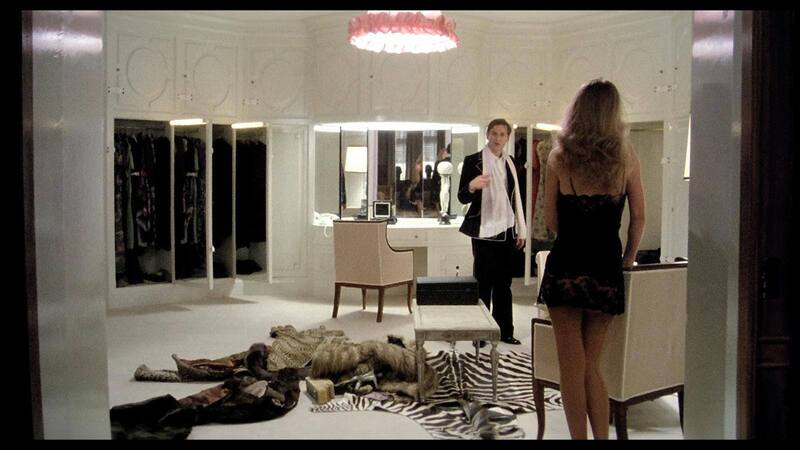
A Brothel Built on Betrayal
Read Time:9 Minute, 33 Second
MOVIE REVIEW
Salon Kitty
 –


Genre: Historical Drama, Erotic Thriller, Exploitation
Year: 1976, 2026 Blu-ray
Runtime: 2h 13m (Extended Director's Cut)
Director: Tinto Brass
Writers: Ennio De Concini, Maria Pia Fusco, Tinto Brass (based on the novel by Peter Norden)
Cast: Helmut Berger, Ingrid Thulin, Teresa Ann Savoy, John Steiner, John Ireland, Tina Aumont, Sara Sperati, Maria Michi
Where to Watch: available November 10, 2026. Pre-order your copy here: www.mvdshop.com or www.amazon.com
RAVING REVIEW: Tinto Brass was never about subtlety, and SALON KITTY makes that clear! And that’s all before the story dives into the espionage thriller hiding underneath all the nudity, Nazi uniforms, and displays of sexual depravity. Released in 1976, SALON KITTY sits at an interesting point in Brass's career, combining the experimental visuals of his earlier filmmaking with the increasingly explicit sexual material that would become his trademark. It's an unusual mix of political commentary, exploitation, and historical fiction, sometimes pulling it all together and occasionally letting the spectacle overwhelm the story. Whatever else you think about Brass, he certainly knew how to make an impression.
The story takes place in Nazi Germany, where Kitty Kellermann (Ingrid Thulin) runs a brothel catering to military officers, diplomats, and members of the political establishment. Her business attracts men whose responsibilities demand absolute loyalty to the Reich, but whose private lives often reveal other secrets. SS officer Helmut Wallenberg (Helmut Berger) recognizes the value of those conversations and turns the establishment into a surveillance operation. Hidden microphones are installed throughout the rooms, while carefully selected women are recruited and trained to encourage their clients to reveal secret intel. Wallenberg's interest goes well beyond protecting the government. He's collecting leverage, and in a political system built on intimidation and unquestioning obedience, access to everyone's secrets gives him an advantage.
Berger makes Wallenberg a truly unpleasant person, someone whose devotion to Nazi ideology is inseparable from his personal appetite for authority. He's calculating, vain, and comfortable treating other people as disposable resources. Berger already portrayed the destructive relationship between fascism, sexuality, and privilege in Luchino Visconti's THE DAMNED, making his casting here all too fitting. His appearance and controlled behavior create an interesting contrast with the increasingly grotesque circumstances surrounding him. Wallenberg doesn't need to become a shouting caricature to communicate how much he sucks. His confidence comes from being in a position where other people have good reason to fear him, and Berger understands how to make that uncomfortable without constantly telling the audience how to feel.
Thulin, on the other hand, is something else altogether as Kitty, a woman who’s spent years controlling powerful men and understands that discretion is essential to keeping her business. Her performance has a composure that lends the character credibility, even as the film grows increasingly outrageous. Kitty isn't shown as someone unfamiliar with the compromises her profession demands, but state surveillance changes the nature of her establishment.
Teresa Ann Savoy's Margherita offers another perspective on the operation, approaching recruitment with sincerity and the political ideals she's been taught to embrace. Her participation is so disturbing because she believes she's contributing to something virtuous, even as we see it for what it is. The conditioning extends beyond training, aiming to erase boundaries and make obedience feel like patriotic service. Margherita's growing awareness of the system around her connects the film to the consequences of that ideology.
Brass stages a succession of sexual examinations and humiliating encounters intended to determine whether the recruits can tolerate whatever their assignments demand. These scenes show how autonomy is reduced to instruments of government policy, though the director's fascination with spectacle occasionally makes his intentions harder to separate from the behavior he depicts.
There's an unmistakable difference between depicting sexual exploitation as an expression of political cruelty and lingering over that exploitation because the filmmaker enjoys pushing boundaries. Brass moves between the two without always making clear where one ends, and the other begins. Some sequences work because their unpleasantness contributes to the depiction of a government that has abandoned every meaningful ethical restraint. Others become extended exercises in provocation, drawing attention away from the people involved and toward whatever outrageous image Brass has decided to place in front of the camera.
The costumes shape the atmosphere, especially the exaggerated military uniforms and formal clothing associated with Wallenberg and the other officials. Designers Jost Jakob and Ugo Pericoli help establish a world obsessed with appearances, status, and social hierarchy. Even the brothel's presentation reflects that obsession. Fiorenzo Carpi's musical contributions introduce another element that distinguishes SALON KITTY. The cabaret-inspired entertainment and musical atmosphere connect the film to the theatrical decadence associated with Berlin during the period. SALON KITTY places the systems of fascist power directly inside its entertainment establishment.
The real Salon Kitty was operated by Kitty Schmidt in Berlin, and accounts of the establishment's involvement in Nazi intelligence activities emerged after the war. SS intelligence officer Walter Schellenberg described the use of the brothel for espionage in his memoirs, including the installation of listening devices and the collection of information from visiting officials. Historians have continued to question the operation's extent and how much reliable intelligence it actually produced. The available evidence supports treating the story as an inspiration rather than accepting every detail of the film as an accurate reconstruction.
That historical connection gives the film an interesting relationship with modern concerns about privacy and government power. Wallenberg's operation depends on creating an environment where people believe they're free from observation, then exploiting the information they reveal when they let their guard down. The technology may be different from modern surveillance, but the underlying behavior remains all too familiar.
At 133 minutes, the extended director's cut gives audiences plenty of time to experience the unique atmosphere. The runtime isn't excessive for a historical drama with several competing ideas. At times, it becomes repetitive in its insistence on showing just how morally bankrupt these characters and institutions have become. Once the film establishes the cruelty of the training program and the sexual hypocrisy of the officials involved, additional examples don't always help to expand the intent.
SALON KITTY circulated internationally in different copies for years, with censorship and distribution decisions affecting what audiences were permitted to see. The extended director's cut from CultFilms restores scenes missing from shorter editions, preserving the film's intended scope and making its more controversial content accessible without the alterations associated with earlier releases. The 50th Anniversary Collector's Edition presents the film on a region-free Blu-ray with its original mono audio. The high-definition presentation is a welcome restoration for a production where costume design, elaborate decor, and cinematography contribute so much to its identity.
The supplemental material includes an English-language interview with Brass discussing the production, along with international and American theatrical trailers. The interview is an especially worthwhile inclusion because the director's intentions remain an important part of understanding how SALON KITTY combines political commentary with provocation. Hearing Brass discuss his decisions gives viewers context for a film that still invites purpose in its execution. The American trailer also offers an interesting look at how distributors marketed a production that could be sold as either historical drama or adult exploitation, depending on what they wanted to emphasize. Collectors receive a reversible sleeve, a two-sided art card, a slipcover, and a reproduction of the original American MADAM KITTY poster.
SALON KITTY also occupies an interesting position within Brass's filmography because it precedes CALIGULA, the notorious production that would become inseparable from his name. Several creative elements appear here, including his attraction to authoritarian figures, elaborate settings, sexual behavior as a reflection of power, and characters whose identities conceal their private desires. Viewers familiar with CALIGULA can see those similarities without assuming the two productions accomplish the same things. SALON KITTY remains connected to political espionage, even when Brass' fascination with excess threatens to distract from it. The film also illustrates how sophisticated exploitation cinema could become when resources and experience came together.
Its place within the Nazisploitation movement creates another distinction. Many productions associated with that category used Nazi imagery as an excuse for increasingly outrageous sexual violence and humiliation. SALON KITTY certainly exploits those images, but it also shows an interest in the political structures behind them more than some of its contemporaries. The characters' behavior is connected to authority, and the surveillance operation provides a reason for examining the relationship between sexuality and control.
For all its extravagance, SALON KITTY works best when the surroundings, performances, and political intrigue reinforce one another. Berger's authority, Thulin's presence, Savoy's perspective, and Adam's production design give the film something to hold interest beyond its reputation for being explicit. Its shortcomings are equally apparent when Brass allows his appetite for provocation to interrupt the story rather than support it. The result is an ambitious, often uncomfortable production that doesn't always use its ideas as effectively as it could.
Brass certainly didn't make SALON KITTY for audiences hoping for a restrained history lesson, and expecting one would be your own problem. It's excessive, ludicrous, often unpleasant, and full of creative decisions that invite arguments about where political commentary ends, and exploitation begins. There's enough craftsmanship and curiosity to make the experience worthwhile, especially in an edition that preserves its controversial, elaborate visual presentation. Just don't mistake the expensive furniture, gorgeous costumes, and polished surroundings for decency. Nearly everyone inside this establishment is hiding something, and Brass seems delighted to make sure nobody keeps their clothes on long enough to hide much.
Bonus Materials:
Making Salon Kitty – unique English-language Tinto Brass interview
International theatrical trailer
USA trailer
New and improved English subtitles and additional SDH
Two-sided art card
Original Madam Kitty American release poster, reproduced to celebrate the film’s 50th anniversary
Collector’s reversible sleeve
Please visit https://linktr.ee/overlyhonestr for more reviews.
Follow me on Letterboxd, Instagram, Twitter, and YouTube. You can also find my social media accounts on most platforms by searching for 'Overly Honest Reviews'.
I’m always happy to hear from my readers; please don't hesitate to say hello or send me any movie questions.
[photo courtesy of CULT FILMS, MVD ENTERTAINMENT]
DISCLAIMER:
At Overly Honest Movie Reviews, we value honesty and transparency. Occasionally, we receive complimentary items for review, including DVDs, Blu-rays, CDs, Vinyl Records, Books, and more. We assure you these arrangements do not influence our reviews, as we are committed to unbiased, sincere evaluations. We aim to help you make informed entertainment choices regardless of our relationship with distributors or producers.
Amazon Affiliate Links:
This site also contains Amazon affiliate links. If you purchase through these links, we may receive a commission. This affiliate arrangement does not affect our commitment to honest reviews and helps support our site. We appreciate your trust and support as you navigate these links.


Happy
0 %

Sad
0 %

Excited
0 %

Sleepy
0 %

Angry
0 %

Surprise
0 %
 0
 0



Average Rating