The Beautiful Chaos of Starting Over
Read Time:12 Minute, 55 Second
MOVIE REVIEW
Jazz Infernal
 –


Genre: Short, Drama, Music
Year: 2025, 2026
Runtime: 16m
Director: Will Niava
Writers: Will Niava, Kristelle Laroche
Cast: Ange Eric N'Guessan, Alexis Belhumeur, Kalombo Kasongo
Where to Watch: shown at the 2026 Sundance Film Festival and Toronto International Film Festival
RAVING REVIEW: Moving to another country is intimidating enough without having to figure out who you are supposed to become once you get there. You're surrounded by unfamiliar people, trying to navigate a place that doesn't necessarily care about your personal history, and whatever you left behind doesn't conveniently disappear just because you've crossed a border. For Koffi (Ange Eric N'Guessan), the young Ivorian musician at the center of Will Niava's JAZZ INFERNAL, that adjustment comes with an additional complication. He carries his father's musical legacy, which connects him to his past but makes it hard to establish an identity entirely his own. Niava and co-writer Kristelle Laroche turn that conflict into an energetic, emotional 16-minute short where jazz becomes the language for everything Koffi struggles to express.
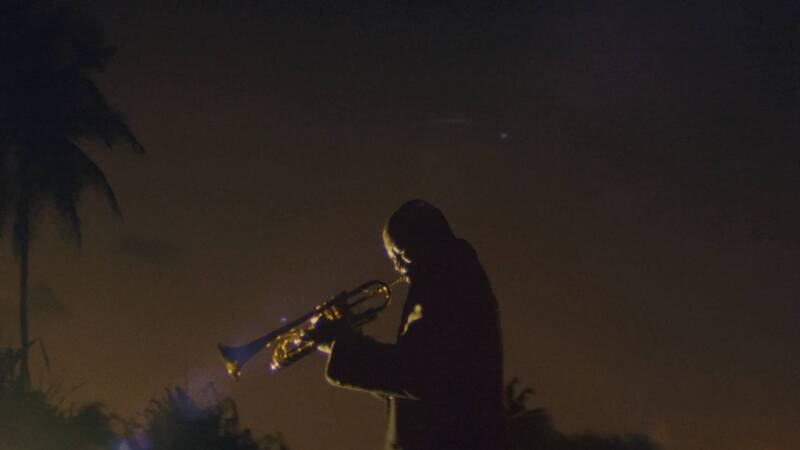
Koffi arrives in Montreal with his trumpet and a deeply personal connection to home. He's a musician searching for a place in an unfamiliar environment, but it's not simply about finding somewhere to perform. He's also dealing with the memory of his father and the expectations that come with inheriting something meaningful from someone who helped shape his life. Music becomes both a comfort and a reminder of what he's lost, complicating his efforts to move forward. The tension between embracing that inheritance and forging his own path gives the film a stronger emotional foundation than its relatively straightforward premise suggests.
Niava doesn't approach the experience as a quiet, sentimental story about someone discovering themselves through music's healing power. JAZZ INFERNAL has a restless quality, moving through Montreal's nightlife with an energy that reflects Koffi's unsettled state of mind. The camera rarely lets the environment feel entirely comfortable, and the shifting rhythm of the visuals helps establish the confusion of arriving somewhere new. An appealing contrast emerges between the excitement of a city full of possibilities and the anxiety of not knowing where you belong.
Harley Francis's cinematography is a major part of that experience. Movement, lighting, and the surrounding nightlife create an atmosphere that feels connected to the musical structure rather than functioning as attractive decoration. Montreal becomes an active part of Koffi's journey, with its crowded social spaces and shifting visual energy reinforcing how overwhelming a new environment can be. The city isn't presented simply as a destination where his problems will eventually be solved. It's a place where he must confront them while learning to navigate an unfamiliar world.
That approach gives the short story an identity beyond the familiar immigrant narrative of leaving one country in search of better opportunities somewhere else. Koffi's experiences aren't separated neatly into the life he left behind and the life he's beginning. His memories and present circumstances remain connected, sometimes competing for his attention. Niava moves between those emotional spaces without treating them as unrelated chapters, reinforcing how the past continues to influence the decisions people make long after their surroundings have changed.
The contrast between Koffi's Ivorian roots and Montreal's nightlife is especially effective because the film doesn't present either location as a simple answer to his problems. Home represents familiarity, family, and the musical inheritance he carries, but those connections are also complicated by grief. Montreal offers new experiences, unfamiliar relationships, and the chance to establish himself as a musician, yet none of those opportunities automatically provide a sense of belonging. Koffi exists somewhere between the two, trying to decide how much of his past to preserve and what kind of future he wants.
N'Guessan gives the film an identifiable human presence amid its shifting visual and musical energy. Koffi isn't simply a stand-in for the immigrant experience or a character whose entire personality revolves around carrying emotional baggage. He's a young musician navigating an unfamiliar environment, and the situation creates a mix of ambition, uncertainty, and vulnerability. His relationship with the trumpet helps establish that personality without turning every emotion into an extended conversation. The instrument is tied to his father, but it also belongs to Koffi's present life and his attempts to build something for himself.
The supporting cast includes Alexis Belhumeur as Oli and Kalombo Kasongo as Kaz, characters who help populate the Montreal environment Koffi is attempting to navigate. The interactions surrounding his arrival give the film room to move beyond an entirely internal examination of grief. Koffi must engage with others, respond to unfamiliar situations, and figure out how to carry himself in circumstances where his history isn't immediately understood. Those encounters shape the night's shifting energy, keeping the narrative from becoming a continuous series of mournful reflections.
The relationship between music and grief carries much of JAZZ INFERNAL's emotional weight. Losing a parent changes the way familiar things are experienced, especially when those things were once shared interests or sources of connection. A song, instrument, or particular sound can preserve memories in ways that ordinary conversation can't. For Koffi, his father's musical influence remains inseparable from his own development. The trumpet represents something passed down to him. Carrying that inheritance raises the question of whether he's pursuing his own dreams or trying to stay connected to someone who's gone.
There's a difference between honoring a parent's influence and letting it determine every decision you make. Koffi's circumstances bring that distinction into focus without requiring him to treat his father's legacy as an obstacle to be discarded. The inheritance matters because it shaped him, and his connection to it remains meaningful even as he tries to establish independence. His challenge is understanding that preserving what he received doesn't mean reproducing another person's life.
Jazz is an especially fitting musical foundation for that conflict. It's a form built on musical traditions while giving performers enormous freedom to interpret, improvise, and develop their own approaches. Musicians learn from those who came before them, but the goal isn't necessarily to sound exactly like their influences. The relationship between inherited knowledge and personal expression is built into the music itself. That connection makes Koffi's instrument relevant beyond its significance as an object associated with his father, allowing the film's central emotional conflict to emerge through its musical identity.
Hichem Khalfa's score reinforces that relationship between character and sound. Music doesn't simply accompany Koffi's experiences; it helps establish the film's movement between excitement, uncertainty, and memory. The changing tempo and musical atmosphere fit a story where the protagonist's state of mind isn't always easy to express through dialogue. Niava understands that a film about a musician benefits from letting music participate in the storytelling rather than repeatedly interrupting the action with isolated performance sequences.
The editing, credited to Thomas Bellefleur, Niava, and Joshua Rosenbaum, also contributes to the film's unusual energy. JAZZ INFERNAL moves between its present-day environment and Koffi's connection to his past, using those shifts to maintain the tension between where he comes from and where he's trying to go. The result is a short that feels more expansive than its running time would suggest. Rather than treating its 16 minutes as an excuse to simplify everything, the filmmakers build their story around a concentrated experience with several emotional concerns operating at once.
That density could easily become exhausting, especially with the amount of visual movement and musical activity. Niava's direction is frequently energetic, and the film doesn't always give its quieter ideas much time to settle before moving into another moment. Yet that restlessness also reflects Koffi's circumstances. His introduction to Montreal isn't a relaxed experience where he can calmly process every memory and decision. He's dealing with grief and ambition while trying to make sense of a new environment, and the film's urgency is connected to that lack of stability.
The short also has an appealing playfulness in how it handles Montreal's nightlife. The atmosphere isn't relentlessly miserable, even though Koffi's emotional circumstances are serious. The unpredictability of navigating unfamiliar people and situations creates room for lighter moments, helping the film avoid reducing the immigrant experience to a constant struggle. Moving somewhere new can be frightening, frustrating, exciting, funny, and occasionally ridiculous, sometimes within the same evening. JAZZ INFERNAL recognizes that those reactions don't have to cancel one another out.
Niava's background brings another dimension to the film. His filmmaking career spans West Africa, Canada, and the United States, and his work has consistently addressed experiences shaped by different cultural environments. That perspective matters to a story about an Ivorian musician trying to establish himself in Montreal, especially because the film refuses to treat African identity as something Koffi must leave behind to participate in Canadian society. His background remains essential to who he is, even as he explores the possibilities of a different life.
The director previously made ZOO, a short that became part of the Criterion Collection, and collaborated with Jeremy Comte on the feature PARADISE. Those projects helped establish his interest in visually distinctive, character-driven storytelling, with JAZZ INFERNAL continuing that approach through its emphasis on movement and musical expression. Niava's work reflects an interest in people whose identities are shaped by multiple locations and experiences, without treating cultural displacement as a single, easily defined emotion.
The production itself also reflects an international collaboration, with producers Zion Lipstein-Saffer and Samuel Caron helping bring the project to the screen. Caron previously produced the Academy Award-nominated short INVINCIBLE, and the team's independent filmmaking experience gives JAZZ INFERNAL a strong creative foundation. The film's visual confidence is especially impressive within the constraints of a short production, where establishing a convincing environment and emotional journey requires careful decisions about what deserves attention.
JAZZ INFERNAL made its world premiere at the Toronto International Film Festival before earning a place among TIFF's Canada's Top Ten selections. It later won the Short Film Jury Award for International Fiction at Sundance, recognition that makes sense given its distinctive visual style and how it blends music with an emotionally grounded personal story. Festival awards don't prove everyone will respond to a film the same way, but these honors show that Niava's approach has connected with audiences and industry professionals across settings.
Its festival success also highlights the importance of short filmmaking as an artistic format, not merely a training exercise for directors hoping to graduate to features. JAZZ INFERNAL doesn't need another hour of material to establish its basic identity, and expanding every relationship or explanation could change the experience considerably. Niava focuses on Koffi during a key transitional moment, letting the combination of music, memory, and visual movement convey much of the emotional context. The film doesn't attempt to provide an exhaustive biography of its protagonist, nor does it require explaining every detail of his family history.
The focus on a single young musician also avoids turning immigration into a generalized argument about national identity. Koffi's experience is shaped by his specific background, profession, and relationship with his father. The challenges of adapting to a new country matter, but the film doesn't suggest every immigrant arrives with the same motivations or emotional circumstances. Koffi's desire to pursue music is inseparable from his grief, making relocation both a practical decision and part of a larger attempt to understand himself.
That specificity gives the film emotional value beyond its technical accomplishments. Beautiful photography and inventive editing can attract attention, but neither automatically makes a character's experiences matter. Here, the musical inheritance establishes a personal connection that gives the visual energy something to support. The memory scenes and the atmosphere of Montreal's nightlife belong to the same emotional journey, even as they represent competing impulses in Koffi's life.
The film's strongest idea is also one of its simplest. Finding your own voice doesn't require forgetting the voices that helped shape it. Koffi's father remains part of his identity, and their musical connection doesn't have to become a burden just because Koffi wants to develop independently. Those feelings can exist together. Grief doesn't disappear when someone discovers a new purpose, and moving forward doesn't mean every connection to the past must be abandoned.
For a film running barely longer than a quarter of an hour, JAZZ INFERNAL has an impressive amount of personality. Its lively cinematography, musical construction, and relationship between memory and the present give it an identity that's difficult to confuse with another short about finding oneself. The film balances frantic movement with quieter emotional concerns, though not always equally well, and its commitment to expressing Koffi's experiences through rhythm and imagery gives its approach a purpose beyond simply looking stylish.
Niava leaves a strong impression by refusing to separate the excitement of a new beginning from the pain of what came before. Koffi's journey is about music, but it's also about the strange responsibility of carrying someone else's influence while trying to become your own person. The trumpet remains a connection to his father, and the music carries that history wherever he goes. What changes is Koffi's relationship with it. He doesn't need to erase the past to find his place in the present; he just needs to figure out which notes belong to him.
Please visit https://linktr.ee/overlyhonestr for more reviews.
Follow me on Letterboxd, Instagram, Twitter, and YouTube. You can also find my social media accounts on most platforms by searching for 'Overly Honest Reviews'.
I’m always happy to hear from my readers; please don't hesitate to say hello or send me any movie questions.
[photo courtesy of TÉLESCOPE FILMS, MUDDY WATER, PRODUCTIONS DISAMARE, TRAVELLING]
DISCLAIMER:
At Overly Honest Movie Reviews, we value honesty and transparency. Occasionally, we receive complimentary items for review, including DVDs, Blu-rays, CDs, Vinyl Records, Books, and more. We assure you these arrangements do not influence our reviews, as we are committed to unbiased, sincere evaluations. We aim to help you make informed entertainment choices regardless of our relationship with distributors or producers.
Amazon Affiliate Links:
This site also contains Amazon affiliate links. If you purchase through these links, we may receive a commission. This affiliate arrangement does not affect our commitment to honest reviews and helps support our site. We appreciate your trust and support as you navigate these links.


Happy
0 %

Sad
0 %

Excited
0 %

Sleepy
0 %

Angry
0 %

Surprise
0 %
 0
 0

Average Rating