Loyalty Comes at a Price
Read Time:18 Minute, 8 Second
MOVIE REVIEW
The Corruptor
 –


Genre: Action, Crime, Drama, Thriller
Year Released: 1999, 2026 4K/Blu-ray
Runtime: 1h 50m
Director(s): James Foley
Writer(s): Robert Pucci
Cast: Chow Yun-Fat, Mark Wahlberg, Ric Young, Byron Mann, Kim Chan, Paul Ben-Victor, Brian Cox, Elizabeth Lindsey, Andrew Pang, Jon Kit Lee, Tovah Feldshuh
Where to Watch: available November 11, 2026. Pre-order your copy here: www.toyrobotvideo.com, www.mvdshop.com, or www.amazon.com
RAVING REVIEW: Chow Yun-Fat spent years making some of the most exciting action movies ever produced in Hong Kong, so Hollywood naturally decided he needed a partner played by Mark Wahlberg. That unlikely pairing sits at the center of THE CORRUPTOR, a violent police thriller that tries to bring the explosive style of Hong Kong action cinema to a distinctly American story about organized crime, divided loyalties, and police corruption. Directed by James Foley, the film boasts an impressive lead, a talented supporting cast, and several ambitious action sequences. The screenplay also becomes increasingly tangled in its own criminal conspiracies, leaving the movie caught somewhere between an entertaining action picture and a more serious examination of institutional corruption.
Chow plays Nick Chen, a decorated NYPD lieutenant who oversees the Asian Gang Unit in Manhattan's Chinatown. His reputation as an effective police officer has earned him considerable authority, but the way he's maintained order has a problem. Chen's relationships with the criminal organizations operating in his jurisdiction extend considerably beyond professional familiarity. He's spent years navigating an environment where cooperation, intimidation, personal favors, and corruption have become nearly impossible to separate. His position lets him shape what happens on the streets, but maintaining that influence means accepting compromises that would make an Internal Affairs investigator very interested in his finances.
The arrival of Danny Wallace (Mark Wahlberg), a young detective assigned to Chen's unit, complicates an already unstable situation. Danny initially seems like the kind of idealistic police officer who believes the line between criminals and law enforcement should be relatively straightforward. Unfortunately, he's entering a world where those distinctions have become meaningless to practically everyone involved. Chen has learned to survive through arrangements that would be unacceptable under ordinary circumstances, and Danny quickly discovers that understanding the rules of Chinatown means recognizing how often they're ignored.
The two find themselves caught between established Tong organizations and the increasingly aggressive Fukienese Dragons, whose power struggle threatens to turn the neighborhood into a battlefield. The conflict involves drug trafficking, extortion, competing criminal interests, and an assortment of people whose allegiances seem to change whenever someone offers a better deal. Chen's connections make him valuable to multiple factions, but they also put him in a position where nearly every decision has consequences. As Danny becomes more involved, the relationship between the two detectives develops into a complicated examination of trust, loyalty, and how much corruption a person can accept before becoming indistinguishable from the criminals they're supposed to arrest.
Chow Yun-Fat is easily the film's greatest asset. His ability to move between charm, authority, vulnerability, and intimidation gives Nick Chen a personality that extends well beyond the familiar image of a morally compromised police officer. Chen understands the environment he's operating in, and Chow brings a sense of experience to a character whose confidence comes from knowing exactly how dangerous his relationships have become. He doesn't approach every confrontation with the same expression or rely exclusively on physical intimidation. His performance suggests a man constantly assessing the people around him, calculating which relationships can be trusted and which might eventually destroy him.
That complexity matters because Nick isn't written as a conventional hero. His corruption isn't simply an unfortunate misunderstanding or a minor professional indiscretion that can be excused because he occasionally does the right thing. He has knowingly participated in arrangements that undermine his responsibilities, and the consequences extend beyond his personal circumstances. Yet Chow makes him interesting without demanding that audiences approve of everything he does. The character's appeal comes partly from the uncomfortable recognition that someone can understand the damage corruption causes while still benefiting from it.
Wahlberg's Danny offers a different kind of performance, built around a younger officer trying to establish himself within a system he doesn't fully understand. At this point in his career, Wahlberg had already demonstrated considerable dramatic ability in BOOGIE NIGHTS, proving he could handle material that demanded more than the physical confidence associated with his earlier celebrity. THE CORRUPTOR puts him in a more conventional action role, though Danny's position as an inexperienced outsider gives him a reason to seem uncertain. That uncertainty contrasts with Chow's considerably more assured presence.
The pairing isn't always as convincing as the filmmakers seem to want. Chow has an effortless screen presence that lets him communicate more through changes in expression than some performers manage with an entire speech. Wahlberg approaches the material with a comparatively blunt intensity, and their contrasting styles don't consistently develop into the chemistry expected from a police partnership. The relationship still matters to the story, but the film is more compelling when it examines their conflicting loyalties than when it relies on the familiar conventions of two mismatched cops learning to work together.
James Foley is an interesting choice to direct this material. His career includes GLENGARRY GLEN ROSS, AT CLOSE RANGE, and AFTER DARK, MY SWEET, productions that demonstrate his interest in damaged characters, destructive relationships, and people making terrible decisions under pressure. THE CORRUPTOR shares some of those concerns, particularly in its exploration of the compromises people make to protect their positions. However, it also tries to deliver the high-energy action associated with directors like John Woo, creating a combination that doesn't always fit comfortably.
That difference becomes clearer when considering Chow's earlier Hong Kong films. A BETTER TOMORROW, THE KILLER, and HARD BOILED helped establish him as an international action icon through stories that combined extraordinary gunplay with intense emotional relationships. Working with Woo, Chow became associated with characters whose loyalty, personal codes, and willingness to sacrifice themselves were as important as their ability to survive enormous shootouts. Those productions developed a recognizable style in which action often extended the characters' emotions.
THE CORRUPTOR borrows several elements from that tradition, including elaborate gun battles, shifting allegiances, and the emphasis on personal loyalty. However, Foley approaches the material from a different background, emphasizing criminal relationships and moral uncertainty alongside the action. The result occasionally feels like two different kinds of movies competing for control. One wants to explore the complexities of policing an immigrant community shaped by organized crime and institutional distrust. The other wants Chow Yun-Fat to pick up a gun and remind everyone why he became famous in the first place.
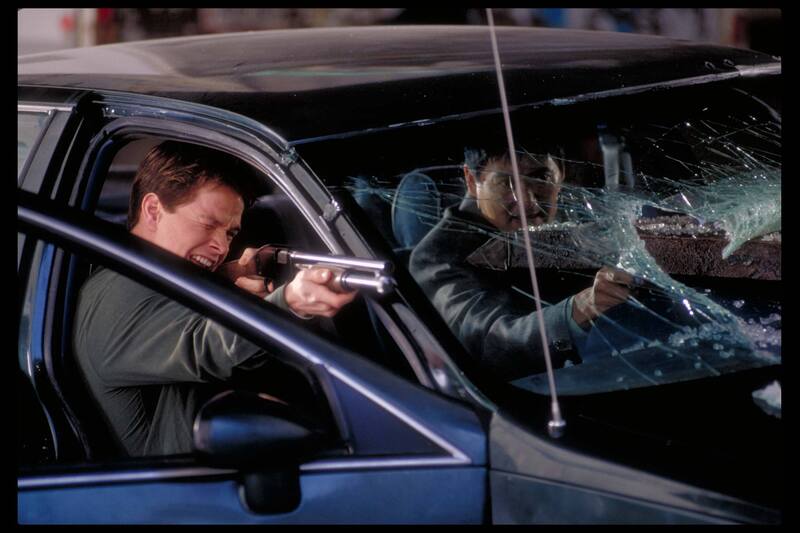
Fortunately, the action delivers some memorable moments. The film's gunfights are loud, violent, and energetic, incorporating the exaggerated physicality associated with Hong Kong action cinema. Rather than restricting the violence to carefully controlled confrontations between a handful of recognizable opponents, the larger sequences emphasize how quickly a dangerous situation can become chaotic. Gunfire erupts, people scramble for cover, and the confrontations frequently extend beyond the individuals responsible for starting them. This willingness to depict the disorder surrounding violence gives the action a different character from the more carefully choreographed exchanges associated with some of Chow's earlier films.
The car chase through Chinatown stands out as an especially ambitious sequence. Vehicle pursuits have become so common in action filmmaking that they can easily feel interchangeable. Still, a densely populated urban environment introduces hazards that make the movement more complicated than a simple contest of speed. The sequence emphasizes the dangers of bringing a violent pursuit into crowded streets, where the surroundings become part of the action. It also allows Foley to focus on physical spectacle rather than explaining another connection between the police, criminal organizations, and the people manipulating both.
The violence is surprisingly harsh for a mainstream American action thriller starring two recognizable actors. THE CORRUPTOR doesn't present Chinatown's criminal conflicts as a colorful collection of harmless rivalries. Its gangs are capable of extreme brutality, and the consequences of their activities extend beyond rival criminals. That willingness to depict an unpleasant environment supports the film's central concerns. However, its reliance on familiar gangster imagery also raises questions about how much genuine understanding the story shows for the community it portrays.
Chinatown is more than a convenient location for the film's criminal activities; it also carries considerable representational baggage. American crime movies have frequently treated Asian communities as mysterious environments governed by traditions and loyalties that outsiders cannot understand. THE CORRUPTOR incorporates elements of that tradition while examining the relationship between law enforcement, immigration, organized crime, and cultural identity. Chow's presence as the central authority figure helps keep the story from being told exclusively through the perspective of a white newcomer, even though Danny's introduction remains an important part of its structure.
Chen's position becomes more complicated in that cultural context. He's expected to represent NYPD authority while maintaining relationships within a community that has its own reasons to distrust law enforcement. His ability to move between those worlds gives him professional advantages, but criminal organizations also know how to exploit his connections. Danny doesn't initially have that knowledge, so his relationship with Chen lets the audience see the competing interests operating throughout the neighborhood. The arrangement is familiar, but the cultural and political circumstances add new possibilities.
Robert Pucci's screenplay doesn't always make the most of those possibilities. As the investigation grows, its collection of criminal factions, police departments, personal histories, and competing agendas becomes difficult to manage. Characters with overlapping motivations move in and out of the story, and the narrative occasionally seems more interested in looking complex than in making individual relationships compelling. There's a difference between a story that challenges audiences to follow a complicated conspiracy and one that makes its underlying conflict harder to understand than necessary. THE CORRUPTOR sometimes drifts into the latter.
That overcrowding also affects the film's pacing. The action sequences provide bursts of energy, but the stretches between them can drag as conversations explain who betrayed whom and which faction holds the advantage. Those developments matter to the central premise, yet the storytelling doesn't always give them enough personality to stick. The movie has the ingredients for a tense crime drama, though competing interests occasionally keep it from maintaining the momentum established by its stronger sequences.
The supporting cast adds personality to the criminal world. Ric Young plays Henry Lee, whose influence in Chinatown reflects the relationship between organized crime and legitimate authority. Byron Mann plays Bobby Vu, while Kim Chan plays Benny Wong. These performers add to the network of rival personalities surrounding Chen and Wallace, creating a community where power depends on relationships that can turn dangerous without warning. Their involvement also reflects the production's interest in assembling a recognizable group of Asian actors rather than relying exclusively on its two American-market stars.
Brian Cox appears as Sean Wallace, Danny's father, adding another layer to the younger detective's background. Cox lends authority to supporting characters without much screen time, and his presence connects Danny's professional ambitions to the personal history that has shaped his understanding of police work. The relationship raises concerns about inheritance and reputation, especially when younger officers discover that the institutions and individuals they admire may not be as straightforward as they once believed.
Paul Ben-Victor, Elizabeth Lindsey, Jon Kit Lee, and Andrew Pang contribute to the ensemble, helping populate a story whose criminal and professional relationships frequently overlap. The film has enough characters to suggest a broader world beyond its central partnership, though not everyone gets the development needed to make that world as compelling as it could be. Some individuals primarily move the investigation forward or complicate the latest arrangement, leaving the stronger dramatic material concentrated around Chen and Wallace.
Cinematographer Juan Ruiz-Anchía gives THE CORRUPTOR a visual identity that is one of its strongest qualities. His photography uses dramatic lighting, deep shadows, and vivid contrasts that suit the film's blend of urban crime drama and stylized action. The presentation has more personality than a straightforward procedural, using the city's appearance to create an environment where danger can emerge from ordinary surroundings. That approach also complements Foley's interest in morally compromised characters, creating a world where the distinction between respectable institutions and criminal operations isn't always visually reassuring.
Interestingly, the production filmed much of it in Toronto, which doubled for sections of Manhattan's Chinatown. That decision matters, given how much of the story depends on its urban environment. Production designer David Brisbin built the visual world that let the film move between recognizable New York locations and Canadian stand-ins. The work required more than placing a few signs in another language throughout the background. The production needed environments that could support large action sequences while maintaining a believable connection to the neighborhood at the story's center.
Editor Howard E. Smith contributes to the film's aggressive action style, particularly in sequences where camera movement, physical confrontations, and rapid perspective shifts are meant to create a sense of disorder. The cutting gives the shootouts a restless quality, though it can also feel overly busy when several things happen at once. The movie clearly aims to capture the energy of Hong Kong action filmmaking, but the rhythm doesn't consistently match the physical clarity that made many of its influences so effective. Sometimes letting a movement play out can be more exciting than cutting away.
Carter Burwell's score adds another recognizable creative name to the production. Burwell is closely associated with the films of the Coen brothers, having composed music for productions such as BLOOD SIMPLE, RAISING ARIZONA, and FARGO. His work on THE CORRUPTOR belongs to a very different type of filmmaking, balancing crime-thriller tension with the energy of its action sequences. The soundtrack also includes contemporary popular music, reflecting an era when mainstream crime movies frequently combined orchestral scoring with songs intended to reinforce their urban atmosphere.
The film's relationship with Chow's career is especially interesting in retrospect. THE REPLACEMENT KILLERS had introduced him to Hollywood leading-man status. Still, the American industry struggled to find material that fully accommodated the combination of charm, emotional vulnerability, and physical confidence that made him such a compelling presence in Hong Kong cinema. THE CORRUPTOR gives him a more complex role than a straightforward professional assassin, yet the larger production still seems unsure whether audiences want the dramatic actor or the action icon.
The disappointing commercial performance didn't help establish the kind of American career his international reputation might have suggested. With a reported production budget of approximately $25 million and worldwide box office earnings of roughly $24.5 million, the film fell short of becoming the commercial breakthrough its cast and genre might have promised. Those numbers don't necessarily reflect the production's artistic value. Still, they show how hard Hollywood found it to translate the popularity of Hong Kong action stars into sustained mainstream success.
That history makes THE CORRUPTOR a worthwhile example of a transitional period in American action filmmaking. Hollywood increasingly borrowed techniques, performers, and visual ideas from Hong Kong cinema, even as the industry struggled to understand what made those productions successful. Simply casting an internationally recognized star and incorporating elaborate shootouts wasn't enough to reproduce the emotional intensity of the best examples. The surrounding characters, relationships, and dramatic structure needed the same attention.
**Toy Robot Video's new 4K UHD and Blu-ray edition** brings the film back into consideration through a restoration sourced from the original camera negative. The two-disc release preserves the movie as a physical-media title while assembling a collection of supplements devoted to its production history. For a film whose cinematography and elaborate action are central to its identity, returning to the original photographic elements is a meaningful starting point for a modern presentation.
The release presents the film in its original widescreen framing and includes 5.1 surround audio. The restoration provides a new source for the film's presentation, though the announced specifications alone don't show how it compares with earlier transfers. Image quality ultimately depends on the restoration decisions, encoding, handling of photographic grain, color reproduction, and condition of the surviving elements. Those details matter when evaluating a 4K edition, particularly for a production whose lighting and visual contrasts are such recognizable parts of its appearance.
The supplements give a clearer reason to appreciate the new edition. THE MUSIC OF CHINATOWN features composer Carter Burwell discussing his contributions, while TURNING TORONTO INTO CHINATOWN brings production designer David Brisbin into the conversation. The latter is an especially welcome inclusion because the film's combination of authentic New York locations and Toronto stand-ins is an important part of its production history. Understanding how those environments were constructed can shed light on choices that are easy to overlook when focusing on the performers and action.
CHOW'S RIGHT-HAND MAN features action director Robert Samuels, offering another production perspective that fits the film's identity. Samuels has extensive connections to Hong Kong martial arts cinema, making his involvement relevant to a movie that blends different filmmaking traditions. The action choreography is one of the production's main attractions, and a discussion with someone directly involved complements the more conventional promotional material often associated with older studio releases.
An archival audio commentary with James Foley keeps the director's perspective part of the package. At the same time, FROM THE (UNDER)GROUND UP preserves a behind-the-scenes featurette about the original production. Archival material matters because interviews recorded around the time of a film's creation can capture perspectives that inevitably change in hindsight. These supplements give collectors a mix of contemporary reflections and material more directly connected to the original release.
The package also includes the music video for UGK's TAKE IT OFF, along with the theatrical trailer and television spots. These additions document how the film was marketed and how its soundtrack contributed to its identity. Promotional materials may not be substantial on their own, but preserving them alongside a restored feature and more detailed interviews creates a fuller record of the production. It's the kind of material that makes a collector's edition feel more considered than simply presenting the movie in a new format.
THE CORRUPTOR remains an uneven but interesting attempt to merge American police corruption drama with the explosive traditions of Hong Kong action cinema. Chow Yun-Fat brings considerable personality to a morally compromised protagonist, while James Foley assembles an impressive technical team and delivers several exciting sequences. The supporting cast adds credibility, and the story's focus on divided loyalties adds more substance than a routine collection of shootouts. Unfortunately, the complicated screenplay, inconsistent pacing, and occasionally awkward central partnership prevent those elements from working together as effectively as they should.
The new Toy Robot Video release gives the film another chance to reach an audience, especially collectors interested in Chow's career and the period when Hollywood tried to incorporate Hong Kong action filmmaking into its own productions. THE CORRUPTOR has enough individual strengths to deserve that attention, even if it never reaches the heights of its influences. Chow Yun-Fat spent years making gunfights look effortless, and Hollywood somehow made giving him a decent screenplay seem like the bigger challenge.
Bonus Materials:
NEW 4K restoration from the original camera negative
NEW The Music of Chinatown, interview with composer Carter Burwell
NEW Turning Toronto Into Chinatown, interview with production designer David Brisbin
NEW Chow's Right-Hand Man, interview with action director Robert Samuels
Archival Audio Commentary with director James Foley
From the (Under)Ground Up, archival featurette of the making of The Corruptor
UGK “Take It Off” Music Video
Theatrical Trailer
TV Spots
Please visit https://linktr.ee/overlyhonestr for more reviews.
Follow me on Letterboxd, Instagram, Twitter, and YouTube. You can also find my social media accounts on most platforms by searching for 'Overly Honest Reviews'.
I’m always happy to hear from my readers; please don't hesitate to say hello or send me any movie questions.
[photo courtesy of TOY ROBOT VIDEO, MVD ENTERTAINMENT]
DISCLAIMER:
At Overly Honest Movie Reviews, we value honesty and transparency. Occasionally, we receive complimentary items for review, including DVDs, Blu-rays, CDs, Vinyl Records, Books, and more. We assure you these arrangements do not influence our reviews, as we are committed to unbiased, sincere evaluations. We aim to help you make informed entertainment choices regardless of our relationship with distributors or producers.
Amazon Affiliate Links:
This site also contains Amazon affiliate links. If you purchase through these links, we may receive a commission. This affiliate arrangement does not affect our commitment to honest reviews and helps support our site. We appreciate your trust and support as you navigate these links.


Happy
0 %

Sad
0 %

Excited
0 %

Sleepy
0 %

Angry
0 %

Surprise
0 %
 0
 0

Average Rating