A Harrowing Reflection of Real-World Extremism
Read Time:6 Minute, 4 Second
TV SERIES REVIEW
The Handmaid’s Tale: The Complete Series
 –
– 

Genre: Drama, Sci-Fi
Year Released: 2017–2025
Runtime: 66 episodes
Director(s): Mike Barker, Kari Skogland, Reed Morano, Elisabeth Moss, Colin Watkinson, Daina Reid, Jeremy Podeswa
Writer(s): Bruce Miller, Margaret Atwood, Yahlin Chang, Dorothy Fortenberry, Eric Tuchman
Cast: Elisabeth Moss, Yvonne Strahovski, Ann Dowd, Bradley Whitford, Max Minghella, O-T Fagbenle, Samira Wiley
Where to Watch: available now, order your copy here: www.amazon.com
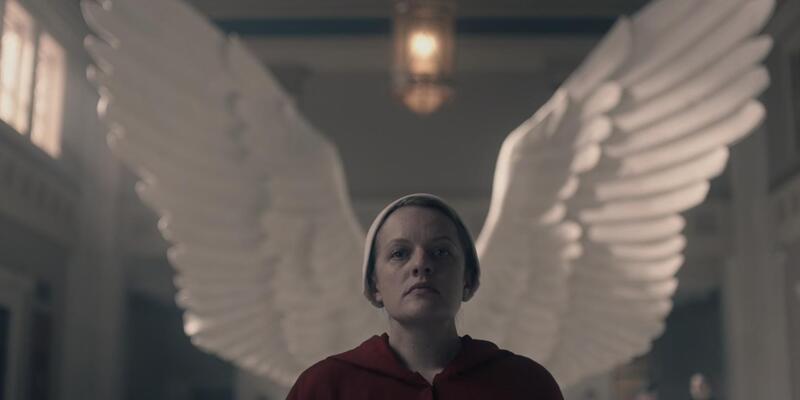
RAVING REVIEW: THE HANDMAID’S TALE always carried a specific goal, but experiencing all six seasons together intensifies how its atmosphere of dread became its greatest tool and, later, its toughest limitation. The vision defined the early seasons; they weren’t content with simply imagining a collapsed America but actively interrogated how a society with democratic roots could break itself into something monstrous. This isn’t just a setting—it’s an autopsy report. The first season, especially, remains one of the strongest debuts in modern television, propelled by the raw immediacy of Elisabeth Moss’ performance. She built June Osborne not as a symbol of rebellion from the outset, but as someone dragged toward resistance through repeated psychological and physical shattering. (The irony is how familiar many aspects of the series look to the real world we’re living in.)
Watching the complete series, it’s clear the show was at its strongest when June’s conflict positioned her between survival and fury. Moss’ ability to convey entire arcs through silence became a defining part of the show’s identity, sustaining THE HANDMAID’S TALE even as the narrative began to feel like we were on repeat. This isn’t to say the series lost itself—it evolved, but in ways that consistently challenged its audience’s patience and loyalty. The shift from tight, character-driven storytelling to broader political conspiracies gave the show ambition but also added distance. That distance became more noticeable in the later seasons, when the emotional throughlines were forced to compete with an expanding ensemble and more complex geopolitical stakes.
Even when the structure wavered, the series never abandoned its commitment to examining power—how it moves, how it corrodes, and how it reshapes those who wield it and those who suffer beneath it. Characters like Serena Joy and Aunt Lydia remained riveting because they embodied that corruption from entirely different angles. Serena’s arc, especially, stands out across the full series run. She begins as an architect of terror, convinced of her own righteousness. She evolves into something deeply contradictory: a woman consumed by guilt, rage, and the desire for control in a world that cages her as much as it empowers her. Yvonne Strahovski’s performance becomes essential to the series experience because it reveals how ideology mutates and how people weaponize their own victimhood to justify past harm.
Ann Dowd’s Aunt Lydia represents another kind of horror: institutional cruelty blended with personal conviction. Across the run, Lydia’s behavior serves as a constant reminder that the systems in Gilead aren’t abstract—they’re maintained by individuals who see themselves as guardians of order. That humanization doesn’t soften her; it sharpens the show’s argument about complicity.
Viewing all six seasons back-to-back also makes the thematic fractures more visible. The show’s relentless bleakness was part of its signature, but it also made the climb uphill. There are only so many cycles of capture, escape, punishment, and near-revolution a story can withstand before those start to feel like gravity pulling everything back into place (see THE WALKING DEAD, but THE HANDMAID’S TALE knew when to wrap things up). By the time the later seasons shift more into Canada and relative safety, the change of landscape doesn’t entirely reset the tone; it instead emphasizes how deeply damaged everyone has become. That becomes both a strength and a limitation. The emotional work is powerful, but the pacing of certain arcs—especially in seasons four and five—sometimes warps the sense of progression.
The final season lands in an interesting place. It’s not the thunderous conclusion many viewers were hoping for, but it frames the story around transition rather than triumph. In some ways, that restraint works. Gilead was never a place that allowed for perfect endings. In other cases, the season’s structure feels compressed, as though the show was bracing to close rather than to conclude its thematic ambitions naturally. Still, the complete series benefits from having that ending included—it makes the collection feel whole, even if the final notes don’t echo as loudly as the earlier ones. And as a note of positivity, the final season prepares us for the sequel series THE TESTAMENTS in ways we may not yet fully understand.
One thing that becomes undeniable when watching the full run is how much the series shaped televised storytelling over the last decade. It arrived during a period of political turbulence and became shorthand for resistance, creeping authoritarianism, and the fragility of rights that should never be taken for granted. Its imagery became part of real-life protest movements, something few shows ever achieve. Whether viewers believe the later seasons retained the same intensity, the cultural impact is significant.
THE HANDMAID’S TALE remains a towering work of long-form drama. Its imperfections are visible, especially when the narrative stretches itself thin, but the emotional authenticity of its performances keeps the journey grounded. Moss, Strahovski, Dowd, Wiley, Whitford, and Minghella all contribute to an ensemble that consistently elevates the material, ensuring the show’s strongest qualities remain intact even as its direction evolves.
The home release itself offers the opportunity to revisit the series with clarity—no gaps, no waiting, just the full story laid out from collapse to reckoning. It reinforces how much this story was always about transformation: June’s, Serena’s, and the world around them. And even when the show’s ambition exceeds its structure, the cumulative impact is profound. This set captures the full weight of a series that demanded attention not through spectacle but through fear, humanity, and the lingering question of how close fiction can come to reality when society refuses to heed its warnings.
Please visit https://linktr.ee/overlyhonestr for more reviews.
You can follow me on Letterboxd, Instagram, Twitter, and YouTube. My social media accounts are also available on most platforms by searching for ‘Overly Honest Reviews’.
I’m always happy to hear from my readers; please don’t hesitate to say hello or send me any questions about movies.
[photo courtesy of WARNER BROS. DISCOVERY HOME ENTERTAINMENT]
DISCLAIMER:
At Overly Honest Movie Reviews, we value honesty and transparency. Occasionally, we receive complimentary items for review, including DVDs, Blu-rays, CDs, Vinyl Records, Books, and more. We assure you that these arrangements do not influence our reviews; we are committed to providing unbiased, honest evaluations. We aim to help you make informed entertainment choices regardless of our relationship with distributors or producers.
Amazon Affiliate Links:
Additionally, this site contains Amazon affiliate links. If you purchase through these links, we may receive a commission. This affiliate arrangement does not affect our commitment to honest reviews and helps support our site. We appreciate your trust and support as we navigate these links.


Happy
0 %

Sad
0 %

Excited
0 %

Sleepy
0 %

Angry
0 %

Surprise
0 %
 0
0
 0
0


Average Rating