A Story Built on Inherited Trauma
Read Time:7 Minute, 8 Second
TV SERIES REVIEW
The Testaments
 –
– 
Genre: Drama, Sci-Fi & Fantasy, Political
Year Released: 2026
Runtime: 10 x 44m episodes
Writer(s): Bruce Miller, Maya Goldsmith, John Weber, Margaret Atwood, others
Cast: Ann Dowd, Chase Infiniti, Lucy Halliday, Rowan Blanchard, Amy Seimetz, Zarrin Darnell-Martin
Where to Watch: premieres on Hulu April 8, 2026
RAVING REVIEW: THE TESTAMENTS shifts the focus of Gilead away from survival and toward indoctrination, and that change immediately alters how the story feels. Instead of watching characters fight against the system from the outside, this series focuses on those who have been raised within it, shaped by it, and, in some cases, still believe in it. That perspective alone gives the narrative a different kind of tension, one rooted less in escape and more in realization. There’s something in this series that understands the assignment and turns it up to eleven. While it may be a slower burn than THE HANDMAID’S TALE, the series understands what it is and lets that impact sit with you. A series that turns observation into confrontation, and refuses to let you look away. Margaret Atwood’s original vision still runs through every part of this, not as a blueprint, but as a warning that continues to prove itself right.
The core of the series follows Agnes and Daisy, two young women from very different backgrounds, as they try to survive or thrive in Gilead. Agnes has grown up in this world, taught to see obedience as purpose, and is a Plum (a young, unmarried daughter of a high-ranking Gilead Commander). Daisy comes in from the outside as a Pearl (a young woman recruited by Gilead's missionaries to move into the country) with a different understanding of what life can be. That contrast is never subtle here, and it doesn’t need to be. It becomes the driving force behind the story, creating friction that feels both personal and ideological. The importance of the relationships in the series comes from how different these young women are.
What works best here is how the series frames that divide. It doesn’t rush to position one as right and the other as wrong. Instead, it allows both perspectives to coexist, even when one is clearly shaped by manipulation. Agnes isn’t written as naive in a simplistic way. She’s a product of her environment, and the show respects that by letting her belief system feel real, even when it’s built on something deeply flawed. She’s not flawed; coming of age within this system is the only thing she knows. Their lives are shaped and molded to become the “perfect” woman in the eyes of Gilead’s elite.
Daisy, on the other hand, carries the weight of knowing there’s something beyond Gilead, but that knowledge doesn’t translate into power. There’s a sense of restraint in how her character is handled. She isn’t dropped into the story as a solution. She’s living within an unfamiliar territory, and that uncertainty becomes part of her arc.
The supporting case here adds so much to the world, but the story is Daisy and Agnes’ to mold and shape the future within the “walls” of this country. Rowan Blanchard’s Shunammite may be one of the most interesting wildcards of the series; an intensity that feels bottled up helps shape her character. While Mattea Conforti’s Beka feels like a parallel to Elisabeth Moss’ June from THE HANDMAID’S TALE, she doesn’t follow the same path but has such an intense arc.
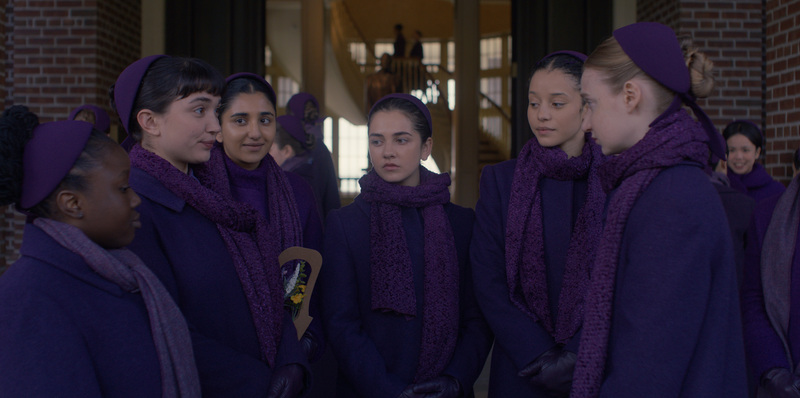
The setting of Aunt Lydia’s preparatory school is where the series finds its identity. It’s not just a location; it’s an environment designed to shape behavior, reinforce ideology, and eliminate doubt. The structure of that space allows the show to explore how control is maintained on a day-to-day level. It’s not always through overt violence. Often, it’s quieter, embedded in routine, expectation, and the constant reinforcement of belief. Ann Dowd returning as Aunt Lydia adds a unique dynamic. Her presence connects this series directly to what came before, but more importantly, it reinforces the idea that Gilead’s power isn’t abstract. It’s administered by people who believe in what they’re doing, or at least believe it’s necessary. That nuance is what keeps the character compelling rather than one-dimensional.
From a storytelling standpoint, the coming-of-age angle distinguishes this from its THE HANDMAID’S TALE. The series isn’t just about resisting a system; it’s about understanding it, questioning it, and deciding what to do with that knowledge. That shift allows for more internal conflict, which in turn gives the narrative room to breathe. The focus here is on a younger cast and a slightly wider storytelling net, but I think it makes the impact even more palpable. Living in the world we do, where women’s autonomy and rights are being challenged almost daily, makes this series feel more like a warning than its predecessor.
There’s also an inherent challenge here. Following a series as defined and widely recognized as THE HANDMAID’S TALE means expectations are already set. THE TESTAMENTS doesn’t try to replicate that tone, but it also doesn’t completely distance itself. It operates in a space that feels connected without being dependent, which is a difficult balance to maintain. I think that makes the series even more impactful. We saw the early days of hell; now we get to see where that evolution led. I can’t wait to see, with terror in my heart and eyes, where we go in season 2.
A story built around internal realization and gradual shifts in perspective needs careful structure to maintain momentum. The series is careful to avoid repetition and allows the world to develop naturally. I want so badly to share some of my favorite aspects of the season, but I refuse to ruin that for anyone. With that said, please be careful in reading others' reviews, because it would be incredibly easy for someone to spoil the twist that gives so much of the season's impact.
The foundation is rock solid. The premise is clear, the characters are positioned to allow future development, and the setting provides a focused environment to explore the themes at play. There’s a sense that the creators understood what made the original compelling, but also recognize that it needs to evolve rather than repeat itself.
By centering the story on younger characters within the system, THE TESTAMENTS opens the door to a different kind of narrative. It’s not just about what Gilead does to people, but what happens when people begin to see it for what it is after being taught not to question it. That realization carries weight, and it drives the series into territory that feels both familiar and new. In my humble opinion, this has a real chance to stand alongside its THE HANDMAID’S TALE as a necessary watch rather than living in its shadow.
@TestamentsonHulu
#TheTestaments
Please visit https://linktr.ee/overlyhonestr for more reviews.
You can follow me on Letterboxd, Instagram, Twitter, and YouTube. My social media accounts can also be found on most platforms by searching for 'Overly Honest Reviews'.
I’m always happy to hear from my readers; please don't hesitate to say hello or send me any questions about movies.
[photo courtesy of HULU, MGM TELEVISION]
DISCLAIMER:
At Overly Honest Movie Reviews, we value honesty and transparency. Occasionally, we receive complimentary items for review, including DVDs, Blu-rays, CDs, Vinyl Records, Books, and more. We assure you that these arrangements do not influence our reviews, as we are committed to providing unbiased and sincere evaluations. We aim to help you make informed entertainment choices regardless of our relationship with distributors or producers.
Amazon Affiliate Links:
Additionally, this site contains Amazon affiliate links. If you purchase through these links, we may receive a commission. This affiliate arrangement does not affect our commitment to honest reviews and helps support our site. We appreciate your trust and support as you navigate these links.


Happy
0 %

Sad
0 %

Excited
0 %

Sleepy
0 %

Angry
0 %

Surprise
0 %
 0
0
 0
0

Average Rating