Ambition That Knows Its Limits and Pushes Anyway
Read Time:8 Minute, 36 Second
CINEMATIC AUDIO EXPERIENCE REVIEW
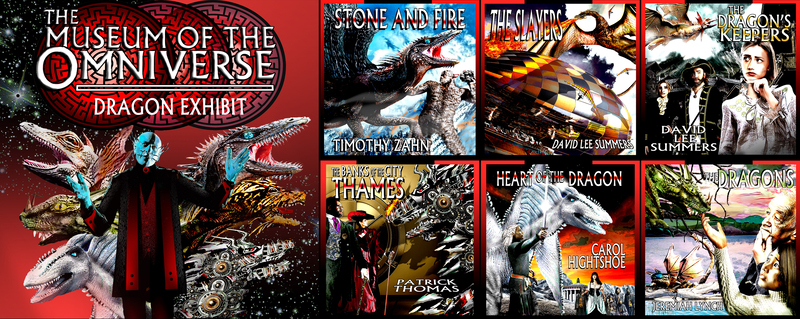
The Museum of The Omniverse: Dragon Exhibit


Genre: Science Fiction, Fantasy, Audio Drama, Anthology
Year Released: 2025
Runtime: 4h +
Director(s): Eric Schumacher, Tyrel Good
Writer(s): David Lee Summers, Timothy Zahn, Carol Hightshoe, Patrick Thomas, Jeremiah Lynch
Cast: Eric Schumacher, Autumn Ivy, Olivia Blake, Bradford Trojan, David Lee Summers, Zoee, Chara Allan, Richard “Chomps” Thompson, Sara Mirasola, Paul Schumacher, Robert Linden, Kristen Keck, Drew Kallen Keck, Charlie “Chick” Allan, Ginger Ferguson, Michelle Chermaine Ramos
Where to Listen: available digitally via major audiobook and audio drama platforms, including Audible, Amazon, Barnes & Noble, Libro.fm, and other international retailers; physical collector editions available directly from the production. Get your copy here: www.museumoftheomniverse.com or www.amazon.com
RAVING REVIEW: Do stories survive because they are remembered, or because forgetting them would force us to confront what we’ve lost? There’s a specific level of creative ambition that rarely survives modern distribution models. It’s the kind that assumes an audience is willing to listen actively, sit with ideas, and follow a work through tonal shifts without being held by the hand. THE MUSEUM OF THE OMNIVERSE: DRAGON EXHIBIT lives in that space. It isn’t content designed for multitasking or background consumption. It’s an audio anthology that asks for time, attention, and curiosity, then rewards those investments with a structured experience that feels intentional and deeply human.
The anthology’s strength comes from how deliberately each story approaches the idea of dragons from a different angle, both thematically and emotionally. David Lee Summers’ “The Slayers” reframes dragon mythology through the lens of industry and exploitation, stripping away romanticism to expose the machinery behind conquest. At the same time, “The Dragon’s Keepers” pivots toward responsibility and regret, asking what it means to change once you recognize the damage you’ve helped normalize. Jeremiah Lynch’s “The Dragons” shifts inward, grounding its fantasy elements in questions of perception and belief, using restraint and vulnerability to unsettling effect. Carol Hightshoe’s “Heart of the Dragon” leans into the mythic identity and transformation, exploring lineage and belonging with a character-driven focus that favors emotional resonance over exhibition. Patrick Thomas’ “Banks of the City Thames” injects a steampunk sensibility that balances intelligence and urgency, using mechanical dragons to critique power structures and institutional greed without losing momentum. Finally, Timothy Zahn’s “Stone and Fire” anchors the collection, presenting dragons as ancient, contemplative beings and allowing moral complexity and patience to guide its resolution rather than dominance or destruction. Together, these stories never compete for attention; they converse with one another, reinforcing the anthology’s broader refusal to reduce dragons to a single meaning or function.
DRAGON EXHIBIT is framed as a visit to an interdimensional museum that can house stories from every universe imaginable. This framing device is more than just a hook. It is structural. The curator's material, particularly when taken as a whole from introduction through conclusion, establishes stakes, tone, and continuity that bind the anthology into a unified experience rather than a loose collection of unrelated pieces.
The opening curator segments ease the listener into the concept without overwhelming them with lore. There’s a sense of controlled instability, a suggestion that something is slightly off within the museum’s vast walls. These moments function less as exposition and more as mood setting, quietly preparing the listener for a collection that will examine power, belief, exploitation, and identity through different lenses.
The anthology’s dragon theme is handled with surprising restraint. Rather than treating dragons as a single symbolic shorthand, the stories approach them as flexible tools within storytelling. Across the exhibit, dragons and the idea of what they are become labor, divinity, inheritance, hallucination, commodity, conscience, and catalyst. This isn’t accidental. It allows the anthology to explore the same core questions from radically different angles without collapsing into redundancy.
The Slayers sets a tone by interrogating the romanticism of dragon hunting. What initially appears to be an adventure narrative gradually reveals itself as a critique of industrial exploitation and obsession. The sound design subtly reinforces this shift, allowing mechanical elements and environmental noise to intrude as the story’s moral transparency erodes. The performances maintain a grounded force that prevents the piece from tipping into caricature, anchoring its themes in character rather than pageantry.
The Dragon’s Keepers offers a counterpoint, focusing on preservation and responsibility rather than conquest. Where The Slayers externalizes conflict through pursuit and obsession, this story turns inward, examining what it means to recognize value only after it has been nearly destroyed. The pacing here is deliberate, giving the listener space to absorb quieter emotional moments. The music supports this restraint, often receding rather than pushing, trusting the narrative to carry itself.
The Dragons marks a pivot for the anthology, shifting away from mythic ideals toward psychological intimacy. Framed through questions of perception and the surprise inclusion of mental health, it challenges the listener to consider whether belief itself can be a form of truth. This is one of the most unsettling entries in the collection, not because of an overt menace, but because of its emotional vulnerability. The performances lean into fragility rather than certainty, and the soundscape reflects this by embracing silence and subtle environmental cues. It’s a story that lingers because it refuses to fix everything.
Heart of the Dragon returns the anthology to a more overtly mythic level, but with a deeply personal core. Identity, legacy, and belonging drive the narrative forward, grounding its fantasy elements in emotional reality. The story’s strength lies in its patience. It allows transformation to feel earned rather than inevitable, using repetition and musical motifs to reinforce the protagonist’s internal journey. The result is an entry that feels expansive without losing focus.
The Banks of the City Thames inject energy and contrast through its steampunk setting and heightened sense of reality. Gears, steam, and extravaganza are present, but they serve as texture rather than distraction. Beneath the surface, the story examines authority, resistance, and who gets to wield power within systems. Humor is used strategically, providing relief without undermining stakes. The shift in tone could have fractured the anthology, but instead it reinforces the collection’s range.
Stone and Fire operate as a philosophical connection point for the exhibit. Its moral complexity and contemplative pacing offer a quiet counterbalance to the more action-driven entries. Dragons here are ancient, reflective beings entangled in human fear and misunderstanding. The story’s restraint is its greatest strength. Rather than forcing resolution, it allows ambiguity to stand, trusting the listener to wrestle with its implications.
What unifies these stories isn’t theme alone, but dedication and creativity. The performances across the anthology are committed, avoiding the unevenness that often plagues large ensemble audio projects. Voices are distinct without being exaggerated, allowing character to emerge organically throughout the stories.
The sound design deserves particular recognition. This is not a case of effects layered on top of narration. The soundscape is integrated into storytelling at every level, shaping space, tension, and momentum. Transitions between the museum and story space are handled with care, ensuring that shifts feel natural rather than abrupt.
Jeff Moon’s original score functions as connective tissue across the exhibit. Rather than overwhelming individual stories with constant musical presence, the score appears and recedes strategically, reinforcing emotion and thematic echoes. Specific patterns recur in ways that subtly link different stories, contributing to the sense that this is a single curated experience rather than a compilation.
By the time the final credits roll, the anthology has established itself not merely as a collection of dragon stories but as a meditation on storytelling itself. The museum becomes a metaphor for how narratives are preserved, forgotten, and rediscovered. The physical presentation, even when accounting for the distinction between supporter and standard editions, aligns philosophically with the project’s goals. In a media landscape increasingly hostile to long-form attention, the decision to give this work a tangible format feels deliberate rather than nostalgic. It reinforces the idea that some stories are meant to be revisited, not skimmed over in a stream.
There are moments where ambition presses against structural limits. The anthology’s tonal shifts demand attentiveness, and listeners expecting uniformity among all the stories may initially struggle. I felt that those moments ultimately strengthened the project by reinforcing its premise. A museum that claims to house every story cannot afford to be singular in tone.
THE MUSEUM OF THE OMNIVERSE: DRAGON EXHIBIT doesn’t ask to be skimmed through. It asks to be experienced. It rewards patience, invites reflection, and treats its audience with respect. As a first volume, it does more than introduce a concept. It earns confidence in what follows. I’m personally pressing play on my second pass through now.
Please visit https://linktr.ee/overlyhonestr for more reviews.
You can follow me on Letterboxd, Instagram, Twitter, and YouTube. My social media accounts can also be found on most platforms by searching for 'Overly Honest Reviews'.
I’m always happy to hear from my readers; please don't hesitate to say hello or send me any questions about movies.
[photo courtesy of SEELIE STUDIOS LLC., HADROSAUR PRODUCTIONS, ERIC SCHUMACHER, DAVID LEE SUMMERS, ORIGINAL MUSIC BY JEFF MOON]
DISCLAIMER:
At Overly Honest Movie Reviews, we value honesty and transparency. Occasionally, we receive complimentary items for review, including DVDs, Blu-rays, CDs, Vinyl Records, Books, and more. We assure you that these arrangements do not influence our reviews, as we are committed to providing unbiased and sincere evaluations. We aim to help you make informed entertainment choices regardless of our relationship with distributors or producers.
Amazon Affiliate Links:
Additionally, this site contains Amazon affiliate links. If you purchase through these links, we may receive a commission. This affiliate arrangement does not affect our commitment to honest reviews and helps support our site. We appreciate your trust and support in navigating these links.


Happy
0 %

Sad
0 %

Excited
0 %

Sleepy
0 %

Angry
0 %

Surprise
0 %
 2
2
 0
0


Average Rating