An Epic That Trusts Its Audience
Read Time:5 Minute, 26 Second
MOVIE REVIEWS
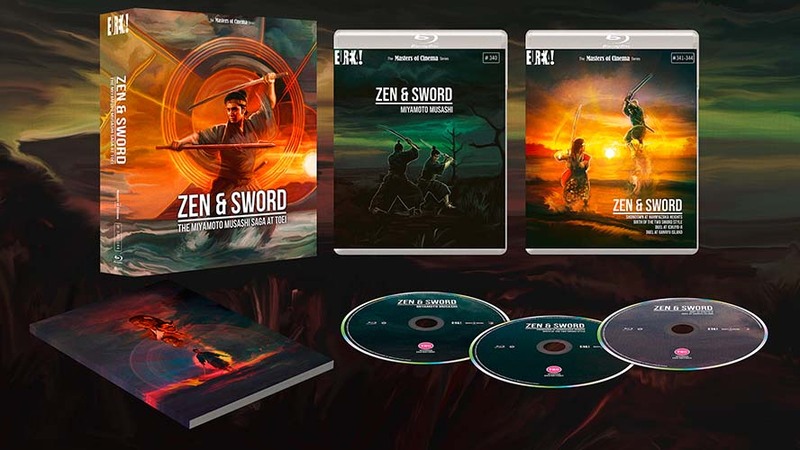
Zen and Sword (Limited Edition Box Set) (Blu-ray)
 –
– 

Genre: Action, Adventure, Historical Drama
Year Released: 1961 / 1962 / 1963 / 1964 / 1965
Runtime: 1h 50m / 1h 46m / 1h 43m / 2h 7m / 2h
Director(s): Tomu Uchida / Tomu Uchida / Tomu Uchida / Tomu Uchida / Tomu Uchida
Writer(s): Eiji Yoshikawa (source novel), screenwriters vary per film
Cast: Kinnosuke Nakamura, Ken Takakura, Wakaba Irie, Rentaro Mikuni, Isao Kimura
Where to Watch: available February 23, 2026. Pre-order your copy here: www.eurekavideo.co.uk
RAVING REVIEW: What does it mean for a legend to be built slowly, through repetition, restraint, and time rather than immediacy or excess? Tomu Uchida’s five-film adaptation of Eiji Yoshikawa’s novelized account of Miyamoto Musashi doesn’t aim to overwhelm, and it doesn’t chase grandeur through constant escalation. Instead, the ZEN & SWORD cycle commits to patience, allowing its central figure to evolve incrementally across years, not hours. That choice defines both the strength and the limitation of the saga, especially when experienced as a complete body of work rather than as individual entries spaced apart by theatrical release windows.
The first film, MIYAMOTO MUSASHI, establishes its tone early. Kinnosuke Nakamura’s performance is deliberately guarded, almost withholding, presenting Musashi less as a romanticized warrior and more as a restless presence still searching for definition. Uchida directs with clarity rather than flourish, grounding the early sections in aftermath and consequence rather than heroic ascent. The film functions as an origin story only in the loosest sense. It’s less concerned with explaining Musashi’s abilities than with showing how little control he has over his own trajectory at this stage. As an opening chapter, it’s solid and purposeful, but also intentionally subdued, setting expectations for a saga that values accumulation.
MIYAMOTO MUSASHI II: SHOWDOWN AT HANNYAZAKA HEIGHTS deepens that approach rather than expanding it. Where a lesser series might lean harder into spectacle at this point, Uchida instead narrows the focus, emphasizing isolation and discipline. The conflicts feel less like set pieces and more like interruptions to Musashi’s recalibration. Nakamura’s physicality becomes more precise here, not flashier, suggesting growth through control rather than dominance. This second entry benefits from stronger momentum than the first, even as it continues to resist conventional pacing expectations.
The third installment, MIYAMOTO MUSASHI III: BIRTH OF THE TWO SWORD STYLE, is where the saga begins to stick together thematically. The introduction of Ken Takakura’s Kojiro Sasaki shifts the balance, finally giving Musashi a counterpart who feels less symbolic and more genuinely oppositional. Takakura’s presence injects a different energy into the series, sharper and more performative, creating contrast without tipping the films into melodrama. This chapter arguably represents the saga’s strongest standalone entry, not because it’s louder or faster, but because its ideas crystallize clearly. Musashi’s philosophy, still forming, now has something concrete to push against.
By the time MIYAMOTO MUSASHI IV: DUEL AT ICHIJYO-JI arrives, the series is comfortable with its own cadence, for better and worse. The extended runtime allows for more reflection, but it also exposes the limitations of Uchida’s restrained approach. Some sequences linger, and the cumulative repetition of thematic ideas begins to test patience. That said, the film’s emotion benefits from the groundwork laid by its predecessors. Moments that might feel understated in isolation carry added resonance here simply because of the time spent with these characters.
The final chapter, MIYAMOTO MUSASHI V: DUEL AT GANRYU ISLAND, delivers the confrontation that the entire saga has been quietly circling. Rather than presenting it as a pretentious culmination, Uchida frames the duel as an inevitability shaped by years of restraint and refusal. The result is effective, even if some viewers may expect more overt emotional release. The payoff isn’t about victory so much as resolution. While that choice aligns with the saga’s philosophy, it also reinforces the sense that this is a series that asks more from its audience than it gives back in the conventional sense.
Viewed together as one saga, ZEN & SWORD stands as a thoughtful, sometimes frustrating, often rewarding chronicle of myth-making through discipline rather than dramatization. Uchida’s direction remains consistent across all five films, which is both admirable and limiting. The series rarely reaches moments of undeniable transcendence, but it also never collapses under its own ambition. Nakamura’s performance anchors the saga with a specific authority, while Takakura’s limited but impactful presence prevents the narrative from becoming insular.
As a complete experience, the set benefits enormously from being watched as a unified whole rather than sampled piecemeal. The Masters of Cinema presentation reinforces that intention, positioning the films not as isolated classics but as components of a long-form character study. The saga’s deliberate pacing and refusal to indulge in heightened drama mean it won’t resonate equally with all viewers, even those well-versed in samurai cinema.
ZEN & SWORD earns its place alongside other major genre sagas of its era through commitment and coherence rather than innovation. It’s a series that respects its audience’s patience, sometimes perhaps too much, but rewards attentiveness with depth, consistency, and a rare sense of earned resolution.
Please visit https://linktr.ee/overlyhonestr for more reviews.
You can follow me on Letterboxd, Instagram, Twitter, and YouTube. My social media accounts can also be found on most platforms by searching for 'Overly Honest Reviews'.
I’m always happy to hear from my readers; please don't hesitate to say hello or send me any questions about movies.
[photo courtesy of EUREKA ENTERTAINMENT]
DISCLAIMER:
At Overly Honest Movie Reviews, we value honesty and transparency. Occasionally, we receive complimentary items for review, including DVDs, Blu-rays, CDs, Vinyl Records, Books, and more. We assure you that these arrangements do not influence our reviews, as we are committed to providing unbiased and sincere evaluations. We aim to help you make informed entertainment choices regardless of our relationship with distributors or producers.
Amazon Affiliate Links:
Additionally, this site contains Amazon affiliate links. If you purchase through these links, we may receive a commission. This affiliate arrangement does not affect our commitment to honest reviews and helps support our site. We appreciate your trust and support as you navigate these links.


Happy
0 %

Sad
0 %

Excited
0 %

Sleepy
0 %

Angry
0 %

Surprise
0 %
 0
0
 0
0


Average Rating