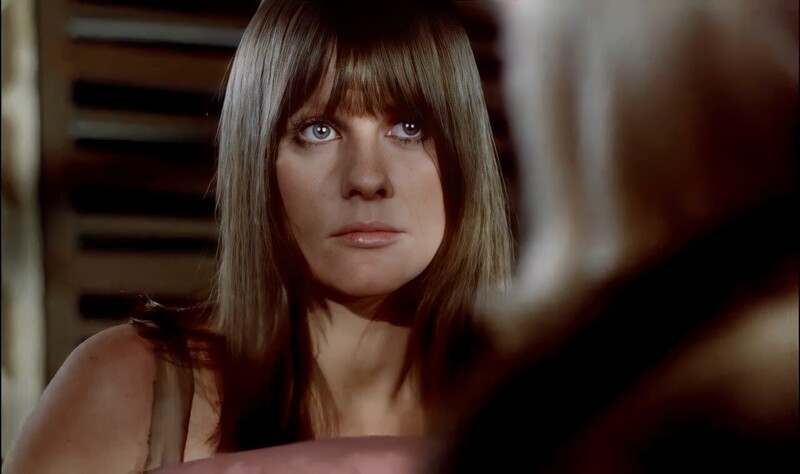
An Exploitative Experiment That Almost Works Perfectly
Read Time:4 Minute, 40 Second
MOVIE REVIEWS
The Flesh & Blood Show
 –
– 


Genre: Horror, Slasher, Mystery
Year Released: 1972, Kino Blu-ray 2026
Runtime: 96m
Director: Pete Walker
Writer: Alfred Shaughnessy
Cast: Ray Brooks, Jenny Hanley, Luan Peters, Robin Askwith, Candace Glendenning
Where to Watch: available now, order your copy here: www.kinolorber.com or www.amazon.com
RAVING REVIEW: THE FLESH AND BLOOD SHOW sits at a crossroads, not just within British horror, but within Pete Walker’s own career. By 1972, Walker was attempting to pivot away from softcore comedies toward something darker and more enduring. What he delivered here is less a fully formed slasher and more a transitional experiment, offering up part sexploitation relic, part proto-giallo, part whodunit, part generational allegory.
The premise is familiar. A group of young actors gathers in an abandoned seaside theatre to rehearse a stage production. The location is isolated, decaying, heavy with history. Before long, members of the cast begin disappearing. The director swears he saw a decapitated corpse in the basement, and of course, only for it to vanish when the police arrive. The stage is set for paranoia, suspicion, and revelation.
What distinguishes the film isn’t its plot mechanics, which are heavily indebted to Agatha Christie-style structure, but also its atmosphere. The seaside setting in Cromer, shot out of season, gives the film an eerie, wind-swept melancholy. The empty pier theatre becomes more than a backdrop; it becomes symbolic. It’s a relic of an older England, creaking under the weight of modern indulgence and cultural change.
Walker is clearly interested in that clash. The young performers are sexually liberated, irreverent, loud, and occasionally obnoxious. They aren’t the moral cautionary archetypes later slasher films would codify, but they do embody a shift. The antagonist represents something else entirely, the ideas of repression, obsession, and unresolved trauma tied to the theatre’s past. That thematic overlay is the film’s strongest asset.
There is considerably more flesh than blood. Nudity is frequent and often unnecessary, something Walker himself later admitted was commercially motivated. The whiplash between exploitative and attempted psychological tension weakens the horror at the center. Instead of building sustained dread, the film drifts in and out of atmosphere.
When Walker focuses on suspense, the results are effective. A nighttime seaside stalking sequence, featuring a masked figure inching closer on a bench, is genuinely anxiety-inducing. The dark, cluttered theatre interiors create spatial uncertainty. Walker often shoots deep into shadow, limiting clarity in a way that mirrors the characters’ confusion. The violence itself is restrained. This isn’t a showcase for blood (despite the title). Most killings are implied rather than depicted. The title promises carnage; the film delivers suggestion. (which works here)
The final act introduces a brief 3D sequence, a marketing gimmick more than a necessity. In hindsight, it feels like the last remnant of Walker’s earlier commercial ideas intruding on a film that’s trying to evolve beyond them.
Performances are serviceable across the board. Ray Brooks carries the narrative as the increasingly rattled director. Jenny Hanley and Luan Peters provide presence and, frequently, exposure. Patrick Barr’s late-film revelation injects some gravitas into what might otherwise feel purely procedural. Historically, the film is far more interesting than it is thrilling.
As an early 1970s British proto-slasher, it predates the American boom that would become the genre-defining era. It shows how the genre was gestating outside the U.S. It also foreshadows Walker’s more cohesive horror entries, like FRIGHTMARE, in which he fully integrates social commentary with brutality.
Viewed today, THE FLESH AND BLOOD SHOW feels like a rehearsal itself, with a director testing the boundaries between exploitation and serious horror. It never quite commits to either side. It’s uneven. It’s indulgent. It’s thematically richer than its surface suggests. And it’s more compelling as a career turning point than as a standalone shocker. Another solid entry in the Kino Cult lineup that’s never afraid to share some of the more unique experiments in cult history.
Product Extras:
Audio Commentary by Film Historians Kat Ellinger and Martyn Conterio
Flesh, Blood, and Censorship, an Interview with Pete Walker, by Elijah Drenner
Interviews with Actress Jenny Hanley, Actor Stewart Bevan, and Third Assistant Director Terry Madden, by James McCabe
Theatrical Trailer
Radio Spot
Please visit https://linktr.ee/overlyhonestr for more reviews.
You can follow me on Letterboxd, Instagram, Twitter, and YouTube. My social media accounts can also be found on most platforms by searching for 'Overly Honest Reviews'.
I’m always happy to hear from my readers; please don't hesitate to say hello or send me any questions about movies.
[photo courtesy of KINO LORBER, KINO CULT]
DISCLAIMER:
At Overly Honest Movie Reviews, we value honesty and transparency. Occasionally, we receive complimentary items for review, including DVDs, Blu-rays, CDs, Vinyl Records, Books, and more. We assure you that these arrangements do not influence our reviews, as we are committed to providing unbiased and sincere evaluations. We aim to help you make informed entertainment choices regardless of our relationship with distributors or producers.
Amazon Affiliate Links:
Additionally, this site contains Amazon affiliate links. If you purchase through these links, we may receive a commission. This affiliate arrangement does not affect our commitment to honest reviews and helps support our site. We appreciate your trust and support as you navigate these links.


Happy
0 %

Sad
0 %

Excited
0 %

Sleepy
0 %

Angry
0 %

Surprise
0 %
 0
0
 0
0



Average Rating