Children Learning What Danger Looks Like
Read Time:5 Minute, 46 Second
MOVIE REVIEW
Timestamp
 –
– 

Genre: Documentary, Observational, War
Year Released: 2025
Runtime: 2h 05m
Director(s): Kateryna Gornostai
Where to Watch: available on Digital/VOD December 19, 2025
RAVING REVIEW: TIMESTAMP is constructed without narration, interviews, or commentary, yet there is not a moment when the film feels silent. On the surface, it documents school life in Ukraine during the ongoing Russian invasion. That premise alone would suggest something direct and investigative, a chronicle of crisis through the eyes of children and teachers. Instead, the film achieves something more: it captures the persistence of the ordinary while the extraordinary becomes constant. Every scene appears calm, but danger is never more than a siren away. The documentary’s design makes normalcy feel like an act of resistance.
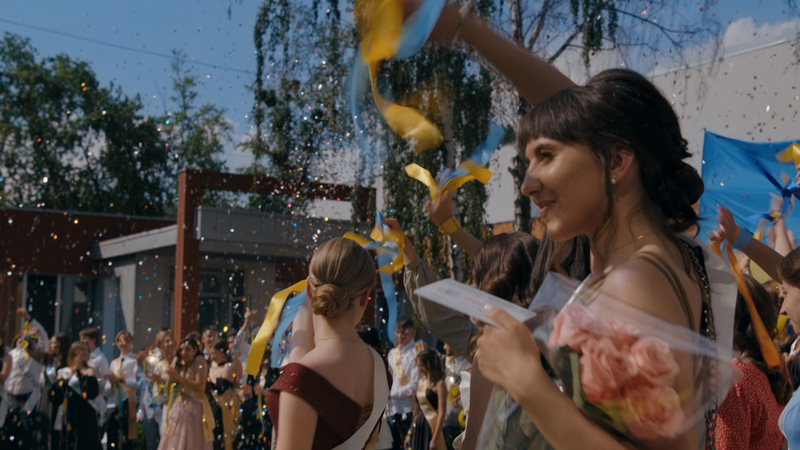
The title comes from a medical practice. In battlefield care, a timestamp is written on a tourniquet to record when it was applied so that the limb can be saved. Gornostai’s statement reveals the metaphor: children now learn this procedure in school. The timestamp marks a moment when a life is being preserved. The film uses this idea more subtly. It marks moments of childhood that could easily disappear under the weight of war. A ceremony. A student dressed as Santa. A graduation with ribbons held high. These are episodes that would be unremarkable in any other country. Here, each one is political by its very existence.
The film is structured like a mosaic. It moves across different regions of Ukraine: schools near the front line, schools in cities that live with intermittent alarms, and schools where lessons take place underground. The geography isn’t labeled, because the point isn’t to map the war. It is to show that every school is affected, regardless of distance from the front. One principal walks the camera through a destroyed wing of her building, a wall sealed by plywood and tape. Children pass through the hall next door on their way to class. The image says everything the film never verbalizes: war erases spaces faster than people can rebuild, yet the day continues.
Because the film refuses traditional structure, the arc develops through accumulation. One scene shows students rehearsing a performance with the instinctive excitement of youth. Another shows children lining up during an alert, turning the walk to a bunker into a routine. A teacher explains equations outdoors to a laptop, broadcasting her class to students displaced in Europe. The contrast is never underlined, but the viewer can feel it. A childhood split in two: one half digital, the other grounded under the threat of artillery that may never arrive, but must always be expected.
Gornostai’s approach has clarity. She does not want to show death, destruction, and loss only as spectacle. She wants to show life and how it continues, fractured, adapted, and reshaped. The film avoids exploitation by refusing to isolate tragedy, and instead shows it in continuity with joy. Children cry on the first day of school. Teachers talk about attendance. Students decorate halls. Without context, these scenes could belong to any school anywhere. With context, they become a portrait of courage without the need for heroism.
The slow pace isn’t accidental. It mirrors the days themselves: full of tasks, punctuated by procedure, always aware of danger but not defined by it. The film’s patience is key. It shows the work required to maintain normalcy rather than simply asserting its existence. There are moments where the observational approach lands with surprising emotional weight. A child learns to identify objects as “safe” or “dangerous” by pointing at pictures. A teddy bear ripped open to reveal a bomb—a doll labeled safe. The lesson is delivered with kindness, but it is heartbreaking because of its necessity. In another scene, a bell rings at an online graduation. The bell was rescued from Bakhmut. It is a symbol of a school that no longer exists, repurposed to celebrate a class that survived the disappearance of everything. The film doesn’t pause to explain the significance. It assumes the audience understands the meaning of an object rescued from occupation.
TIMESTAMP also captures something rarely seen in war documentaries: teachers becoming infrastructure. They manage fear like logistics. They turn basements into classrooms, playgrounds into evacuation drills, and Zoom into a bridge between scattered communities. The work is invisible outside the frame, but the camera makes it visible. Education becomes a form of civil defense. Each lesson reinforces the idea that the country has a future worth preparing for. The emotional resonance comes from contradiction. Children learn to hold onto innocence while learning survival. Teachers celebrate milestones while memorizing evacuation maps. The film shows that war creates fractures across generations, but it also shows how adults conspire to hold those fractures together with rituals that feel small until they disappear.
What lingers is the feeling of a country trying to protect a future that cannot be guaranteed. The film ends without triumph or defeat. It ends with routine. A class, a bell, a hallway, a lesson. Moments marked like timestamps: fragile, necessary, preserved. The absence of commentary becomes its own argument. The audience is not told what to feel. Instead, the time spent in these schools creates empathy through contact.
TIMESTAMP is a powerful documentary not because it shocks, but because it refuses to reduce children and teachers to symbols. It watches them. It watches them adjust. It watches them protect each other. In doing so, it reminds the viewer that war is not always visible. Sometimes it is a classroom, a bell from a ruined town, and the persistence of a lesson that will matter long after alarms stop.
Please visit https://linktr.ee/overlyhonestr for more reviews.
You can follow me on Letterboxd, Instagram, Twitter, and YouTube. My social media accounts can also be found on most platforms by searching for 'Overly Honest Reviews'.
I’m always happy to hear from my readers; please don't hesitate to say hello or send me any questions about movies.
[photo courtesy of 2BRAVE PRODUCTIONS, CINÉPHAGE PRODUCTIONS, RINKEL FILM, A_BAHN, KIMSTIM FILMS]
DISCLAIMER:
At Overly Honest Movie Reviews, we value honesty and transparency. Occasionally, we receive complimentary items for review, including DVDs, Blu-rays, CDs, Vinyl Records, Books, and more. We assure you that these arrangements do not influence our reviews, as we are committed to providing unbiased and sincere evaluations. We aim to help you make informed entertainment choices regardless of our relationship with distributors or producers.
Amazon Affiliate Links:
Additionally, this site contains Amazon affiliate links. If you purchase through these links, we may receive a commission. This affiliate arrangement does not affect our commitment to honest reviews and helps support our site. We appreciate your trust and support as you navigate these links.


Happy
0 %

Sad
0 %

Excited
0 %

Sleepy
0 %

Angry
0 %

Surprise
0 %
 0
0
 0
0


Average Rating