Control Disguised As Comfort
Read Time:5 Minute, 30 Second
MOVIE REVIEW
Dooba Dooba
 –
– 


Genre: Horror
Year Released: 2026
Runtime: 1h 15m
Director(s): Ehrland Hollingsworth
Writer(s): Ehrland Hollingsworth
Cast: Amna Vegha, Betsy Sligh, Erin O’Meara, Winston Haynes, Billy Hulsey
Where to Watch: in select theaters and on digital platforms January 23, 2026
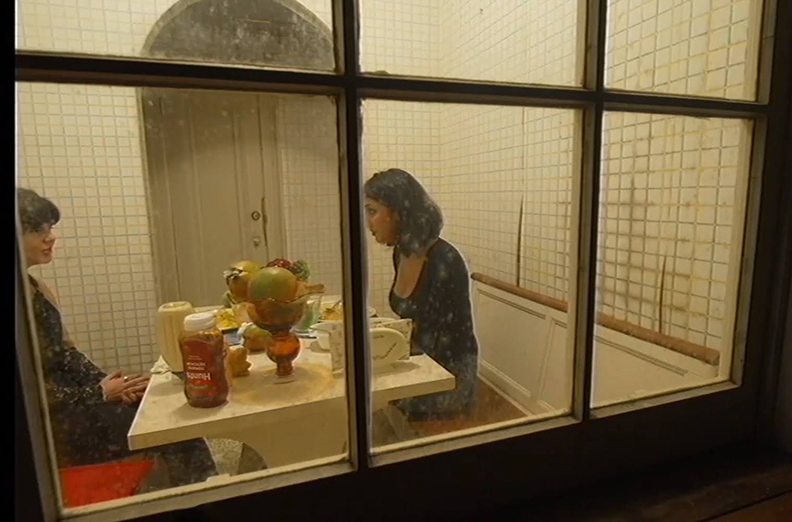
RAVING REVIEW: How much control are you willing to surrender if someone promises it will keep you safe? DOOBA DOOBA opens with that unsettling question and then builds an entire film around the discomfort of never knowing who is in charge of the situation you’re watching. Framed entirely through in-home security cameras and rooted in the analog/found footage horror tradition, the film doesn’t try to make you feel welcome. It wants you disoriented, unsure, and constantly second-guessing what you’re seeing and why you’re being allowed to see it at all.
At its most basic level, DOOBA DOOBA is a self-contained babysitting nightmare, but the setup's simplicity is deceptive. The film understands that found footage doesn’t need escalation through exhibition; it needs erosion. Scene by scene, it chips away at the viewer’s sense of normalcy until every moment feels suspicious. By locking the perspective to static, impersonal cameras, the film removes the safety net of traditional visual storytelling. There is no guiding hand telling you where to look or how to feel. You’re left watching like a witness who shouldn’t be there.
Amna Vegha carries the film with a performance built on restraint rather than panic. Her character never comes across as exaggerated; she feels like someone trying to stay polite, professional, and calm in a situation where something clearly is wrong, but she’s not sure yet what it is. That approach is crucial. The horror only works because Amna behaves like a real person would, balancing discomfort rather than fleeing from it. Each decision feels like something someone might talk themselves into, which makes the eventual imbalance hit all the harder.
Betsy Sligh’s performance is where the film takes some bigger risks. The character walks a narrow line between vulnerability and menace, and the film refuses to label her too quickly. Sligh avoids the common tells, keeping her intentions clouded in a way that’s far more unsettling than overt aggression. The audience is constantly recalibrating how to read her, which mirrors Amna’s experience inside the house. The film understands that ambiguity can be scarier than clarity, especially when control is the central theme.
One of DOOBA DOOBA’s best choices is its refusal to justify its own presentation. The footage glitches, cuts, and encroaches with fragments that don’t always make their purpose clear. Instead of explaining these interruptions, the film lets them exist as part of the experience. That choice won’t work for everyone, but it aligns perfectly with the film’s worldview. This is a story about systems that observe people without empathy; of course, the footage doesn’t care if you’re confused.
The analog horror influence is unmistakable, but the film isn’t content to simply imitate the aesthetic. It uses the rigidity of security cameras to explore power dynamics within the home. Who placed these cameras, who monitors them, and who understands how to manipulate them becomes a quiet but persistent source of tension. The audience is given information that the characters aren’t, which creates a constant feeling of dread rather than surprise. You’re not waiting for something to jump out; you’re waiting for someone to realize they’ve already lost control.
Where DOOBA DOOBA occasionally stumbles is in its commitment to its own minimalism. The film’s dedication to atmosphere means that some narratives remain intentionally underdeveloped. For viewers onboard with the experience-first approach, that ambiguity will feel purposeful. For others, it may feel like potential left unexplored. There are moments when the film hints at deeper thematic or character exploration but doesn’t quite push them as far as it could, opting instead to maintain its mood rather than sharpen its conclusions.
At the same time, the restraint is also part of what keeps the film from overstaying its welcome. At just over 75 minutes, DOOBA DOOBA understands exactly how long it can sustain its tension without diluting its effect. It doesn’t pad its runtime or chase a deeper ending. When the film concludes, it leaves you unsettled, which feels appropriate given its preoccupation with unresolved control and observation.
DOOBA DOOBA isn’t interested in broad appeal or even easy scares. It’s designed for viewers willing to sit in discomfort and let the atmosphere do the heavy lifting. It asks you to accept that horror doesn’t always need to give you a clean cut final product; sometimes it just sits in the corner of the frame, waiting to be acknowledged.
DOOBA DOOBA is a confident genre experiment that doesn’t always transcend its influences but uses them purposefully. It won’t convert skeptics of found footage horror, but for those who already appreciate the genre, it offers something genuinely unsettling and thoughtfully constructed. It’s a film that knows exactly what it wants to be, and more importantly, knows what it doesn’t need to explain.
Please visit https://linktr.ee/overlyhonestr for more reviews.
You can follow me on Letterboxd, Instagram, Twitter, and YouTube. My social media accounts can also be found on most platforms by searching for 'Overly Honest Reviews'.
I’m always happy to hear from my readers; please don't hesitate to say hello or send me any questions about movies.
[photo courtesy of DARK SKY FILMS]
DISCLAIMER:
At Overly Honest Movie Reviews, we value honesty and transparency. Occasionally, we receive complimentary items for review, including DVDs, Blu-rays, CDs, Vinyl Records, Books, and more. We assure you that these arrangements do not influence our reviews, as we are committed to providing unbiased and sincere evaluations. We aim to help you make informed entertainment choices regardless of our relationship with distributors or producers.
Amazon Affiliate Links:
Additionally, this site contains Amazon affiliate links. If you purchase through these links, we may receive a commission. This affiliate arrangement does not affect our commitment to honest reviews and helps support our site. We appreciate your trust and support as you navigate these links.


Happy
0 %

Sad
0 %

Excited
0 %

Sleepy
0 %

Angry
0 %

Surprise
0 %
 0
0
 0
0

Average Rating