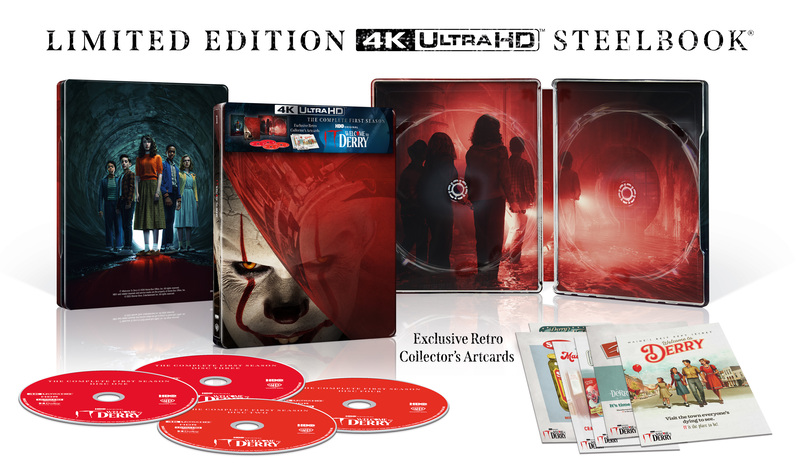
Derry Was Already Broken Before
Read Time:5 Minute, 37 Second
TV SERIES REVIEW
IT: Welcome to Derry
 –
– 

Genre: Horror, Drama, Mystery
Year Released: 2025, Physical release 2026
Runtime: 8 x 45m episodes (8 hours 30 minutes including bonus content)
Created by: Andy Muschietti, Barbara Muschietti, Jason Fuchs
Cast: Bill Skarsgård, Jovan Adepo, Taylour Paige, Chris Chalk, James Remar
Where to Watch: available May 5, 2026, pre-order your copy here: www.amazon.com
RAVING REVIEW: There’s a moment early on, before the story really settles in, where the camera lingers just a little too long on an ordinary street in Derry. Nothing jumps out. There's no sudden scare. No clown in sight. But something feels off anyway. That unease sticks with you, and it ends up defining the entire season more than any single appearance from Pennywise. That choice says everything about what this series is trying to do.
Instead of chasing the immediate payoff of fear, IT: WELCOME TO DERRY builds a case for it. It treats the town like a crime scene that’s been rotting for decades, layering small, human details until the horror starts to feel less like an invasion and more like a symptom. And for a while, that restraint works better than expected.
The 1962 setting isn’t just aesthetic dressing. The show leans into it, with social tension, paranoia, and institutions that look stable on the surface but are already cracking underneath. The military subplot, which could have easily felt like filler, feeds into that larger concept. People try to control something they don’t understand while ignoring the damage already done. It gives the season a wider frame than the films ever had, even if it occasionally pulls focus away from the core story.
What’s interesting is how long the show holds Pennywise at a distance. Not absent, never really at least, but withheld. The presence is there from the start, shifting forms and slipping into corners of scenes, but the familiar version of the character is treated like something the show has to earn. When it finally leans into that iconography, it lands harder because of the wait.
Bill Skarsgård doesn’t overplay it either. He doesn’t need to. There’s a confidence in how little the show asks from him early on. When he does step forward, it feels less like a performance ramping up and more like something finally revealing. But the tradeoff for that slow build is inconsistency. The structure splits attention between multiple storylines, kids, families, and the military, and not all of them carry the same intensity. Some characters feel more fleshed out, while others hover closer to placeholders. You can feel the show reaching for a broader portrait of Derry, but that expansion comes at the cost of focus. There are stretches where the story drifts, not because nothing is happening, but because it’s happening in too many directions at once.
That unevenness shows up in the pacing. The first half moves cautiously, almost testing how long it can delay. Then the back half tightens, and suddenly the show clicks into place. Episodes start to connect. Tension builds faster and faster instead of reseting. By the time it reaches its final stretch, there’s a sense of control that wasn’t always there earlier.
One episode in particular, the Black Spot storyline, hits with a significance the rest of the season occasionally circles but doesn’t always reach. It’s direct, grounded, and uncomfortable in a way that cuts deeper than the supernatural elements. It’s also where the show’s central focus becomes clearest. Derry doesn’t just house evil; it participates in it.
What the show understands, more than it always executes, is that fear here isn’t about surprise. It’s about accumulation. The sense that something has been wrong for a long time, and nobody has stopped it. That idea carries the season through its rougher patches. What gives the series real pressure within the larger Pennywise mythology is how it stops treating the creature as the starting point of fear and instead reframes it as something sustained, almost enabled, by everything around it. The films positioned Pennywise as a recurring nightmare. This pushes further back and asks why that nightmare keeps working. By tying the entity to cycles of violence, buried history, and collective denial, the show expands the mythology without overexplaining it. It doesn’t strip away the mystery; it thickens it. The idea that Derry isn’t just a hunting ground but an active participant in the cycle makes the mythology feel less like a monster story and more like a system that resets itself every generation. That shift matters. It gives the prequel a reason to exist beyond filling gaps, grounding Pennywise in something larger than a single form or era, and reinforcing the unsettling notion that the real horror isn’t just that IT returns, it’s that Derry always makes room for it.
By the end, IT: WELCOME TO DERRY doesn’t feel complete so much as established. It’s laid the groundwork, sometimes messily, sometimes impressively, but clearly with a longer plan in mind. Some characters need more depth. Some ideas need tightening. But when it works, it taps into something the films only brushed against, the quiet, generational damage that makes a place like Derry possible in the first place. The clown may be the hook. The town is the story.
Please visit https://linktr.ee/overlyhonestr for more reviews.
You can follow me on Letterboxd, Instagram, Twitter, and YouTube. My social media accounts can also be found on most platforms by searching for 'Overly Honest Reviews'.
I’m always happy to hear from my readers; please don't hesitate to say hello or send me any questions about movies.
[photo courtesy of WARNER BROS. DISCOVERY HOME ENTERTAINMENT]
DISCLAIMER:
At Overly Honest Movie Reviews, we value honesty and transparency. Occasionally, we receive complimentary items for review, including DVDs, Blu-rays, CDs, Vinyl Records, Books, and more. We assure you that these arrangements do not influence our reviews, as we are committed to providing unbiased and sincere evaluations. We aim to help you make informed entertainment choices regardless of our relationship with distributors or producers.
Amazon Affiliate Links:
Additionally, this site contains Amazon affiliate links. If you purchase through these links, we may receive a commission. This affiliate arrangement does not affect our commitment to honest reviews and helps support our site. We appreciate your trust and support as you navigate these links.


Happy
0 %

Sad
0 %

Excited
0 %

Sleepy
0 %

Angry
0 %

Surprise
0 %
 0
0
 0
0

Average Rating