Home As an Idea That Keeps Receding
Read Time:5 Minute, 19 Second
MOVIE REVIEWS
A Russian Winter (Un hiver russe)
 –
– 


Genre: Documentary
Year Released: 2026
Runtime: 1h 27m
Director(s): Patric Chiha
Where to Watch: shown at the 2026 Berlin International Film Festival
RAVING REVIEW: What happens after you refuse to become what your country demands of you, and where do you go when that refusal costs you everything? That question hangs over A RUSSIAN WINTER from the beginning, not as a rhetorical device, but as a lived condition. Patric Chiha doesn’t frame his documentary around shock, urgency, or outrage. Instead, he situates the film in a colder, more unsettling space, the long emotional winter that follows a decision when there is no clear reward for doing the right thing.
Set in the wake of Russia’s full-scale invasion of Ukraine, the film follows Margarita, Yuri, and a small circle of friends who chose exile over military service or prison. This isn’t a story about escape as liberation. Chiha is far more interested in what comes after the plane lands, after the border is crossed, after the initial relief wears off. His subjects exist in a suspended state, unable to return home, yet never fully belonging anywhere else. They’re physically safe, but emotionally unmoored, caught between a past they can no longer inhabit and a future that refuses to take shape.
Chiha’s approach is deliberately restrained. There are no talking heads delivering grand political statements, no archival montages designed to contextualize history for the audience. The invasion is ever-present, but it exists as pressure rather than spectacle. Conversations drift toward uncertainty, guilt, longing, and frustration. The film trusts the audience to understand the stakes without being instructed on how to feel. That trust becomes one of A RUSSIAN WINTER’s greatest strengths.
What makes the film especially effective is its refusal to frame exile as heroic. These aren’t portraits of triumphant dissidents building new lives abroad. The emotional reality is far messier. There is shame in surviving when others can’t leave. There is resentment toward countries that offer safety without belonging. There is exhaustion from having to explain yourself over and over, to justify your absence, to prove your refusal was meaningful. Chiha allows these contradictions to coexist without judgment.
The documentary’s pacing mirrors the experience it depicts. Time stretches. Moments repeat. Conversations circle the same unresolved questions. For some viewers, this may feel deliberately slow or even frustrating. That reaction feels intentional. A RUSSIAN WINTER isn’t interested in momentum because its subjects have none. Their lives are defined by waiting, and the film asks the audience to sit with them in that waiting.
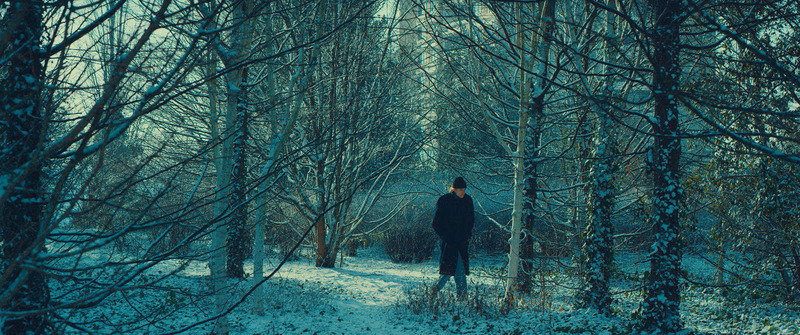
The film maintains a subdued palette that reinforces its tone without overreaching into symbolism. Cinematographer Céline Bozon captures spaces that feel temporary and impersonal, apartments that don’t yet feel lived in, streets that could belong to almost any European city. This anonymity underscores the film’s central idea, that exile flattens. Everywhere looks like somewhere you do not belong.
Sound and music are used sparingly, never pushing scenes toward manufactured emotion. Composer Youri Nosenko’s contributions sit quietly beneath the surface, adding texture rather than emphasis. Silence often does more work than score, allowing pauses, unfinished thoughts, and uncomfortable gaps to speak for themselves.
What A RUSSIAN WINTER does especially well is resist the temptation to universalize its subjects too quickly. While the film clearly speaks to a broader generation displaced by authoritarianism and war, it never turns its participants into symbols. Margarita and Yuri remain specific people with specific contradictions, not avatars for a political thesis. That specificity gives the film its emotional weight. At the same time, Chiha is careful not to let the documentary drift into passivity. The film understands that choosing exile is itself an act with consequences. The refusal to comply does not end the story; it begins a new one shaped by loss, uncertainty, and the slow erosion of identity.
Seen as part of Chiha’s broader body of work, the film represents a continuation rather than a departure. He remains drawn to people living at the margins of societal expectations, navigating identities that don’t fit neatly into categories. Here, that interest intersects with one of the defining geopolitical crises of the present moment, giving the film an urgency that never overwhelms its intimacy.
A RUSSIAN WINTER ultimately leaves you with a quiet, lingering unease rather than a sense of closure. It doesn’t tell you what comes next for its subjects because they don’t know themselves. That uncertainty is the point. The film understands that exile is not a single event but an ongoing condition, reshaping how you see home, responsibility, and the future.
As an experience, this is a strong, thoughtful documentary that prioritizes emotional honesty over immediacy. It’s not designed to provoke applause or outrage. It is designed to sit with you, to ask uncomfortable questions, and to refuse easy answers. In doing so, it earns its place as one of the more quietly impactful festival documentaries of the year.
Please visit https://linktr.ee/overlyhonestr for more reviews.
You can follow me on Letterboxd, Instagram, Twitter, and YouTube. My social media accounts can also be found on most platforms by searching for 'Overly Honest Reviews'.
I’m always happy to hear from my readers; please don't hesitate to say hello or send me any questions about movies.
[photo courtesy of AURORA FILMS, LE FRESNOY – STUDIO NATIONAL DES ARTS CONTEMPORAINS, BEST FRIEND FOREVER, THE PR FACTORY]
DISCLAIMER:
At Overly Honest Movie Reviews, we value honesty and transparency. Occasionally, we receive complimentary items for review, including DVDs, Blu-rays, CDs, Vinyl Records, Books, and more. We assure you that these arrangements do not influence our reviews, as we are committed to providing unbiased and sincere evaluations. We aim to help you make informed entertainment choices regardless of our relationship with distributors or producers.
Amazon Affiliate Links:
Additionally, this site contains Amazon affiliate links. If you purchase through these links, we may receive a commission. This affiliate arrangement does not affect our commitment to honest reviews and helps support our site. We appreciate your trust and support as you navigate these links.


Happy
0 %

Sad
0 %

Excited
0 %

Sleepy
0 %

Angry
0 %

Surprise
0 %
 0
0
 0
0


Average Rating