Kink, but Make It Mass Market
Read Time:7 Minute, 21 Second
MOVIE REVIEW
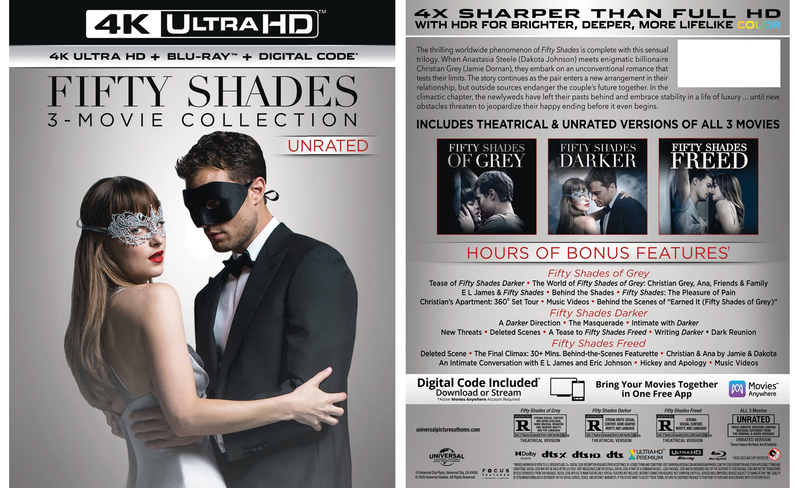
Fifty Shades: 3-Movie Collection
 –
– 

 / /
/ /
Genre: Drama, Romance
Year Released: 2015 / 2017 / 2018, 2026 4K Collection
Runtime: 372 minutes
Director(s): Sam Taylor-Johnson / James Foley
Writer(s): Kelly Marcel / Niall Leonard / E.L. James
Cast: Dakota Johnson, Jamie Dornan, Jennifer Ehle, Rita Ora, Luke Grimes, Marcia Gay Harden, Eloise Mumford
Where to Watch: available February 3, 2026, pre-order your copy here: www.moviezyng.com or www.amazon.com
RAVING REVIEW: What happens when an explicit phenomenon is filtered through the mechanism of a major Hollywood studio, flattened into a palatable fantasy, and then asked to carry the weight of an entire culture’s unresolved hang-ups about sex, power, and desire? That question defines FIFTY SHADES: 3-MOVIE COLLECTION.
Seen together, away from the noise, the jokes, and the decade of think-pieces about why the films shouldn’t have existed, the Fifty Shades trilogy plays less like a scandal and more like a case study. These films are not misunderstood masterpieces, but they are far more intentional and coherent than their reputation suggests. They know exactly who they are for, what they are selling, and how much they can safely show without scaring off the audience they’re courting. The kink here isn’t transgression. It’s accessibility.
The first thing that becomes obvious when revisiting all three films back-to-back is that this trilogy is not actually about BDSM. It is about fantasy management. About how far mainstream cinema can flirt with taboo before retreating to safety. About packaging desire in a way that feels daring while never truly relinquishing control. The films are less interested in sex than in atmosphere, status, and power dynamics, which is why they offer a colder, cleaner, and far more restrained experience than their cultural footprint suggests.
That restraint is most effective in FIFTY SHADES OF GREY, the strongest entry by a noticeable margin. Sam Taylor-Johnson’s direction gives the film a controlled, almost clinical visual identity. Glass walls, muted palettes, immaculate interiors, and carefully composed frames dominate the screen. This is a movie that understands that anticipation can be more seductive than explicitness, even if it occasionally overplays its own hand. The erotic buzz in the film isn’t in what’s shown, but in what’s suggested, negotiated, and left unresolved.
Dakota Johnson’s performance as Anastasia Steele is the trilogy’s most consistent asset and the reason the first film works as well as it does. She plays Ana not as naive or as a stand-in for the audience’s fantasy, but as someone who feels and understands the situation’s absurdity and allure in equal measure. Her reactions, pauses, and understated humor ground the film in something human. Johnson understands that Ana’s curiosity is her power, and that shift reframes the dynamic in a way the script often struggles to articulate.
Jamie Dornan’s Christian Grey is more concept than character, and that is by design here. He is wealth, trauma, control, and emotional inaccessibility wrapped in tailored suits and modern architecture. Dornan sells the physicality and presence, but the character’s interiority is deliberately withheld, limiting range while reinforcing the fantasy. Christian is not meant to be relatable. He is intended to be intimidating, curated, and slightly unreal, like the lifestyle he represents.
The film’s Oscar-nominated song placement isn’t incidental. The soundtrack functions as emotional shorthand, providing warmth and sensuality where the visuals deliberately pull back. Music does a tremendous amount of heavy lifting across the trilogy, but nowhere more effectively than here. Without it, Grey would feel even colder. With it, the film finds a measure that allows audiences to project desire onto a carefully neutral canvas.
Where FIFTY SHADES OF GREY succeeds is in its clarity of purpose. It is a gateway fantasy, not an education. It introduces kink as a concept without demanding engagement with its complexities. That limitation is also its appeal. It invites curiosity without obligation, and for its intended audience, that balance works.
FIFTY SHADES DARKER marks a shift in tone that reveals the franchise’s long-term struggle. With James Foley taking over directing duties, the film becomes glossier, louder, and more overtly melodramatic. Ambiguity gives way to escalation. External threats replace internal tension. The film is less interested in Ana’s perspective and more focused on expanding Christian’s backstory and turning conflict into a soap opera spectacle.
This is where the trilogy begins to feel less confident in its own skin. Darker wants to be sexier, more dangerous, and more intense, but it often achieves those goals by simplifying dynamics that were previously more interesting when left undefined. The kink becomes decorative rather than thematic. Power struggles are spelled out instead of implied. The mystery fades, replaced by repetition and plot mechanics that feel more obligatory than organic.
Dakota Johnson remains compelling, even as the script increasingly asks her to carry emotions that feel underdeveloped. Dornan attempts to broaden Christian’s range, with mixed results. The chemistry fluctuates, not because it vanishes entirely, but because the film no longer trusts silence or suggestion to do the work. Everything is louder, shinier, and more insistent, which paradoxically makes it less seductive.
By the time FIFTY SHADES FREED arrives, the trilogy has fully embraced its role as fantasy fulfillment rather than erotic exploration. The film leans into lifestyle porn, genre blending, and heightened stakes that feel only tangentially connected to the intimacy that launched the series. This is the most conventional entry, structured like a glossy romantic thriller with luxury as its primary language.
There is a strange honesty to Freed, even as it becomes increasingly absurd. The film stops pretending it’s pushing boundaries and instead focuses on delivering closure, exhibition, and reassurance. The kink is largely sidelined in favor of wealth, security, and traditional power structures. Desire gives way to ownership. Control becomes domestic. The fantasy resolves into something safer, softer, and far less complicated.
Criticisms about these films being “not erotic enough” miss what they are actually selling. The eroticism here is aspirational, not explicit. It’s about access, exclusivity, and the illusion of choice within carefully defined boundaries. These films are uncomfortable with messiness. They want desire without consequences, danger without risk, and kink without discomfort. That tension defines the entire trilogy.
Watching all three together also highlights how much cultural baggage they’ve been forced to carry. These films became a lightning rod for conversations they were never equipped to handle, nor particularly interested in addressing. Consent, power imbalance, and representation are present, but filtered through the safest possible ways. That is a limitation, but it is also intentional.
As a collection, the films benefit from being seen as a complete arc rather than isolated targets for ridicule. The trajectory from curiosity to glossy melodrama to full fantasy resolution makes sense, even if the execution falters along the way. The 4K presentation underscores how meticulously these films are made. Whatever one thinks of the storytelling, the craftsmanship is rarely sloppy.
FIFTY SHADES: 3-MOVIE COLLECTION works best when approached honestly, without moral panic or ironic detachment. These aren’t great films, but they are not accidents. They are carefully engineered products that reflect mainstream cinema’s ongoing discomfort with adult desire, especially when centered on female curiosity. They flirt, retreat, compromise, and sanitize, but they never pretend to be something else. The kink may be mild, the dialogue occasionally clunky, and the fantasy aggressively curated, but something is revealing in how these films exist, persist, and continue to be discussed. They are about control, yes, but also about who gets to enjoy fantasy without being dismissed for it.
That alone makes them worth revisiting, if not fully surrendering to.
Please visit https://linktr.ee/overlyhonestr for more reviews.
You can follow me on Letterboxd, Instagram, Twitter, and YouTube. My social media accounts can also be found on most platforms by searching for ‘Overly Honest Reviews’.
I’m always happy to hear from my readers; please don’t hesitate to say hello or send me any questions about movies.
[photo courtesy of UNIVERSAL]
DISCLAIMER:
At Overly Honest Movie Reviews, we value honesty and transparency. Occasionally, we receive complimentary items for review, including DVDs, Blu-rays, CDs, Vinyl Records, Books, and more. We assure you that these arrangements do not influence our reviews, as we are committed to providing unbiased and sincere evaluations. We aim to help you make informed entertainment choices regardless of our relationship with distributors or producers.
Amazon Affiliate Links:
Additionally, this site contains Amazon affiliate links. If you purchase through these links, we may receive a commission. This affiliate arrangement does not affect our commitment to honest reviews and helps support our site. We appreciate your trust and support as you navigate these links.


Happy
0 %

Sad
0 %

Excited
0 %

Sleepy
0 %

Angry
0 %

Surprise
0 %
 0
0
 0
0

Average Rating