The Beauty and Violence of Creative Overreach
Read Time:6 Minute, 3 Second
MOVIE REVIEW
Queen Kelly
 –
– 

Genre: Drama, Romance
Year Released: 1929, Milestone / Kino Lorber 4K Reconstruction 2025–2026
Runtime: 1h 41m
Director(s): Erich von Stroheim
Writer(s): Erich von Stroheim, Marian Ainslee, Benjamin Glazer
Cast: Gloria Swanson, Walter Byron, Seena Owen, Tully Marshall
Where to Watch: opens January 16, 2026, at Film Forum
RAVING REVIEW: What do we judge when the film in front of us was never allowed to finish becoming itself? QUEEN KELLY exists in that uncomfortable space between artifact and artwork, a film that cannot be separated from its collapse yet refuses to be dismissed because of it. Any serious engagement with this work has to accept that incompleteness isn’t a defect bolted onto the experience—it’s the experience. What survives is not a tidy narrative, but a raw exposure of ambition colliding with power, ego, censorship, and the end of an entire cinematic era.
From its opening movements, QUEEN KELLY announces Erich von Stroheim’s worldview without hesitation. This is a film obsessed with surfaces and what they conceal: silk gowns hiding rot, royal ceremony masking cruelty, religious devotion coexisting with desire. Stroheim’s camera lingers on objects the way other directors linger on faces, insisting that wealth, ritual, and excess tell the truth before characters ever do. It’s immediately clear why this material made financiers nervous. Nothing here is gentle. Nothing is reassuring. Even romance is treated as something dangerous, a destabilizing force rather than a reward.
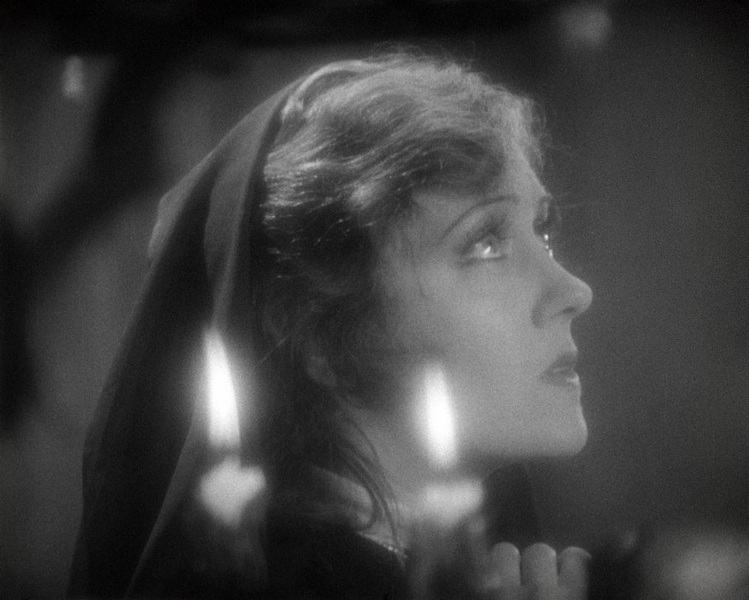
Gloria Swanson’s performance is the emotional anchor that keeps the film from tipping into pure provocation. She plays innocence not as naïveté, but as vulnerability weaponized by the world around her. Her expressions carry an extraordinary range—fear, longing, shame, resolve—often within the same shot. This is not a passive ingénue role, even when the narrative places her in powerless situations. Swanson’s presence constantly pushes against the frame, as if daring the film to follow her somewhere safer, even as Stroheim seems determined to deny that possibility. The tension between star and director becomes visible on screen, and that friction is part of what makes the film so compelling.
Seena Owen’s Queen Regina is deliberately excessive, bordering on grotesque, and that choice feels intentional rather than misguided. Stroheim isn’t interested in psychological subtlety when it comes to power. He wants the monarchy to look obscene, predatory, and unrestrained. Regina’s jealousy isn’t just personal; it’s institutional. She doesn’t merely punish Kelly for betrayal—she asserts ownership over bodies, status, and desire itself. The infamous whipping scene isn’t shocking because of violence alone, but because of how ritualized it is, how calmly it’s framed as an extension of authority rather than an outburst of rage.
The unfinished second half, set in Africa and reconstructed through surviving footage, stills, and intertitles, is where QUEEN KELLY becomes something stranger and more haunting. The narrative momentum fractures, but the thematic throughline sharpens. Innocence doesn’t evolve here; it’s repurposed. Kelly’s displacement into a bordello environment isn’t played as sensationalism for its own sake. It’s presented as the logical endpoint of a system that consumes purity as currency. Stroheim’s obsession with decay—moral, physical, societal—comes into full view, even as the film struggles to hold itself together structurally.
This is where the reconstruction becomes both a gift and a complication. Watching QUEEN KELLY now means constantly shifting between immersion and awareness—between being absorbed in the imagery and being reminded of what’s missing. Still photographs and explanatory titles interrupt the flow, but they also underline the tragedy of what was lost. You’re not just watching a film; you’re watching a process that was violently halted. That awareness never fully disappears, and perhaps it shouldn’t. The film’s power lies partly in that discomfort.
Visually, the surviving footage is astonishing. Stroheim’s control over composition, texture, and spatial hierarchy remains evident even in fragments. Candlelight, shadows, fabric, architecture—all of it contributes to a suffocating sense of ornamentation pressing down on the characters. The excess isn’t decorative; it’s accusatory. Everything in this world is too much, and that “too much” is precisely the point. The film doesn’t collapse under its weight—it exposes it.
At the same time, QUEEN KELLY isn’t immune to criticism. The narrative, even in ideal circumstances, was clearly heading toward extremity rather than balance. Some character motivations verge on symbolic abstraction rather than lived psychology. The reconstructed ending, no matter how thoughtfully assembled, can’t replicate the dramatic cohesion of a finished work. These limitations are real, and pretending otherwise does the film no favors. But they don’t erase its achievement. If anything, they reinforce its position as a boundary-pushing work that Hollywood simply wasn’t equipped to absorb.
Context matters here. This wasn’t just the collapse of a single production—it was the collapse of Stroheim’s directing career and the end of silent cinema’s dominance. QUEEN KELLY stands at that crossroads, embodying both the artistic freedom of the late silent era and the industrial clampdown that followed. It’s impossible to watch without sensing the doors closing around it. The film doesn’t fade out so much as it’s cut off mid-breath.
QUEEN KELLY earns its place not because it’s complete, but because what survives is too potent to ignore. This is cinema as evidence of ambition, of conflict, of an artist unwilling to dilute his vision and an industry reluctant to accommodate it. It’s frustrating, mesmerizing, flawed, and essential. You don’t watch QUEEN KELLY expecting closure. You watch it to understand what happens when art reaches beyond its moment.
Please visit https://linktr.ee/overlyhonestr for more reviews.
You can follow me on Letterboxd, Instagram, Twitter, and YouTube. My social media accounts can also be found on most platforms by searching for 'Overly Honest Reviews'.
I’m always happy to hear from my readers; please don't hesitate to say hello or send me any questions about movies.
[photo courtesy of KINO LORBER, MILESTONE FILM & VIDEO]
DISCLAIMER:
At Overly Honest Movie Reviews, we value honesty and transparency. Occasionally, we receive complimentary items for review, including DVDs, Blu-rays, CDs, Vinyl Records, Books, and more. We assure you that these arrangements do not influence our reviews, as we are committed to providing unbiased and sincere evaluations. We aim to help you make informed entertainment choices regardless of our relationship with distributors or producers.
Amazon Affiliate Links:
Additionally, this site contains Amazon affiliate links. If you purchase through these links, we may receive a commission. This affiliate arrangement does not affect our commitment to honest reviews and helps support our site. We appreciate your trust and support in navigating these links.


Happy
0 %

Sad
0 %

Excited
0 %

Sleepy
0 %

Angry
0 %

Surprise
0 %
 0
0
 0
0

Average Rating