The Intimacy of Testimony
Read Time:5 Minute, 43 Second
MOVIE REVIEW
In the Room
 –
– 

Genre: Documentary
Year Released: 2025, 2026
Runtime: 1h 16m
Director: Brishkay Ahmed
Where to Watch: shown at the 2026 Santa Barbara International Film Festival
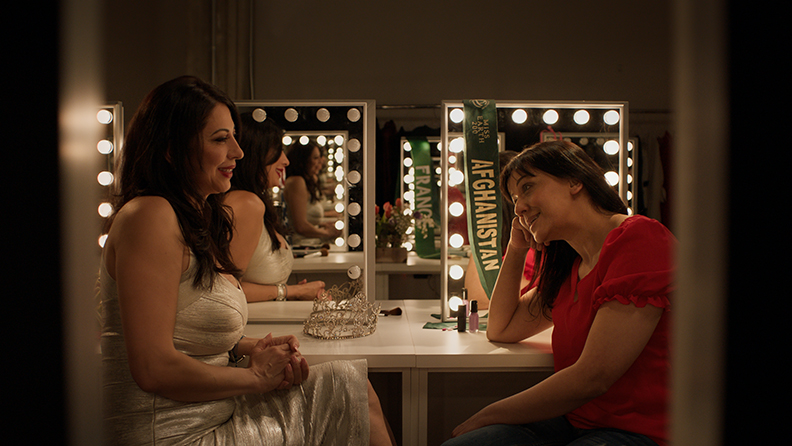
RAVING REVIEW: What does resistance look like when survival itself becomes a radical act? IN THE ROOM doesn’t approach that question through historical overview, but through presence, conversation, and an unflinching willingness to sit with discomfort. Directed by Brishkay Ahmed, the documentary brings together five Afghan women whose lives have been shaped by visibility, backlash, exile, and courage, not as symbols, but as people reckoning with what it means to speak when silence is safer.
The structure is deceptively straightforward. Ahmed places herself in conversation with Nelofer Pazira-Fisk, Vida Samadzai, Sahar Parniyan, Mozhdah Jamalzadah, and Shogofa Sediqi, women who each gained international attention through media, art, or activism, and who paid a heavy price for that visibility. Rather than assembling a chronological history of Afghanistan’s recent political collapse, the film allows memory to guide the narrative. Stories surface organically, shaped by emotion, creating a portrait that feels universal rather than explanatory.
What immediately distinguishes IN THE ROOM from more conventional political documentaries is its structural intimacy. These conversations are shaped by memory and mood rather than symbolism. The rooms they take place in aren’t presented as prisons or hiding places, but as environments that allow vulnerability. Ahmed has made it clear that this choice was about the emotional atmosphere, and the film bears that out. Each space feels tuned to the person occupying it, reinforcing the idea that resistance doesn’t always scream from the rooftops. Sometimes it begins silently, behind closed doors, in the act of telling the truth out loud.
Ahmed’s presence as both filmmaker and participant adds a layer of complexity that the film never attempts to smooth over. She never positions herself as an objective observer, nor does she dominate the narrative. Instead, she acknowledges her own history, her missteps, and the limits of her understanding. One of the film’s most affecting moments comes when Ahmed reflects on pushing Sahar Parniyan to adopt a Western model of visibility during her time directing television in Kabul, an admission that reframes activism not as purity, but as responsibility. The film recognizes that good intentions can still cause harm, especially when the stakes are survival.
Each woman’s story reinforces how quickly celebration can turn into condemnation. Media attention, once framed as progress, becomes a liability. Praise gives way to threats. Careers collapse into exile. IN THE ROOM never sensationalizes this backlash, but it doesn’t soften it either. The consequences are spoken in direct terms: death threats, forced departures, and permanent separation from home. The film’s power lies in its refusal to dramatize these outcomes. They are presented as facts, devastating precisely because of their inevitability.
What IN THE ROOM makes uncomfortably clear is that Afghanistan isn’t presented as a distant anomaly, but as a warning. The film insists that the erosion of rights doesn’t begin with an abrupt catastrophe, but with gradual normalization, legal reframing, and cultural indifference. Ahmed and her collaborators are explicit in pushing back against the false comfort of distance, the belief that what happens there could never happen here. The stories in the film echo far beyond national borders, inviting Western audiences to examine threats to bodily autonomy, immigration status, racialized belonging, and LGBTQIA2S+ safety within their own political systems. By drawing this parallel without collapsing differences, the documentary reframes Afghan women’s resistance as both specific to their cause and a universal message, a reminder that rights, once treated as conditional, rarely stop eroding at the margins.
The documentary makes striking choices without drawing attention to itself. Projection design, archival material, and recreated elements are woven into the conversations in a way that deepens emotional resonance rather than interrupting it. These visual layers function less as exposition and more as memory triggers, fragments of a past that cannot be fully reclaimed. The result is a film that feels emotionally textured without becoming ornamental. One particularly striking moment is a projection on the floor in front of Mozhdah Jamalzadah as she watches a performance she gave before then-President Barack Obama. That moment is absolutely captivating from a visual and emotional standpoint.
What lingers most is the film’s insistence that Afghanistan’s story isn’t an isolated tragedy. Ahmed repeatedly positions the erosion of women’s rights as a warning rather than a closed chapter. The return of the Taliban, international recognition of their authority, and the normalization of extremist governance are framed not as distant political developments, but as signals with global implications. The women in the film are profoundly aware that their experiences are being watched, studied, and potentially replicated elsewhere.
IN THE ROOM avoids the trap of offering hope as a possible conclusion. There is solidarity here, and resolve, but no illusion of safety. Resistance is ongoing, fragile, and costly. The film asks its audience not for sympathy, but for vigilance. It demands attention without offering the comfort of resolution, reminding viewers that bearing witness is not the same as taking action, but it is where responsibility begins. By grounding global catastrophe in personal testimony, IN THE ROOM achieves something incredibly rare. It never asks viewers to understand Afghanistan as a concept. It asks them to understand women, memory, consequence, and the price of being seen. In doing so, it becomes less a documentary about a country and more a document of what happens when the right to exist freely is treated as conditional.
Please visit https://linktr.ee/overlyhonestr for more reviews.
You can follow me on Letterboxd, Instagram, Twitter, and YouTube. My social media accounts can also be found on most platforms by searching for 'Overly Honest Reviews'.
I’m always happy to hear from my readers; please don't hesitate to say hello or send me any questions about movies.
[photo courtesy of NATIONAL FILM BOARD OF CANADA (NFB)]
DISCLAIMER:
At Overly Honest Movie Reviews, we value honesty and transparency. Occasionally, we receive complimentary items for review, including DVDs, Blu-rays, CDs, Vinyl Records, Books, and more. We assure you that these arrangements do not influence our reviews, as we are committed to providing unbiased and sincere evaluations. We aim to help you make informed entertainment choices regardless of our relationship with distributors or producers.
Amazon Affiliate Links:
Additionally, this site contains Amazon affiliate links. If you purchase through these links, we may receive a commission. This affiliate arrangement does not affect our commitment to honest reviews and helps support our site. We appreciate your trust and support as you navigate these links.


Happy
0 %

Sad
0 %

Excited
0 %

Sleepy
0 %

Angry
0 %

Surprise
0 %
 0
0
 0
0

Average Rating