When Escapism Meant Absolute Commitment
Read Time:5 Minute, 35 Second
MOVIE REVIEW
Stingray: The Complete Series (1964) – Imprint Television #32
 –
– 


Genre: Science Fiction, Adventure, Family
Year Released: 1964–1965, Imprint Blu-ray 2025
Runtime: 17h
Director(s): Gerry Anderson, Sylvia Anderson
Writer(s): Gerry Anderson, Sylvia Anderson
Cast: Ray Barrett, Don Mason, Robert Easton, David Graham, Lois Maxwell
Where to Watch: available now, order your copy here: www.viavision.com.au
RAVING REVIEW: STINGRAY offers a journey through a fascinating transitional space in television history. It is both a breakthrough and a prototype; a show that feels historically vital while also revealing its limitations. As the first British television series filmed entirely in color, it represents a technical leap forward that immediately sets it apart from its contemporaries. At the same time, it stands as a conceptual bridge between earlier Supermarionation experiments and the more refined work that would follow.
Set beneath the ocean’s surface, STINGRAY leans fully into mid-century futurism. Marineville, W.A.S.P., and the sleek design of the Stingray submarine itself embody a distinctly optimistic vision of technology as a means of protection, order, and progress. This is a series that deeply believes in systems: in uniforms, hierarchies, and the reassuring presence of command structures. Commander Shore, Troy Tempest, and the supporting crew are less psychologically complex characters than embodiments of function. They exist to move, to react, and to restore balance when threats emerge.
That simplicity is both the show’s greatest strength and its most obvious limitation. The episodic structure allows for constant invention; underwater civilizations, rogue threats, and elaborate mechanical set pieces arrive at a rapid pace. Each episode efficiently introduces conflict, escalates the stakes, and resolves the danger within a half-hour. For younger viewers, this rhythm is ideal. For modern audiences visiting the series as adults, the repetition becomes more noticeable. Narrative surprise gives way to familiarity, and character growth remains largely static.
Yet within that rigidity, STINGRAY frequently stumbles into something more intriguing. The underwater setting lends the series an unexpectedly somber tone. Unlike the skies of other Anderson shows, the ocean here feels claustrophobic, isolating, and occasionally melancholic. There’s an undercurrent of loneliness to Marineville, heightened by the perpetual sense that humanity is a guest in a world it doesn’t fully understand. The series rarely articulates this explicitly, but it lingers in the visual language and musical cues.
Barry Gray’s score plays a crucial role in shaping that atmosphere. His compositions elevate scenes that might otherwise feel perfunctory, adding shading that the marionettes themselves cannot fully express. The music carries tension, romance, and unease with a confidence that compensates for the medium's limitations. In many ways, the score does as much storytelling as the scripts.
The characters, while prototypical, aren’t without nuance. Troy Tempest is heroic without being flamboyant; consistent rather than charismatic, while Marina remains one of the series’ most curious figures. Silent and idealized, she functions less as a character and more as a symbol; an embodiment of mystery and unattainability. The series never deepens her role, which reflects the era’s sensibilities, but it does contribute to the strange emotional texture that distinguishes STINGRAY from more straightforward children’s programming.
From a historical perspective, STINGRAY is essential viewing for understanding the evolution of genre television. It introduces design philosophies, pacing, and experiments that would later be refined in THUNDERBIRDS and CAPTAIN SCARLET. Watching the series now, it’s impossible not to see it as a foundation. The ambition is evident, even when execution occasionally falls short.
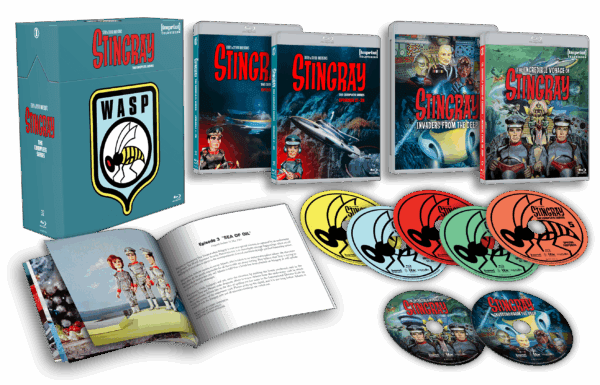
That sense of ambition extends to the physical production itself. The Imprint release treats STINGRAY not as disposable nostalgia, but as a work worthy of preservation and context. The presentation highlights the craftsmanship of the models, sets, and puppetry, revealing details that were never meant to be scrutinized so closely. Rather than diminishing the experience, this clarity reinforces the labor and ingenuity behind the production.
The supplemental material is extensive and curated. New audio commentaries, archival insights, and featurettes deepen appreciation for the series’ place within the Anderson legacy. The inclusion of compilation films adds even more value without overwhelming the set’s focus. The hardcover booklet further positions this release as a definitive edition rather than a standard issue.
Dialogue can occasionally feel stiff, conflict resolution is often simplistic, and thematic exploration remains surface-level. Compared to modern serialized storytelling, the emotional stakes rarely evolve beyond immediate danger. It is rewarding, influential, and frequently charming, but not consistently transformative.
What ultimately gives STINGRAY the edge is its sincerity. There is no irony in its construction, no self-awareness about its own strangeness. It commits to its premise and trusts its audience to come along for the ride. That earnestness is increasingly rare, and it gives the series a warmth that persists even when individual episodes blur together.
STINGRAY: THE COMPLETE SERIES is best approached with adjusted expectations. It is not a hidden masterpiece; it’s a historically significant, deeply earnest, occasionally uneven work that laid critical groundwork for what followed. For viewers interested in television history, genre evolution, or the Anderson catalog specifically, it remains an essential chapter.
Imprint’s release honors that legacy with care and respect, ensuring the series can be revisited not just as a childhood memory, but as a meaningful artifact of television’s past. STINGRAY stands as a vital stepping stone; a series that dared to dive deep before anyone knew just how far the journey would go.
Please visit https://linktr.ee/overlyhonestr for more reviews.
You can follow me on Letterboxd, Instagram, Twitter, and YouTube. My social media accounts can also be found on most platforms by searching for 'Overly Honest Reviews'.
I’m always happy to hear from my readers; please don't hesitate to say hello or send me any questions about movies.
[photo courtesy of IMPRINT FILMS, VIA VISION]
DISCLAIMER:
At Overly Honest Movie Reviews, we value honesty and transparency. Occasionally, we receive complimentary items for review, including DVDs, Blu-rays, CDs, Vinyl Records, Books, and more. We assure you that these arrangements do not influence our reviews, as we are committed to providing unbiased and sincere evaluations. We aim to help you make informed entertainment choices regardless of our relationship with distributors or producers.
Amazon Affiliate Links:
Additionally, this site contains Amazon affiliate links. If you purchase through these links, we may receive a commission. This affiliate arrangement does not affect our commitment to honest reviews and helps support our site. We appreciate your trust and support in navigating these links.


Happy
0 %

Sad
0 %

Excited
0 %

Sleepy
0 %

Angry
0 %

Surprise
0 %
 0
0
 0
0



Average Rating