Where Music Exists Beyond Sound
Read Time:5 Minute, 34 Second
MOVIE REVIEW
SŪNNA (Listen)
 –
– 

Genre: Drama
Year Released: 2025, 2026
Runtime: 13m
Director(s): Radha Mehta
Writer(s): Radha Mehta
Cast: Anisha Nagarajan, Aaliya Mehta, Behzad Dabu, Alyssa Diaz
Where to Watch: shown at the 2026 Cleveland International Film Festival
RAVING REVIEW: A life built around sound doesn’t just disappear, and SŪNNA (LISTEN) understands that loss in a way that feels closer, more personal, and uncomfortably real. This isn’t a film interested in sentiment or quick emotional shortcuts. Instead, it plants itself in the disorientation that comes with losing something so foundational, then begins rebuilding from that absence. At just over thirteen minutes, it moves with a sense of purpose that never feels rushed, allowing each moment to carry weight without overstaying its welcome.
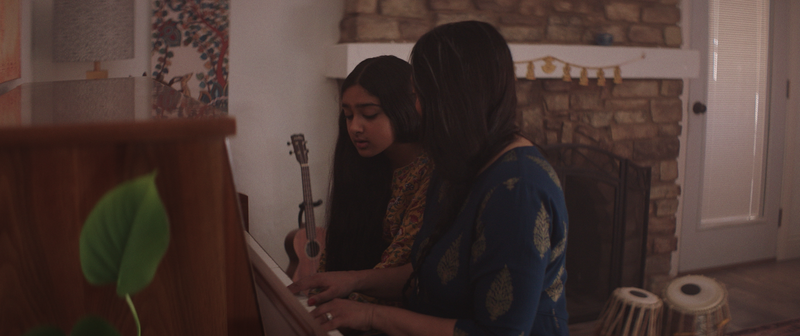
A young musician, Savita, suddenly loses her hearing and is forced to confront what that means for her, her art, and her future. What follows isn’t a traditional arc of overcoming adversity in just an inspirational sense. The film leans into the uncertainty of that transition, capturing the frustration, confusion, and grief that come with it. There’s no all-knowing clarity, no sudden revelation that fixes everything. Instead, SŪNNA lets the process feel ongoing, messy, and deeply human.
Anisha Nagarajan carries the film with a performance that avoids exaggeration and settles into a more grounded tone. Her portrayal of Savita doesn’t rely on any dramatic outbursts to communicate pain. It’s in the smaller shifts, the hesitation in her movements, the way she interacts with the world when sound is no longer a guarantee. That restraint becomes one of the film’s strongest assets, inviting the audience to meet her where she is rather than pushing them toward a specific emotional response.
The supporting cast plays a crucial role in shaping that experience without taking the focus away. Aaliya Mehta brings a presence that reinforces the film’s sense of authenticity, while Behzad Dabu and Alyssa Diaz contribute to a framework of support that never feels overly idealized. These relationships are important, but they’re not presented as solutions. They exist alongside Savita’s journey rather than defining it, which allows the film to maintain its focus where it belongs.
Where SŪNNA separates itself is in how it approaches sound, or the absence of it. Instead of treating silence as a void, the film reshapes it into something expressive. The sound design becomes an active storytelling tool, shifting between what is heard, what is remembered, and what is felt. That distinction matters more than you might think. The film isn’t just about losing hearing; it’s about redefining how experience is processed. Moments that could have been played as tragic instead take on a different texture, one that emphasizes adaptation rather than defeat.
The cinematography by Isue Shin doesn’t attempt to overwhelm the audience with stylization, but it remains intentional in how it frames Savita’s world. There’s a noticeable attention to physical interaction, how hands move, and how space is perceived without the guidance of sound. It’s subtle, but it reinforces the film’s idea that identity isn’t tied to a single sense.
What also stands out is how the film incorporates cultural identity without turning it into a surface-level detail. Music, memory, and heritage are all intertwined here, not as background elements, but as parts of Savita’s reconstruction. The film recognizes that losing one part of you doesn’t erase everything else. Instead, it allows those remaining connections to become the foundation for something new. That balance between personal experience and cultural specificity gives the film a broader resonance without diluting its perspective.
The film’s brevity works in its favor in several ways. There’s no excess here, no unnecessary detours that dilute its focus. Every scene contributes to the core exploration, and the film trusts its audience enough to fill in the gaps without spelling everything out. That aligns with the overall tone, which avoids turning the story into something overly instructive or sentimental.
The film’s conclusion lands with a confidence that feels earned. Rather than offering a neatly packaged resolution, it settles into a space that acknowledges growth without pretending that the journey is complete. That choice reinforces the idea that adaptation isn’t a single moment of transformation, but an ongoing process. It’s a more honest way to end the story, and it remains consistent with everything that came before.
SŪNNA (LISTEN) doesn’t try to position itself as a definitive statement on hearing loss or identity, and that’s part of what makes it so effective. It’s a personal story told with care, shaped by lived experience, and presented without unnecessary embellishment. The film understands the weight of its subject, but it also recognizes that resilience doesn’t always look dramatic. Sometimes it’s quiet, incremental, and difficult to define in real time.
For a short film, it leaves a long-lasting impression, not because it demands attention, but because it earns it. There’s clarity in its intent, respect for its characters, and a willingness to sit with discomfort rather than rush past it. It doesn’t overreach, and it doesn’t need to. What it offers is focused, thoughtful, and emotionally grounded, which is more than enough to set it apart.
Please visit https://linktr.ee/overlyhonestr for more reviews.
You can follow me on Letterboxd, Instagram, Twitter, and YouTube. My social media accounts can also be found on most platforms by searching for 'Overly Honest Reviews'.
I’m always happy to hear from my readers; please don't hesitate to say hello or send me any questions about movies.
[photo courtesy of DOSE OF SOUL, LLC]
DISCLAIMER:
At Overly Honest Movie Reviews, we value honesty and transparency. Occasionally, we receive complimentary items for review, including DVDs, Blu-rays, CDs, Vinyl Records, Books, and more. We assure you that these arrangements do not influence our reviews, as we are committed to providing unbiased and sincere evaluations. We aim to help you make informed entertainment choices regardless of our relationship with distributors or producers.
Amazon Affiliate Links:
Additionally, this site contains Amazon affiliate links. If you purchase through these links, we may receive a commission. This affiliate arrangement does not affect our commitment to honest reviews and helps support our site. We appreciate your trust and support as you navigate these links.


Happy
0 %

Sad
0 %

Excited
0 %

Sleepy
0 %

Angry
0 %

Surprise
0 %
 0
0
 0
0


Average Rating