Wealth, Status, and the Slow Erosion of Control
Read Time:5 Minute, 29 Second
MOVIE REVIEW
The Gilded Age: The Complete Third Season
 –
– 

Genre: Drama, Historical
Year Released: 2025
Runtime: 8 x 60m episodes
Director(s): Michael Engler, Salli Richardson-Whitfield
Writer(s): Julian Fellowes, Sonja Warfield
Cast: Carrie Coon, Christine Baranski, Cynthia Nixon, Morgan Spector
Where to Watch: available now on DVD here: www.amazon.com
RAVING REVIEW: The third season of THE GILDED AGE offers the confidence of a series that has settled into its identity. The world is grounded, the characters established, and the show is no longer working to convince the audience of its worth. Instead, this season focuses on escalation. The aftermath of the Opera War leaves the old order weakened, and the Russells step into the vacuum with a level of determination that transforms the social landscape of 1880s New York. The tension between tradition and progress has always been the backbone of this series, but Season 3 pushes those contrasts further, showing how ambition can reshape an entire community.
Bertha Russell’s push for dominance forms one of the season’s strongest aspects. Carrie Coon gives the character a fiery precision, navigating the setbacks and victories of her ascent with a mix of grace and resolve. Bertha’s attempts to solidify her family’s place at the top of New York society aren’t played as triumphs; they’re framed as hard-won battles where public perception matters just as much as private choices. This is especially clear in the season’s final arc involving the ball, where every invitation becomes a political gesture, and every acceptance or refusal carries real weight.
George Russell’s storyline echoes this high-stakes maneuvering but moves into the world of industry and innovation. Morgan Spector portrays George as someone increasingly aware that his decisions can shape the future of American business. His railroad gambit adds pressure not only to his financial standing but to the stability of his entire household. The season presents his risk as something that could change the nation’s economy, reminding viewers that the wealthy of this era were not simply playing social games; they were actively defining the country’s direction. George’s storyline complements Bertha’s perfectly, giving the Russells a season where both halves of the couple are tested in ways that feel consequential.
Across the street, the van Rhijn household faces conflict grounded in family rather than empire. Agnes’s rigidity, always a defining trait, becomes even more disruptive now that Ada assumes a role that alters the household's balance. Cynthia Nixon delivers one of her most understated performances as Ada, handling the shift in power with sensitivity. The sisters’ dynamic has always been compelling, but Season 3 allows it to deepen in ways that reveal how change can unsettle even the most dignified environments. Their conflicts unfold with the intensity of two people who love each other but refuse to see the world the same way.
Peggy’s arc, meanwhile, provides some of the season’s most grounded moments. Her relationship with the Newport doctor is layered, not because of romantic uncertainty, but because of the expectations placed upon her by his family and society at large. Peggy has long been one of the show’s centerpieces, and this season gives her a storyline that expands her aspirations while challenging her personally. The writers handle her narrative with care, keeping the focus on her ambitions without diminishing the complexity of the relationships around her.
The ensemble remains one of the show’s most compelling assets. The sheer number of returning cast members—Christine Baranski, Denée Benton, Harry Richardson, Blake Ritson, Audra McDonald, Nathan Lane, Debra Monk, John Douglas Thompson, and many others—creates a lived-in environment where every storyline feels connected to a broader outside. No character feels unnecessary. Even those with smaller arcs help articulate the season’s central themes of change, ambition, and the shifting boundaries of status.
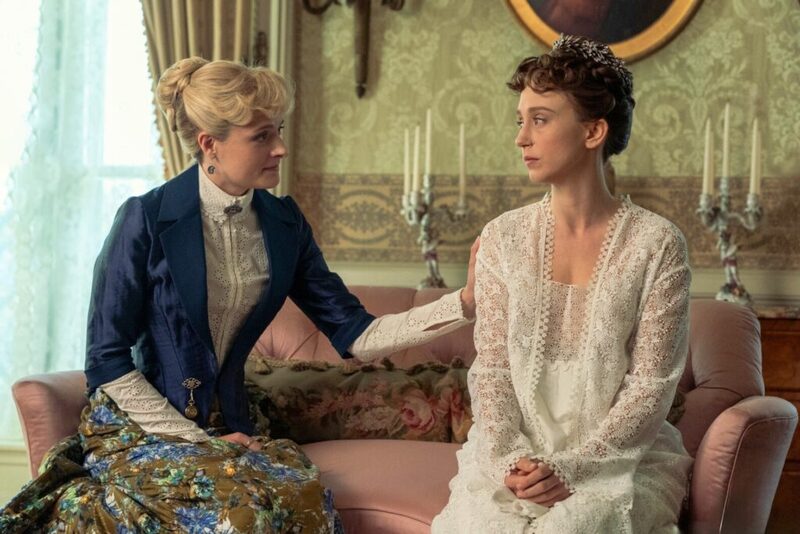
The opulence of the Gilded Age is not treated as decoration but as storytelling. The costume work is meticulous, highlighting class, personality, and social intention with remarkable clarity. The Russell interiors gleam with ambition; the van Rhijn household reflects a quieter, older understanding of respectability; and the public spaces show just how much money and influence shaped New York’s identity.
The writing is measured but sharper this time. Dialogues hold more tension, especially as characters confront the consequences of their social positioning. Julian Fellowes leans into the idea that progress often requires sacrifice, and the season explores this without moralizing. Characters are allowed to make bold, flawed, or self-protective decisions, and the script respects them enough to let the audience interpret the implications.
Season 3 succeeds because it brings clarity to every storyline. The show has always been about the negotiation between aspiration and propriety, but this chapter demonstrates how fragile social victories truly are. Characters who seemed secure now question their identities, while those previously dismissed step into newfound confidence. Every choice feels connected to something larger. THE GILDED AGE’s third season doesn’t rely on extravaganza to keep viewers invested. It depends on character, intention, and the slow pressure of change. This is the season where the show becomes itself—ambitious, elegant, incisive, and unafraid to show the cost of power.
Please visit https://linktr.ee/overlyhonestr for more reviews.
You can follow me on Letterboxd, Instagram, Twitter, and YouTube. My social media accounts can also be found on most platforms by searching for 'Overly Honest Reviews'.
I’m always happy to hear from my readers; please don't hesitate to say hello or send me any questions about movies.
[photo courtesy of HBO, WARNER BROS. DISCOVERY HOME ENTERTAINMENT]
DISCLAIMER:
At Overly Honest Movie Reviews, we value honesty and transparency. Occasionally, we receive complimentary items for review, including DVDs, Blu-rays, CDs, Vinyl Records, Books, and more. We assure you that these arrangements do not influence our reviews, as we are committed to providing unbiased and sincere evaluations. We aim to help you make informed entertainment choices regardless of our relationship with distributors or producers.
Amazon Affiliate Links:
Additionally, this site contains Amazon affiliate links. If you purchase through these links, we may receive a commission. This affiliate arrangement does not affect our commitment to honest reviews and helps support our site. We appreciate your trust and support as you navigate these links.


Happy
0 %

Sad
0 %

Excited
0 %

Sleepy
0 %

Angry
0 %

Surprise
0 %
 0
0
 0
0



Average Rating