A Samurai Trilogy That Rejects Samurai Mythology
Read Time:8 Minute, 44 Second
MOVIE REVIEW
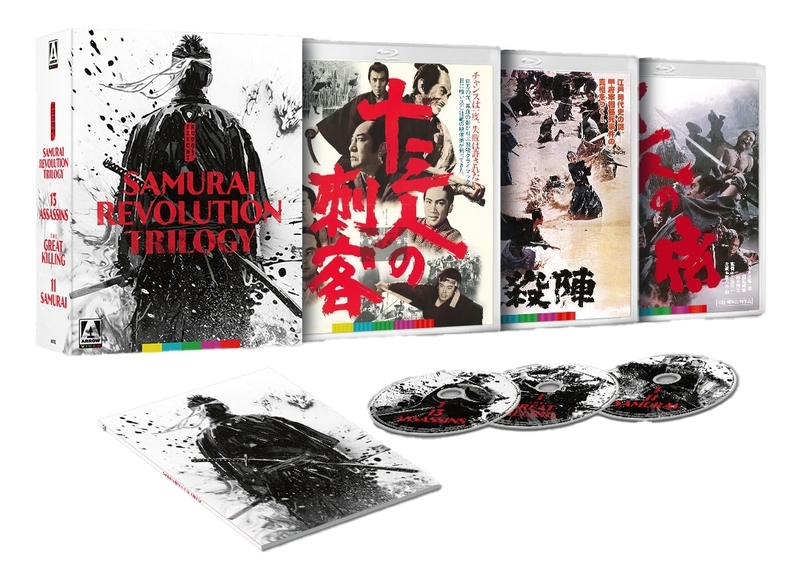
Eiichi Kudo's Samurai Revolution Trilogy [Limited Edition]
13 Assassins (Jûsannin no shikaku)
The Great Killing (Daisatsujin)
Eleven Samurai (Jûichinin no samurai)
 –
– 

Genre: Action, Drama, History
Year Released: 1963 / 1964 / 1967, Arrow Video Blu-ray 2026
Runtime: 2h 05m / 1h 58m / 1h 40m
Director(s): Eiichi Kudo
Writer(s): Kaneo Ikegami / Kaneo Ikegami / Takeo Kunihiro, Norifumi Suzuki, Kei Tasaka
Cast: Chiezo Kataoka, Kotaro Satomi, Takayuki Akutagawa, Isao Natsuyagi, Tetsuro Tanba, Kei Sato, Toru Abe, Yuriko Mishima, Junko Fuji
Where to Watch: available March 31, 2026, pre-order your copy here: www.arrowvideo.com, www.mvdshop.com, or www.amazon.com
RAVING REVIEW: Samurai cinema has spent decades building up the myth and legends that make it work. The noble warrior draws his blade to protect the innocent; honor is sacred, and loyalty to the ruling class is rarely questioned. EIICHI KUDO’S SAMURAI REVOLUTION TRILOGY exists almost entirely to dismantle that idea. Across three films released between 1963 and 1967, Kudo subverts the romanticized icon of the samurai, forcing it into the harsher, more political reality of the Tokugawa shogunate. The result is a trio of films that treat feudal Japan less like a stage for heroics and more like a system built on fear, corruption, and loyalty.
Arrow Video’s new three-disc Blu-ray set finally gives these films the presentation they deserve. For years, many could only see the first entry indirectly through Takashi Miike’s 2010 remake of 13 ASSASSINS. While that remake is spectacular in its own right, seeing Kudo’s original trilogy together reveals a much broader thematic journey. These films aren’t simply action stories about warriors planning assassinations. They’re political dramas about men confronting the moral contradictions of the system they serve.
The trilogy begins with 13 ASSASSINS, the most widely known entry and arguably the film that defines the project as a whole. Set during the waning years of the Tokugawa shogunate, the story centers on a sadistic feudal lord whose brutality threatens to destabilize the political order. Because of his connection to the ruling family, justice is impossible through normal channels. The only solution is assassination. A veteran samurai assembles a small group of warriors willing to sacrifice their lives to eliminate the tyrant before he can gain greater power.
What makes 13 ASSASSINS so powerful is how carefully it balances patience and pageantry. The first half of the film creeps across the screen in slow, tactical preparation, introducing the men who will carry out the mission and exploring the morality behind their decision. When the climactic ambush finally arrives, the film erupts into a long and chaotic battle staged across an entire village. Even today, the sequence remains an astonishing piece of action filmmaking, built less on stylized choreography and more on the reality of bodies colliding in mud, smoke, and steel.
THE GREAT KILLING follows a year later and pushes the trilogy into darker territory. While the first film focuses on a carefully organized assassination plot, the second entry explores a rebellion that has already begun to collapse. Political conspirators are arrested, tortured, and forced to betray one another. The surviving characters must decide whether continuing the mission still holds meaning when victory appears impossible.
This middle chapter is the bleakest of the three films. Kudo shifts the emphasis from planning to psychological exhaustion. The samurai at the center of the story are no longer romantic figures preparing for a noble sacrifice. They’re men confronting the possibility that their rebellion may accomplish nothing beyond their own deaths. The action sequences remain intense, but they are framed less as triumph and more as desperate resistance against an overwhelming political machine.
By the time the trilogy reaches 11 SAMURAI, Kudo has refined his formula. The final film condenses the structure established in the earlier entries, presenting another assassination plot sparked by injustice within the feudal hierarchy. When a powerful lord commits an act of violence against a neighboring clan, the political system responds by protecting the perpetrator and punishing the victims. Eleven warriors decide that justice must come from outside the system itself.
While the story echoes elements of the earlier films, 11 SAMURAI feels more pressing. The narrative moves quickly, scattering bursts of action throughout rather than saving everything for a single moment of chaos. Kudo still builds toward a final confrontation, but the film spends more time exploring the tension between loyalty to authority and loyalty to justice. The characters understand the system they serve is fundamentally broken, yet their identities remain tied to the very code that sustains it.
What unites the trilogy is Kudo’s refusal to romanticize the samurai class. These films repeatedly show how the ideals of honor and loyalty can be twisted into tools of oppression. Lords abuse their power without consequence. Political leaders protect the guilty to preserve the illusion of stability. Even the warriors attempting to correct these injustices are trapped within the same hierarchical structure that created the problem. (This sounds all too familiar to our modern world, I guess, the more things change, the more they stay the same.)
Kudo’s direction reinforces this perspective through cinematography that strips away any sense of romantic nostalgia. The landscapes feel harsh and unforgiving. Battle sequences unfold in mud, rain, and smoke rather than the elegant settings often associated with classic chanbara films.
The trilogy also benefits from an extraordinary ensemble of performers drawn from the golden age of Japanese period cinema. Chiezo Kataoka brings gravitas to the role of Shinzaemon in 13 ASSASSINS, portraying a veteran warrior who understands the mission's suicidal nature. Kotaro Satomi appears across the trilogy, bringing intensity to multiple roles within Kudo’s evolving vision of rebellion. Actors like Tetsuro Tanba, Kei Sato, and Isao Natsuyagi contribute to a cast that feels populated by figures drawn directly from the genre’s most iconic films.
Watching the three films together highlights how Kudo gradually expands his critique of the feudal system. The first film questions whether assassination can serve justice. The second examines what happens when rebellion collapses under its own weight. The third confronts the idea that justice may require abandoning the very system that defines a samurai’s identity. The trilogy emerged during a period when Japanese filmmakers were increasingly using historical settings to comment on contemporary political tensions. Kudo’s films carry a quiet anger directed not only at feudal authority but at the lingering structures of power that continued to shape postwar society.
For viewers accustomed to the more polished samurai films, the SAMURAI REVOLUTION TRILOGY may feel surprisingly raw. The sword fights are more brutal than elegant. The heroes rarely achieve victory in the traditional sense. What remains instead is a sobering portrait of men trying to reconcile their sense of honor with a political system that no longer deserves their loyalty. Seen together, these three films form one of the most important statements in the samurai genre. Kudo doesn’t dispel the myth of the noble warrior. Instead, he exposes the cost of living by it in a world where power answers only to itself.
Bonus Materials
LIMITED EDITION CONTENTS
High-Definition Blu-ray (1080p) presentation of all three films
Original lossless Japanese mono audio on all three films
Optional newly translated English subtitles for all three films
Limited edition packaging with reversible sleeves featuring original and newly commissioned artwork by Tom Fournier
Illustrated collectors’ booklet featuring new writing on the films by Chris D., Earl Jackson, and Alain Silver
DISC ONE – 13 ASSASSINS
Brand new audio commentary by film critic and Japanese cinema expert Tom Mes
The Samurai Variations, a brand new video essay by music supervisor and Japanese cinema expert James Balmont on legendary composer Akira Ifukube’s score for the film
Samurai Guerrilla Part 1, an archival interview where Eiichi Kudo’s former assistant director, Misao Arai, and filmmaker Dirty Kudo discuss Eiichi Kudo and Toei’s role in the Japanese film landscape of the 1960s
Theatrical trailers
DISC TWO – THE GREAT KILLING
Brand new audio commentary by film critic David West
Magician of Light and Shadow, a brand new video essay by film critic and Japanese cinema expert Daisuke Miyao on the cinematography seen in the film
Samurai Guerrilla Part 2, an archival interview where Misao Arai and Dirty Kudo discuss the jidaigeki genre and expand on the political dimension of The Great Killing
Masaaki Ito Remembers Eiichi Kudo, a tribute to the director by his former assistant and brother-in-law
DISC THREE – 11 SAMURAI
Brand new audio commentary by film critic David West
Fighting the Poison, a brand new video essay by film critic and Japanese cinema expert Jonathan Clements on the historical setting and context of the film
Samurai Guerrilla Part 3, an archival interview where Misao Arai and Dirty Kudo discuss some of the filming techniques seen in the film and the conception of the Samurai as seen in Eiichi Kudo’s jidaigeki films
Eiichi Kudo: The Art of Realism, an archival interview with Fabrice Arduini, filmmaker and programmer for the House of Culture of Japan in Paris, where he discusses jidaigeki and the films of Eiichi Kudo
Please visit https://linktr.ee/overlyhonestr for more reviews.
You can follow me on Letterboxd, Instagram, Twitter, and YouTube. My social media accounts can also be found on most platforms by searching for 'Overly Honest Reviews'.
I’m always happy to hear from my readers; please don't hesitate to say hello or send me any questions about movies.
[photo courtesy of ARROW VIDEO, MVD ENTERTAINMENT]
DISCLAIMER:
At Overly Honest Movie Reviews, we value honesty and transparency. Occasionally, we receive complimentary items for review, including DVDs, Blu-rays, CDs, Vinyl Records, Books, and more. We assure you that these arrangements do not influence our reviews, as we are committed to providing unbiased and sincere evaluations. We aim to help you make informed entertainment choices regardless of our relationship with distributors or producers.
Amazon Affiliate Links:
Additionally, this site contains Amazon affiliate links. If you purchase through these links, we may receive a commission. This affiliate arrangement does not affect our commitment to honest reviews and helps support our site. We appreciate your trust and support as you navigate these links.


Happy
0 %

Sad
0 %

Excited
100 %

Sleepy
0 %

Angry
0 %

Surprise
0 %
 1
1
 0
0


Average Rating