A Pressure Cooker of Masculinity and Misery
Read Time:5 Minute, 29 Second
MOVIE REVIEW
Talk Radio (Blu-ray)
 –
– 

Genre: Thriller, Drama
Year Released: 1988, 2026 Kino Lorber Blu-ray
Runtime: 1h 49m
Director(s): Oliver Stone
Writer(s): Eric Bogosian, Tad Savinar, Stephen Singular
Cast: Eric Bogosian, Ellen Greene, Leslie Hope, Alec Baldwin, John C. McGinley, John Pankow
Where to Watch: available now, order your copy here: www.kinolorber.com or www.amazon.com
RAVING REVIEW: TALK RADIO feels less like a movie about broadcasting and more like a man voluntarily locking himself inside an emotional chaos every night for entertainment. Oliver Stone takes Eric Bogosian’s stage play. He turns it into something claustrophobic, hostile, intense, and weirdly hypnotic, trapping the audience in the same cycle of rage, loneliness, ego, and self-destruction that consumes Barry Champlain in real time. Nearly four decades later, the film plays with the uncomfortable realization that it wasn’t simply examining shock media culture. It was predicting where public discourse was heading long before social media permanently industrialized outrage.
Barry works because the film refuses to make him easy to admire. He’s intelligent, charismatic, ruthless, emotionally manipulative, and completely addicted to the sound of his own confrontation. His late-night radio show thrives on humiliation. Callers phone in looking for connection, validation, or conflict, and Barry tears into them with a mixture of contempt and exhilaration that gradually starts poisoning every relationship in his life. He understands his audience better than anyone else around him, but he also despises them for needing him in the first place.
Bogosian’s performance is extraordinary because he never turns Barry into a misunderstood truth-teller. The character occasionally says things that sound insightful or brutally honest, but the film constantly undercuts the fantasy that he’s some noble anti-establishment prophet. Barry feeds off outrage because outrage gives him purpose. Every caller, every conspiracy theorist, every racist rant, every lonely insomniac searching for someone to listen to becomes fuel for their ego. Bogosian plays him like a man terrified of silence because silence would force him to confront himself.
TALK RADIO understands how media personalities can simultaneously hate their audiences while becoming dependent on them. Barry repeatedly claims he’s exposing hypocrisy and stupidity, but he’s also manufacturing the exact environment he claims to despise. He turns alienation into entertainment and then acts horrified when the audience responds accordingly. The movie never lets him escape responsibility for the culture he belongs to.
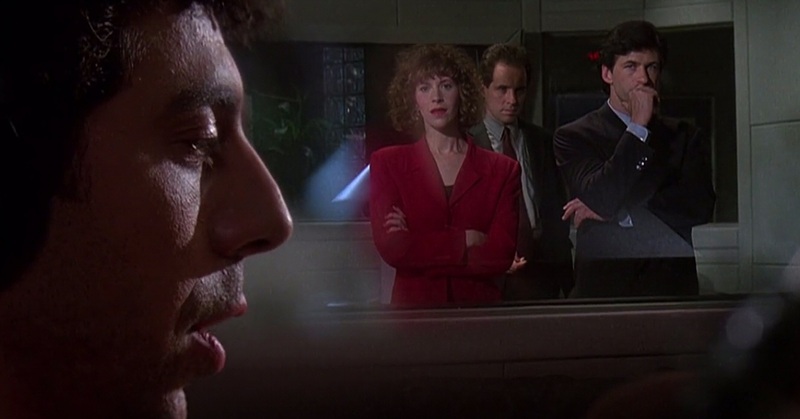
Stone’s direction amplifies that psychological suffocation brilliantly. The radio booth becomes its own kind of prison cell, glowing with cigarette smoke, reflections, spinning camera movements, and constant noise. Robert Richardson’s cinematography creates an almost feverish atmosphere in which Barry appears powerful and trapped. Stone’s visual style often gets accused of excess, sometimes fairly, but here the restlessness and aggressive editing actually reinforce the emotional instability consuming the character.
The sound design might be the film’s most important technical achievement. TALK RADIO weaponizes voices. Callers overlap, insults pile up, static fills the air, and conversations become impossible to fully process cleanly. The audience experiences the same sensory exhaustion Barry does. Every interaction feels invasive. Even moments outside the station carry traces of emotional noise bleeding into Barry’s personal life. The movie creates the sensation of a brain permanently overstimulated by anger and attention.
What makes the film feel especially eerie today is how accurately it captures the emotional mechanics that would later dominate internet culture. Barry functions like a prototype for modern outrage-driven personalities who confuse attention with meaning and conflict with honesty. He understands that audiences become addicted to emotional stimulation, even when it’s ugly. People don’t call his show because they want solutions. They call because they want permission to feel angry, scared, hateful, entertained, or noticed for a few seconds.
The film also recognizes the loneliness underneath that behavior. Beneath all the cruelty and confrontation sits a deep desperation for connection that nobody in TALK RADIO seems capable of expressing in a normal way. Barry’s relationship with Ellen Greene carries that sadness at its core. She still sees fragments of humanity inside him, but she also understands how corrosive the show has become. Their scenes together reveal the exhaustion of loving someone who is all performance.
The repetition becomes part of the experience itself. Barry’s life has become cyclical. Every night he enters the booth, provokes strangers, feeds on their reactions, alienates the people closest to him, then returns to do it all again. The film traps the audience in that loop. By the final act, the exhaustion becomes inseparable from the point Stone and Bogosian are making.
The ending lands as hard as it does because the film understands Barry’s real addiction was never fame alone. He needed the audience’s hatred almost as much as their attention because both proved he existed. TALK RADIO strips away the illusion that public performance can fill emotional emptiness, leaving behind something much uglier. Viewed now, the movie feels disturbingly prophetic without ever becoming smug about it. Stone and Bogosian weren’t simply warning about shock radio. They were dissecting an entire culture increasingly unable to separate entertainment from emotional collapse.
Product Extras:
NEW Audio Commentary by Film Historians Alexandra Heller-Nicholas and Josh Nelson
NEW Interview with Director Oliver Stone
Original Theatrical Trailer
Please visit https://linktr.ee/overlyhonestr for more reviews.
You can follow me on Letterboxd, Instagram, Twitter, and YouTube. My social media accounts can also be found on most platforms by searching for 'Overly Honest Reviews'.
I’m always happy to hear from my readers; please don't hesitate to say hello or send me any questions about movies.
[photo courtesy of KINO LORBER]
DISCLAIMER:
At Overly Honest Movie Reviews, we value honesty and transparency. Occasionally, we receive complimentary items for review, including DVDs, Blu-rays, CDs, Vinyl Records, Books, and more. We assure you that these arrangements do not influence our reviews, as we are committed to providing unbiased and sincere evaluations. We aim to help you make informed entertainment choices regardless of our relationship with distributors or producers.
Amazon Affiliate Links:
Additionally, this site contains Amazon affiliate links. If you purchase through these links, we may receive a commission. This affiliate arrangement does not affect our commitment to honest reviews and helps support our site. We appreciate your trust and support as you navigate these links.


Happy
0 %

Sad
0 %

Excited
0 %

Sleepy
0 %

Angry
0 %

Surprise
0 %
 0
0
 0
0



Average Rating