When War Reaches Every Living Thing
Read Time:6 Minute, 38 Second
MOVIE REVIEW
Animals in War
 –
– 


Genre: Drama
Year Released: 2025, 2026
Runtime: 1h 38m
Director(s): Myroslav Slaboshpytskyi, Yuliia Shashkova, Maksym Tuzov, Oleksii Mamedov, Sviatoslav Kostiuk, Ivan Sautkin, Andrii Lidahovskyi
Writer(s): Myroslav Slaboshpytskyi, Yuliia Shashkova, Maksym Tuzov, Oleksii Mamedov, Sviatoslav Kostiuk, Ivan Sautkin, Andrii Lidahovskyi
Cast: Sean Penn, Denys Kapustin, Artem Chernii, Maryna Koshkina, Andrii Isaienko, Oleksii Zubkov, Olha Korotiaieva, Mykhailo Pulianskyi, Olha Martynyshyn, Nazar Hladii
Where to Watch: premiering via VOD, leading digital platforms, and Film Movement Plus on June 26, 2026
RAVING REVIEW: War films often return to the same ideas because those images are so impactful and clear. Soldiers, weapons, destroyed buildings, emptied streets, families running, bodies waiting to be counted. ANIMALS IN WAR doesn’t ignore any of that devastation, but it changes the point of entry. The film looks at Russia’s full-scale invasion of Ukraine through animals caught inside the human-made catastrophe, and that is more than a framing device. It strips war of its arguments, slogans, strategies, and excuses until all that remains is harm spreading outward from people who started it to every living thing forced to endure it.
The film is a seven-part anthology, with each story built around an animal and the people whose lives become connected to it under the pressure of war. A rabbit, a cow, a dog, a goat, cats, fish, and an eagle all become witnesses in different ways. Some are companions. Some are reminders of the world that existed before everything was interrupted. Some simply endure, which may be the most heartbreaking role of all. ANIMALS IN WAR isn’t asking viewers to value animals over people. It’s asking them to understand that war doesn’t stop at the edge of human suffering.
That idea could have easily turned manipulative. A film about animals suffering in wartime has an obvious emotional shortcut available at almost every moment, and there are scenes here designed to hurt. What keeps ANIMALS IN WAR from feeling engineered is the sincerity of its structure and the variety of its approaches. The segments don’t all play the same role. Some lean toward realism. Others drift closer to allegory, fable, or imagination. The result is uneven, as anthologies often are, but the unevenness rarely feels careless. It feels like a group of artists trying to process the same trauma through different emotions.
The most visible name here is Sean Penn, appearing in EAGLE, written and directed by Myroslav Slaboshpytskyi. His presence will understandably draw attention, but the film doesn’t become a Sean Penn production, and that honestly helps. He works as a point of recognition inside a project that remains Ukrainian in voice, urgency, and grief. The segment uses sound, distance, and communication to examine how war travels before being seen. It’s a powerful opening into the film’s larger journey. Violence isn’t confined to the blast. It moves through air, bodies, memory, landscape, and whatever connections survive long enough to be heard.
COW IN THE FOG is among the film’s most direct entries, following a young boy facing hunger, cold, fear, and impossible pressure after escaping an occupied village. The cow isn’t treated as a symbol in some literary sense. It’s a living being whose presence forces the boy to remain attached even as the world around him demands hardening. That’s where ANIMALS IN WAR often finds its vision. The animals don’t explain the war. They reveal who people become while responding to it.
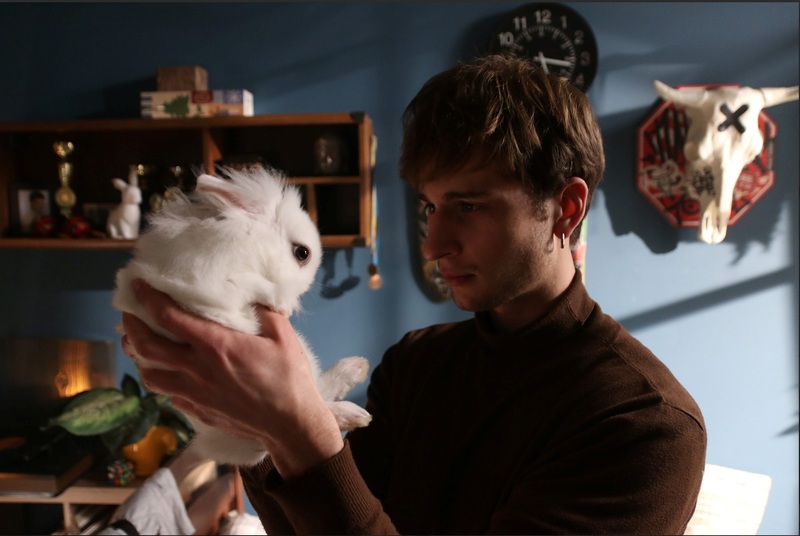
RABBIT: THERE AND BACK AGAIN really shows a different kind of ache because of how intimate its premise feels. A child and a rabbit wake into a world that has changed overnight. That simplicity is devastating. The film understands that war is often experienced first as confusion. The room is the same, the home is the same, the animal is still there, and yet the future has been changed forever. The rabbit suddenly becomes part of everyday life, and the segment captures how quickly childhood can be forced into fear without giving children the ability to understand what has happened.
SONNY, centered on the loss of a dog and a human, pushes into grief more directly. It raises one of the anthology’s recurring questions. Who is saving whom? The human characters often believe they’re protecting animals, but the film repeatedly complicates that assumption. Sometimes caring for another creature is the only thing keeping someone alive inside themselves. Sometimes responsibility becomes a bridge back from numbness. That emotional exchange gives ANIMALS IN WAR its moral center. Compassion isn’t presented as sentimental decoration. It’s survival work.
UNDERWATER ADVENTURE takes a stylistic turn, using imagination and a fish’s journey to create a child-friendly expression of destruction. This is also where the anthology’s range becomes clearest. Not every segment operates with the same force, and some shifts land harder than others. Yet the film’s willingness to change form matters. War damages adults, children, animals, cities, forests, rivers, and dreams differently.
TORPEDO and WE ARE ALRIGHT bring the film back toward occupied spaces, daily decisions, and the performance of normalcy. The goat in TORPEDO becomes tied to resistance, routine, and survival inside a village under occupation. WE ARE ALRIGHT uses cats and domestic departure to expose how people minimize panic just to keep moving. Both segments understand something essential about wartime behavior. People often say they’re fine because saying anything else would require stopping, and stopping can feel impossible.
ANIMALS IN WAR works its best when it trusts devastation. There are moments when the music and emotional emphasis push harder than necessary, and a few stories feel blunter than others. The film doesn’t need to underline every wound. The premise already cuts deep.
This is a deeply affecting anthology, and its occasional heavy hand comes from urgency, not cynicism. It’s a film made in response to an ongoing catastrophe, not from a distance. That matters. ANIMALS IN WAR is grieving, angry, tender, and pleading all at once. It sees war as a humanitarian disaster, an ecological disaster, and a spiritual failure. It asks viewers to look beyond the obvious casualties without ever minimizing them.
ANIMALS IN WAR stands as a powerful, varied, and necessary work. Its anthology structure has some natural inconsistencies, but the shared purpose holds. The film’s best segments don’t simply make animals stand in for innocence. They remind us that innocence is everywhere during war, often unnoticed, and almost always paying for decisions it never made. The animals can’t explain what has happened to them. The film gives its silence shape.
Please visit https://linktr.ee/overlyhonestr for more reviews.
You can follow me on Letterboxd, Instagram, Twitter, and YouTube. My social media accounts can also be found on most platforms by searching for 'Overly Honest Reviews'.
I’m always happy to hear from my readers; please don't hesitate to say hello or send me any questions about movies.
[photo courtesy of MNIBUS ENTERTAINMENT, FILM MOVEMENT]
DISCLAIMER:
At Overly Honest Movie Reviews, we value honesty and transparency. Occasionally, we receive complimentary items for review, including DVDs, Blu-rays, CDs, Vinyl Records, Books, and more. We assure you that these arrangements do not influence our reviews, as we are committed to providing unbiased and sincere evaluations. We aim to help you make informed entertainment choices regardless of our relationship with distributors or producers.
Amazon Affiliate Links:
Additionally, this site contains Amazon affiliate links. If you purchase through these links, we may receive a commission. This affiliate arrangement does not affect our commitment to honest reviews and helps support our site. We appreciate your trust and support as you navigate these links.


Happy
0 %

Sad
0 %

Excited
0 %

Sleepy
0 %

Angry
0 %

Surprise
0 %
 0
0
 0
0


Average Rating