When Luxury Turns Claustrophobic
Read Time:6 Minute, 41 Second
MOVIE REVIEW
Waves of Lust (Ondata di piacere)
 –
– 

Genre: Erotic Thriller, Drama
Year Released: 1975, 2026 Blu-ray
Runtime: 88 minutes
Director: Ruggero Deodato
Writers: Gianlorenzo Battaglia, Lamberto Bava, Franco Bottari, and Fabio Pittorru
Cast: Silvia Dionisio, Al Cliver, John Steiner, Elizabeth Turner
Where to Watch: available now, order your copy here: www.kinolorber.com or www.amazon.com
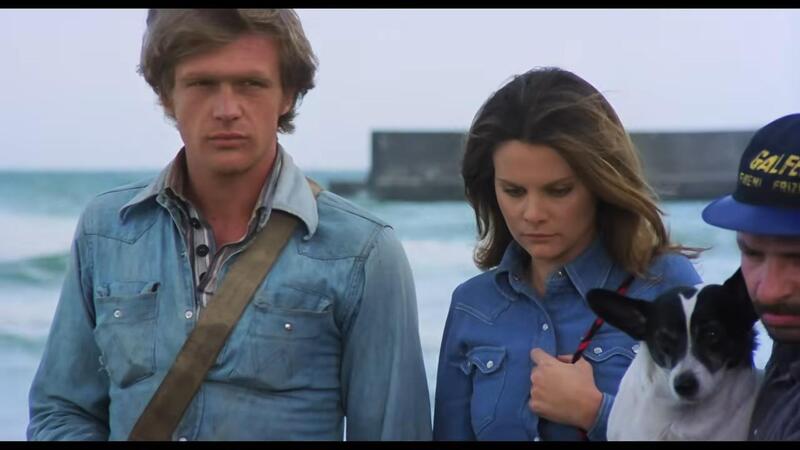
RAVING REVIEW: You would think, by default, a film that takes place primarily on a yacht should make the world feel larger. In WAVES OF LUST, it does the opposite. The sea stretches out in every direction, the sun bakes the deck, and director Ruggero Deodato slowly turns all that open space into a floating trap where money, sex, resentment, and power begin to breathe the same stale air.
The film is pure 70s Euro-thriller bait. Irem (Al Cliver) and Barbara (Silvia Dionisio) are a young, sexually liberated couple drifting through a Sicilian getaway when they cross paths with Giorgio (John Steiner), a wealthy industrialist with a yacht, a cruel streak, and very little interest in hiding either. His wife, Silvia (Elizabeth Turner), lives under his control, absorbing humiliation and abuse while he turns every interaction into a test of dominance. Giorgio invites Irem and Barbara aboard, and the trip begins as a sun-drenched exercise in temptation before curdling into jealousy, manipulation, and danger.
There’s barely enough plot here to fill the cabin, but that isn’t automatically a dealbreaker. WAVES OF LUST works best as a pressure piece, not as a tightly engineered thriller. Deodato isn’t building an intricate mystery. He’s watching four people circle each other in a setting where escape is theoretically everywhere and practically nowhere. The boat becomes a social experiment with cocktails, exposed skin, economic imbalance, and bad intentions. Everyone looks relaxed until you notice how much watching there is.
John Steiner’s Giorgio is written with almost no redeeming qualities, which can make the class commentary feel a bit pointed. Still, Steiner understands the usefulness of a villain who doesn’t need to be an antihero. He plays him as a man who thinks money has freed him from decency. Giorgio doesn’t seduce as much as appraise. He treats Barbara as a new acquisition, Silvia as damaged property, and Irem as an inconvenience he can dismiss or provoke whenever bored. Steiner’s performance is comprehensive enough to fit the exploitation frame but controlled enough to keep Giorgio’s cruelty from becoming cartoonish too quickly.
Silvia Dionisio gives Barbara a different kind of control. Her performance is tied to the film’s eroticism, and Deodato’s camera never pretends otherwise, but Dionisio brings more to the role than decoration. Barbara knows the effect she has on Giorgio, and part of the film’s tension comes from the uncertainty of whether she’s improvising, teasing, testing boundaries, or following a plan already in motion. She can look carefree and calculating in the same scene, which helps WAVES OF LUST stay more interesting than its simple setup suggests.
Al Cliver’s Irem is the least forceful presence of the four, though that partly fits the character’s role in the strange sexual and psychological back-and-forth onboard. He watches, waits, reacts, and occasionally seems too passive for someone supposedly caught in a dangerous game. That can make him feel underwritten, especially next to Steiner’s aggression and Dionisio’s control of the frame. Elizabeth Turner fares better as Silvia, whose fear and hunger for escape give the film its stakes. She’s the person most visibly damaged by Giorgio’s domination, and Turner makes her vulnerability feel unstable rather than helpless.
Giorgio represents wealth, ownership, and cruelty, but the movie doesn’t make Irem and Barbara vigilantes standing outside that corruption. They’re drawn to the yacht, to the luxury, to the freedom money appears to offer. Their disgust with Giorgio is real, yet so is their fascination with the world he controls. That tension gives WAVES OF LUST a little more bite than a standard erotic thriller where bad people simply use sex as a prelude to violence.
The film’s social commentary is more suggestive than developed. Deodato gestures toward class resentment and capitalist rot, but Giorgio is so monstrous that the critique doesn’t have much complexity. He’s less a person than a target the movie keeps painting in thicker strokes. That makes the eventual psychological unraveling easy to anticipate, even if the ride there has enough sleazy atmosphere to hold attention.
As exploitation cinema, though, WAVES OF LUST has a grimy confidence that keeps it alive. Deodato would go on to make far more notorious films. This earlier work already shows his interest in people behaving badly under pressure, with the camera refusing to look away. The violence is limited compared with his later reputation, yet the cruelty is still felt in the way Giorgio controls the mood. The threat isn’t only physical. It’s social, sexual, financial, and emotional. He poisons the air until everyone else has to decide whether they’re outlasting him, using him, or becoming more like him.
This release gives WAVES OF LUST a stronger reason to resurface. The restoration is important for a film so dependent on sun, water, skin, interiors, and period style. The disc’s extras also help contextualize a movie that could easily be dismissed as disposable if viewed only for its surface. The commentary from Adrian Smith and Rod Barnett, the deleted scenes, the EROTIC TSUNAMI making-of documentary, and the Deodato-directed TV commercials give the package more value for Eurocult collectors than the film might have on its own.
WAVES OF LUST isn’t Deodato’s strongest film, nor is it an especially deep thriller. Its story is thin, some of its sexual politics are ugly in the way many exploitation films of its era are, and the suspense sometimes drifts when it should tighten. At the same time, it has enough atmosphere, cast chemistry, restored visual appeal, and power games to make it worthwhile for viewers already interested in Italian genre cinema. This is a movie of sunburned decadence, bad rich people, beautiful scenery, and worse impulses. It doesn’t cut as deeply as it thinks it does, but it knows how to trap four people on a boat and let the rot rise with the heat. For Euro-sleaze fans, that may be enough to make the trip worth taking.
Product Extras:
Audio Commentary by Film Historians and Hosts of Wild, Wild Podcast Adrian Smith and Rod Barnett
Deleted Scenes
Making-of Documentary Erotic Tsunami
TV commercials directed by and commented on by Ruggero Deodato
Please visit https://linktr.ee/overlyhonestr for more reviews.
You can follow me on Letterboxd, Instagram, Twitter, and YouTube. My social media accounts can also be found on most platforms by searching for 'Overly Honest Reviews'.
I’m always happy to hear from my readers; please don't hesitate to say hello or send me any questions about movies.
[photo courtesy of RARO CINEMA ART VISIONS, KINO LORBER]
DISCLAIMER:
At Overly Honest Movie Reviews, we value honesty and transparency. Occasionally, we receive complimentary items for review, including DVDs, Blu-rays, CDs, Vinyl Records, Books, and more. We assure you that these arrangements do not influence our reviews, as we are committed to providing unbiased and sincere evaluations. We aim to help you make informed entertainment choices regardless of our relationship with distributors or producers.
Amazon Affiliate Links:
Additionally, this site contains Amazon affiliate links. If you purchase through these links, we may receive a commission. This affiliate arrangement does not affect our commitment to honest reviews and helps support our site. We appreciate your trust and support as you navigate these links.


Happy
0 %

Sad
0 %

Excited
0 %

Sleepy
0 %

Angry
0 %

Surprise
0 %
 0
0
 0
0


Average Rating