Asylum Walls and Broken Youth
Read Time:6 Minute, 58 Second
MOVIE REVIEW
Head Against the Wall (La tête contre les murs)
 –
– 


Genre: Drama
Year Released: 1959, 2026 Radiance Films Blu-ray
Runtime: 95 minutes
Director: Georges Franju
Writers: Jean-Pierre Mocky and Jean-Charles Pichon, based on the novel by Hervé Bazin
Cast: Jean-Pierre Mocky, Pierre Brasseur, Paul Meurisse, Anouk Aimée, Charles Aznavour, Édith Scob
Where to Watch: available now, order your copy here: www.radiancefilms.us, www.mvdshop.com, or www.amazon.com
RAVING REVIEW: Before Georges Franju gave horror cinema one of its most unsettling experiences with EYES WITHOUT A FACE, he made a film about confinement that didn’t need masks, scalpels, or exaggeration to feel disturbing. LA TÊTE CONTRE LES MURS is built from locked doors, family authority, medical certainty, and the terrifying ease with which a person can be removed from ordinary life once the right signatures are in place.
François Gérane (Jean-Pierre Mocky) is introduced as a young man with too much anger, too little discipline, and no real place within the world his father expects him to enter. He steals, rebels, burns through chances, and carries himself with the restless arrogance of someone who doesn’t know how much power other people have over him. After one theft too many, his father doesn’t call the police or try to understand why. He has committed François to a psychiatric institution, where rebellion is redefined as illness and disobedience becomes something to be managed.
LA TÊTE CONTRE LES MURS has an undeniably sharp political edge without turning into a lecture. The film understands the asylum as more than a hospital. It’s a mechanism of social correction, a place where families, doctors, and class power can hide punishment behind medical practice. François may be irresponsible, selfish, and often difficult to sympathize with, but Franju doesn’t need him to be innocent for the film’s outrage to register. The horror here is that imperfection gives authority an excuse to erase him.
Mocky, who also adapted Hervé Bazin’s novel, plays François with a rawness that can be abrasive by design. He isn’t trying to make the character easy to like. François is impulsive, immature, and sometimes painfully naïve about the forces closing around him. That makes him more interesting than a more innocent version of this character would have been. He’s not a saint crushed by cruelty. He’s a flawed young man whose flaws are used against him by a system more dangerous than anything he’s done.
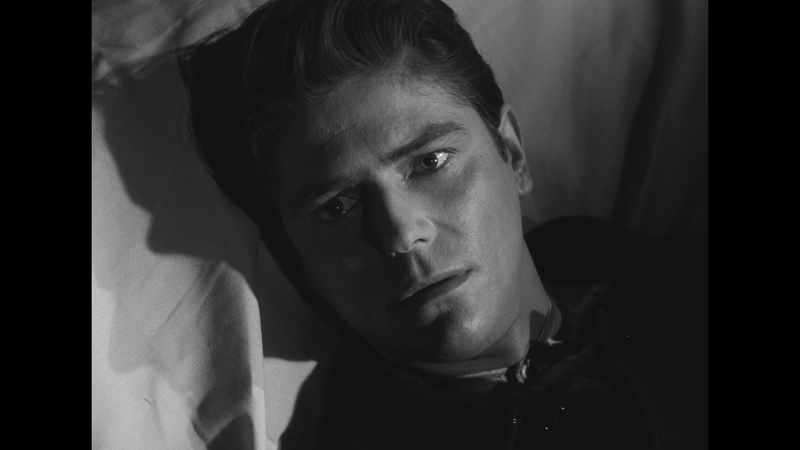
Franju’s direction is already recognizable here, even if the film doesn’t have the unnerving precision of his later work. His eye finds dread in normality. The institution is shot with a chill, but there’s poetry in the way the images hang in corridors, fields, faces, and bodies waiting for permission to move. The black-and-white cinematography by Eugen Schüfftan gives the film a hard, shadowed beauty. It’s not showy, and it doesn’t need to be. The images feel drained of warmth, as if the building itself has learned to suppress emotion.
A failed escape, an epileptic seizure, the sight of patients gathered in institutional routines, and the grim repetition of doors opening only to close again all carry a charge that reaches beyond plot. Franju had already made documentaries that stared directly at people and systems most preferred not to look at, and that background matters here. He doesn’t treat the asylum as a backdrop for melodrama. He studies it as a place where cruelty can become ordinary through repetition.
Pierre Brasseur’s Dr. Varmont represents the old order with a chilling lack of doubt. He speaks as someone who believes containment is care because society has allowed him to. Paul Meurisse’s Dr. Emery offers a more humane alternative, and the film uses their opposition to examine competing ideas of psychiatry, control, and dignity. Their conflict gives the film its moral framing, and Brasseur’s cold authority makes an immediate impression.
Charles Aznavour brings the film some of its most fragile moments as Heurtevent, a long-term resident whose gentleness makes the institution feel even more punishing. He doesn’t appear as just a supporting figure or a sentimental symbol of suffering. His presence broadens the movie’s emotional range and deepens François’s experience in the asylum. Anouk Aimée, as Stéphanie, gives François a connection to the world beyond the walls, though the role itself is thinner than her presence deserves. She brings tenderness and distance to a part that sometimes functions more as memory and regret than as a developed person.
The film can be uneven, especially when its ideas are more forceful than its narrative. Some stretches feel more observational, and the character relationships don’t always carry the emotion the film seems to want from them. Those issues keep the film from hitting with the same force as Franju’s best work, but they don’t take away its impact. As a debut feature, it’s fascinating because so much of his later visions are already visible. The clinical and the dreamlike sit side by side. Compassion is present, but it’s never gentle. Beauty appears in places where beauty shouldn’t survive. Violence can be sudden, quiet, or bureaucratic, and Franju seems equally disturbed by all three forms.
The new Radiance Blu-ray release gives the film a welcome chance to be seen as more than a footnote in his filmography. The 4K restoration respects the textures of Schüfftan’s photography, and the uncompressed mono audio helps Maurice Jarre’s score retain its strange, sometimes abrasive tone. The archival interviews and newer material about Mocky also matter because LA TÊTE CONTRE LES MURS is as much his project as it is Franju’s. It began with Mocky’s passion for the material, and even under another director’s control, that anger remains in the bones of the film.
LA TÊTE CONTRE LES MURS may not be as refined or unforgettable as the films that would define Franju. But it’s a strong, wounded, visually striking debut with real historical and emotional value. It’s a film about madness that’s more troubled by the sanity of the people in charge. That idea still cuts deep, even when the film around it occasionally wanders.
Bonus Materials:
4K restoration by Éclair Classics supervised by Mocky Delicious Products
Uncompressed mono PCM audio
Archival interview with screenwriter and star Jean-Pierre Mocky (2008, 10 mins)
Archival interview with director Georges Franju and actor Charles Aznavour (1958)
Interview with Jean-Pierre Mocky’s assistant and friend Eric Le Roy (2023, 25 mins)
Archival trailer
Newly improved English subtitle translation
Reversible sleeve featuring designs based on original posters
Please visit https://linktr.ee/overlyhonestr for more reviews.
You can follow me on Letterboxd, Instagram, Twitter, and YouTube. My social media accounts can also be found on most platforms by searching for 'Overly Honest Reviews'.
I’m always happy to hear from my readers; please don't hesitate to say hello or send me any questions about movies.
[photo courtesy of RADIANCE FILMS, MVD ENTERTAINMENT]
DISCLAIMER:
At Overly Honest Movie Reviews, we value honesty and transparency. Occasionally, we receive complimentary items for review, including DVDs, Blu-rays, CDs, Vinyl Records, Books, and more. We assure you that these arrangements do not influence our reviews, as we are committed to providing unbiased and sincere evaluations. We aim to help you make informed entertainment choices regardless of our relationship with distributors or producers.
Amazon Affiliate Links:
Additionally, this site contains Amazon affiliate links. If you purchase through these links, we may receive a commission. This affiliate arrangement does not affect our commitment to honest reviews and helps support our site. We appreciate your trust and support as you navigate these links.


Happy
0 %

Sad
0 %

Excited
0 %

Sleepy
0 %

Angry
0 %

Surprise
100 %
 1
1
 0
0

Average Rating