Humanity Disappears Beneath the Noise
Read Time:6 Minute, 48 Second
MOVIE REVIEW
Tetsuo: The Bullet Man [Limited Collector's Edition]
 –
– 

Genre: Horror, Science Fiction, Body Horror, Cyberpunk
Year Released: 2009, 2026 Blu-ray
Runtime: 1h 11m
Director(s): Shinya Tsukamoto
Writer(s): Shinya Tsukamoto, Hisakatsu Kuroki
Cast: Eric Bossick, Akiko Monô, Yûko Nakamura, Stephen Sarrazin, Shinya Tsukamoto
Where to Watch: available now, order your copy here: www.unearthedfilms.com, www.mvdshop.com, or www.amazon.com
RAVING REVIEW: The camera doesn’t observe Anthony’s transformation so much as become part of the experience alongside it. Metal scrapes, bodies twitch, voices become swallowed by noise, and the image repeatedly threatens to come apart before the character does. TETSUO: THE BULLET MAN is an exhausting 71 minutes by design, though Shinya Tsukamoto’s commitment to sensory punishment becomes both its greatest strength and its most persistent obstacle.
Released two decades after TETSUO: THE IRON MAN and 17 years after TETSUO II: BODY HAMMER, this third entry doesn’t directly continue either story. Tsukamoto returns to the same anxieties surrounding flesh, machinery, masculinity, repression, and urban life, rebuilding them around an English-speaking American living in Tokyo. The familiar transformation remains, but the anger driving it has been attached to a more conventional revenge story. Ironically, I’ve struggled for so long to separate these films from another series of films; both MAN OF MARBLE (CZŁOWIEK Z MARMURU, 1977) and MAN OF IRON (CZŁOWIEK Z ŻELAZA, 1981) are two VERY different films, but ironically have a focus at their core on similar ideals. While the Tetsuo films are very different experiences, they look at struggle on a similar level.
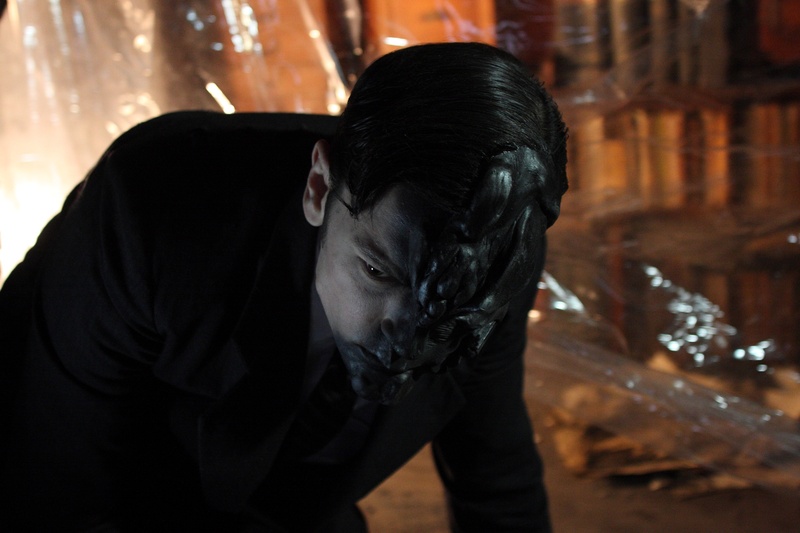
Anthony is an office worker whose carefully ordered life collapses when a driver deliberately kills his young son. Grief quickly gives way to physical changes that he can’t explain or control. His skin hardens, mechanical structures push through his body, and his rage reshapes him into something closer to a weapons system than a man. That gives the film an emotional foundation that is immediately understandable. A father losing his child requires little explanation, and Eric Bossick throws himself into Anthony’s anguish with an intensity Tsukamoto matches through violent editing and relentless sound design. The problem is that the performance and presentation begin at such a high level that they leave themselves nowhere convincing to go.
Bossick spends much of the film shouting, shaking, gasping, or staring in disbelief at what his body has become. His physical commitment is never in question, especially when Anthony is being thrown through rooms or struggling against another stage of his mutation. The quieter dialogue, however, exposes his limitations, with several conversations sounding stiff enough to interrupt the emotional pressure Tsukamoto is trying to build.
The decision to make TETSUO: THE BULLET MAN primarily in English creates an unusual distance between the characters and their surroundings. Anthony’s status as an outsider fits the story, but the language often feels imposed upon scenes rather than a natural connection by the people speaking it. Exposition arrives in statements, emotional exchanges become awkward, and even urgent revelations can sound like information being recited for the audience.
Akiko Monô brings more natural feeling to Yuriko, Anthony’s wife, and the person forced to experience both the loss of their child and her husband’s increasingly frightening behavior. She’s given less psychological room than Anthony, yet Monô finds genuine terror beneath the film’s chaos. Yuriko isn’t simply afraid of the creature emerging in front of her; she’s watching grief turn someone she loves into a weapon she may no longer recognize. That loss of identity remains more interesting than the revenge plot. Anthony’s transformation isn’t merely an extraordinary reaction activated by anger. His body becomes evidence that something has always been waiting beneath the bland office-worker exterior, tied to family secrets and decisions made long before his son’s death.
Tsukamoto again treats machinery as an extension of buried human urges. Wires and metal don’t replace the flesh in a focused technological upgrade. They rupture it. The resulting designs look painful, heavy, and difficult to carry, preserving the handmade physical discomfort associated with the series even as this entry works with a larger scale. The practical construction of the Bullet Man remains one of the movie’s strongest achievements. Anthony’s form doesn’t resemble an armored hero built to sell toys or launch sequels. He looks like an industrial accident that learned to move, with pieces jutting from his body at angles that suggest function has overwhelmed any semblance of human anatomy. TETSUO: THE BULLET MAN is more literal and less dangerous in its ideas. It explains more, presents a recognizable family tragedy, and moves toward the shape of an unusual superhero origin story, even as Tsukamoto’s direction resists that familiarity.
Shinya Tsukamoto plays the mysterious figure provoking Anthony’s evolution, bringing a cold, mocking presence to the film. His character understands the transformation better than Anthony and treats human suffering as part of a larger experiment. Their conflict gives the story an opponent, though his motives are conveyed through a mix of cryptic behavior and explanation that never proves as compelling as his appearance. The larger conspiracy surrounding Anthony’s body provides answers without making the film more satisfying. Each revelation reduces some of the uncertainty that made the physical changes disturbing. The first TETSUO could feel like a nightmare that had begun before viewers arrived and would continue after they left; this installment spends more time trying to account for its machinery.
The end credits bring Trent Reznor’s “Theme for Tetsuo: The Bullet Man,” a collaboration that feels almost inevitable given the shared industrial language between Nine Inch Nails and Tsukamoto’s work. Its grinding impact matches the film so naturally that it sounds less like an outside contribution than another sound generated by Anthony’s body. The track arrives late, but it gives the experience an appropriately abrasive final pulse.
Unearthed Classics’ 2026 edition presents the film on Blu-ray with 5.1 surround audio. Supplements include an audio commentary with Eric Bossick and Japanese cinema expert Tom Mes, the TETSUO: THE BULLET MAN – MULTI MATERIAL VERSION, a photo gallery, and trailers. That alternate version and commentary offer context for a production whose history and divided reputation are nearly as interesting as the finished feature.
Anthony becomes a “gun” because rage has left no room for anything else inside him. Tsukamoto communicates that idea through every scrape, flash, and collision, even when the film’s constant motion blurs its impact. The result is a damaged but recognizably personal conclusion to the trilogy.
Bonus Materials:
Audio Commentary with Actor Eric Bossick and Japanese cinema expert Tom Mes
Tetsuo: The Bullet Man – Multi Material Version
Photo Gallery
Trailers
Please visit https://linktr.ee/overlyhonestr for more reviews.
You can follow me on Letterboxd, Instagram, Twitter, and YouTube. You can also find my social media accounts on most platforms by searching for 'Overly Honest Reviews'.
I’m always happy to hear from my readers; please don't hesitate to say hello or send me any questions about movies.
[photo courtesy of UNEARTHED FILMS, MVD ENTERTAINMENT]
DISCLAIMER:
At Overly Honest Movie Reviews, we value honesty and transparency. Occasionally, we receive complimentary items for review, including DVDs, Blu-rays, CDs, Vinyl Records, Books, and more. We assure you that these arrangements do not influence our reviews, as we are committed to providing unbiased and sincere evaluations. We aim to help you make informed entertainment choices regardless of our relationship with distributors or producers.
Amazon Affiliate Links:
Additionally, this site contains Amazon affiliate links. If you purchase through these links, we may receive a commission. This affiliate arrangement does not affect our commitment to honest reviews and helps support our site. We appreciate your trust and support as you navigate these links.


Happy
0 %

Sad
0 %

Excited
100 %

Sleepy
0 %

Angry
0 %

Surprise
0 %
 1
1
 0
0

Average Rating