Horror Gets Loud Behind Prison Walls
Read Time:7 Minute, 37 Second
MOVIE REVIEWS
Ghost in the Cell
 –
– 


Genre: Action, Comedy, Horror, Thriller
Year Released: 2026
Runtime: 1h 46m
Director: Joko Anwar
Writer: Joko Anwar
Cast: Abimana Aryasatya, Bront Palarae, Dimas Danang Suryonegoro, Endy Arfian, Aming Sugandhi, Arswendy Bening Swara, Almanzo Konoralma
Where to Watch: in select theaters on October 2, 2026
RAVING REVIEW: GHOST IN THE CELL can go from a vicious murder to an absurd joke quickly enough to make you wonder whether Joko Anwar is daring the movie to fall apart. Then he'll throw in a prison fight, political satire, another grotesque body, and something supernatural before giving the characters room to be funny again. Keeping all of that under control seems almost impossible, which makes it strangely entertaining to watch Anwar keep testing how much one movie can hold.
Anyone coming from his darker work should probably adjust expectations early. The filmmaker behind SATAN'S SLAVES and IMPETIGORE hasn't abandoned horror, and GHOST IN THE CELL can still get wonderfully nasty when it wants to, but this is considerably more playful. Fear is only one piece of the experience because Anwar seems equally interested in making the audience laugh at these men, care about them, watch them beat each other senseless, and recognize the institutional absurdity surrounding them.
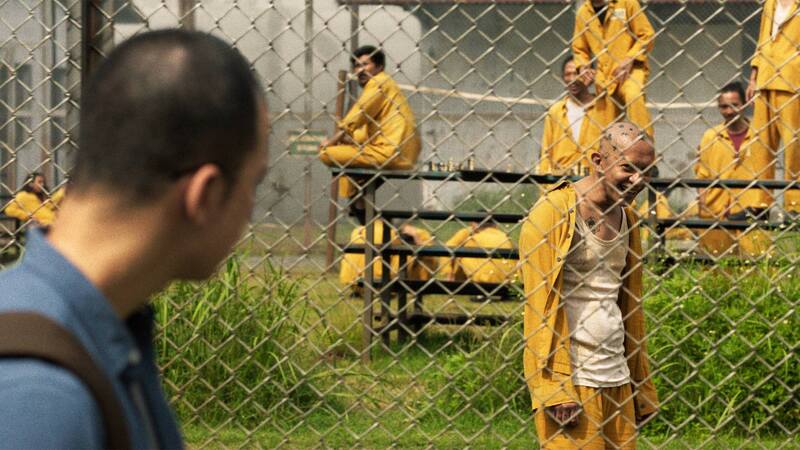
The setting gives him a lot to work with. A high-security prison is divided by gangs, personalities, money, and power, while the people supposedly maintaining order aren't necessarily any less dangerous than the inmates. Before the supernatural threat fully takes hold, Anwar has already established a place where survival depends on understanding a complicated system of alliances and knowing where you fall within an unofficial hierarchy.
New inmate Dimas, played by Endy Arfian, gives us an entry point into that ecosystem. He arrives with very little understanding of how the prison functions, and the tour of his new surroundings becomes an efficient way for Anwar to introduce a large collection of characters without making the opening feel like an endless series of introductions. Enough distinctive personalities are scattered through the cellblocks that remembering who belongs where becomes surprisingly easy.
Then prisoners start dying, and GHOST IN THE CELL gets much less interested in behaving itself. These aren't discreet supernatural deaths followed by someone finding a body under a sheet. Anwar turns several victims into elaborate displays, combining gore with an almost ridiculous level of presentation that makes the aftermath as memorable as the attack.
That excess fits a movie where nearly everything is turned up a little further than expected. Abimana Aryasatya, Bront Palarae, Dimas Danang, Aming Sugandhi, and the rest of the ensemble aren't asked to disappear into grim realism because Anwar wants personality bouncing around the prison. Even relatively small characters can become memorable through a strange mannerism, unexpected joke, or sudden burst of violence.
Dimas Danang is especially useful in keeping the comedy alive without making the supernatural danger meaningless. His Irfan understands the prison better than Dimas does, and his presence gives several stretches an almost buddy-comedy quality despite the terrible things happening around them. The humor can be broad, but the actors commit to it hard enough that much of it lands.
Aming Sugandhi is another standout because GHOST IN THE CELL embraces characters who would probably be reduced to background decoration in a more straightforward prison thriller. Anwar keeps finding little reasons to give someone another moment, reaction, or joke. That approach helps the prison feel populated by actual personalities rather than expendable bodies waiting for their turn in the horror machinery.
The downside is that giving the movie this many personalities, genres, and ideas also creates stretches where it seems to be competing with itself. A gruesome sequence can be interrupted by comedy before the horror has fully settled, while an emotional moment occasionally has to fight for space against the next joke. The tonal changes appear intentional, but intentional chaos is still chaos, and not every transition is equally smooth.
The film also packs a lot of story into 106 minutes. Rivalries, the supernatural mystery, corrupt authority figures, personal histories, social class, prison politics, violence, and comedy are constantly pushing for attention. The energy keeps GHOST IN THE CELL from becoming boring, but the film sometimes moves past an interesting idea before it has done enough with it.
That becomes particularly noticeable in Anwar's use of the prison as a larger social statement. There are clear differences between the treatment of powerful people and everyone else, with privilege functioning inside the walls much the same way it does outside them. Money and status don't disappear because someone enters prison; they simply buy a different version of incarceration.
Anwar isn't subtle about the point, nor does he appear interested in being subtle. The corruption is exaggerated, the inequality is plainly visible, and authority repeatedly becomes another part of the joke. GHOST IN THE CELL works best when those ideas grow naturally from the environment rather than stopping the horror to explain what everything represents.
Knowing the film was made for an Indonesian audience is useful here because some of the political humor carries a specificity international viewers won't necessarily catch. The broader ideas still travel easily. Anyone can understand the absurdity of a supposedly controlled institution where rules depend on who has money, who knows whom, and who possesses enough power to ignore whatever rules remain.
The ghost becomes almost funny in that context, because an otherworldly killer isn't automatically the worst thing about being trapped inside this place. Human beings have already created a system capable of making life miserable before anything supernatural arrives. Anwar uses horror to disrupt that existing order instead of pretending everything functioned properly until the haunting began.
For all of the satire, though, the gore may be what horror fans remember first. GHOST IN THE CELL enjoys physical effects and doesn't hide the damage once bodies start piling up. Several images have an elaborate ugliness that feels designed to make viewers recoil, then look again to process what Anwar put on screen.
The action also gives the movie another identity beyond supernatural horror. Anwar stages bursts of close-quarters fighting that exploit narrow corridors, barred rooms, and bodies packed together with little space to move. The prison doesn't simply provide the backdrop; its physical restrictions regularly shape how characters fight, run, hide, and attempt to survive.
With so much happening, the quieter material inevitably gets less attention. Some characters become far more interesting than the time available for them, while others seem built primarily to serve a joke or conflict before the movie moves along. Anwar's enthusiasm for the entire ensemble is infectious, but cutting one or two threads might have given the strongest relationships more room to breathe.
Still, something is appealing about a filmmaker refusing to strip his movie down into the safest possible version of itself. GHOST IN THE CELL could have been an effective supernatural prison thriller without the comedy, social commentary, or wild supporting characters. Anwar clearly wasn't interested in stopping there.
The result is messier than his best horror, but the mess often feels alive. One sequence might be genuinely creepy, the next intentionally ridiculous, and another unexpectedly brutal, with the film trusting viewers to follow it through each shift. Not every swing connects, yet there are enough of them that the misses don't erase how much personality is packed into the movie.
GHOST IN THE CELL earns its 3.5 out of 5 by being ambitious enough to risk losing control and entertaining enough that the instability becomes part of the attraction. Anwar hasn't made the cleanest mixture of horror, comedy, action, and social satire. Still, he has made one that feels unmistakably his, with plenty of blood on the floor and absolutely no interest in behaving quietly behind bars.
Please visit https://linktr.ee/overlyhonestr for more reviews.
You can follow me on Letterboxd, Instagram, Twitter, and YouTube. You can also find my social media accounts on most platforms by searching for 'Overly Honest Reviews'.
I’m always happy to hear from my readers; please don't hesitate to say hello or send me any questions about movies.
[photo courtesy of WELL GO USA ENTERTAINMENT]
DISCLAIMER:
At Overly Honest Movie Reviews, we value honesty and transparency. Occasionally, we receive complimentary items for review, including DVDs, Blu-rays, CDs, Vinyl Records, Books, and more. We assure you these arrangements do not influence our reviews, as we are committed to unbiased, sincere evaluations. We aim to help you make informed entertainment choices regardless of our relationship with distributors or producers.
Amazon Affiliate Links:
This site also contains Amazon affiliate links. If you purchase through these links, we may receive a commission. This affiliate arrangement does not affect our commitment to honest reviews and helps support our site. We appreciate your trust and support as you navigate these links.


Happy
0 %

Sad
0 %

Excited
0 %

Sleepy
0 %

Angry
0 %

Surprise
0 %
 0
0
 0
0


Average Rating