Saturday Night Ambition, Monday Morning Reality
Read Time:6 Minute, 51 Second
MOVIE REVIEW
The Music Machine [Blu-ray]
 –
– 

Genre: Drama, Music
Year Released: 1979, 2026 Severin Films Blu-ray
Runtime: 1h 31m
Director(s): Ian Sharp
Writer(s): James Kenelm Clarke, Ian Sharp
Cast: Gerry Sundquist, Patti Boulaye, David Easter, Michael Feast, Ferdy Mayne, Clarke Peters, Brenda Fricker
Where to Watch: available now, order your copy here: www.severinfilms.com
RAVING REVIEW: Disco reached North London with fewer resources, more rain, and little hope of resembling the fantasy sold by the movies it wanted to recreate. THE MUSIC MACHINE responds by placing its glitter above unemployed young adults, cramped flats, cheap drinks, and people who view one dance competition as a possible route toward a different life. The result is neither a convincing musical drama nor an outright failure. It’s a frequently clumsy production whose limitations preserve something far more interesting than the story it was trying to tell.
Comparisons to SATURDAY NIGHT FEVER were inevitable in 1979 and remain unavoidable now. Gerry Pearson wears the clothes, spends his nights at a club, and becomes determined to prove himself through dancing. A competition promises the winning couple roles in a movie, turning an ordinary nightspot into an unlikely gateway toward fame. The resemblance is obvious enough that THE MUSIC MACHINE rarely attempts to disguise where the initial idea came from. Ian Sharp’s film becomes more distinctive whenever it leaves that behind. The streets, estates, and family homes don’t carry the romantic sheen associated with stories about discovering stardom. Gerry’s prospects are limited before he enters the competition, and winning doesn’t feel like the final step in a lifelong artistic pursuit. He wants an escape because remaining where he is offers very little.
Gerry Sundquist makes him likable in flashes, particularly when his insecurity breaks through his swagger. Gerry isn’t a natural performer waiting to be discovered. He’s an unemployed young man who sees dancing as the one area where confidence might compensate for a lack of direction. That distinction gives his pursuit a working-class desperation. The problem is that Gerry never becomes an especially convincing dancer. Editing often cuts around his limitations, favoring close-ups, reaction shots, and brief movements rather than letting the choreography show why this particular man might win a major competition. Gerry improves because the screenplay says he does, not because the camera provides much evidence. In a movie built around competitive dancing, that absence is difficult to overlook.
His roughness could have supported an underdog story if the surrounding dancers weren’t so much stronger. David Easter brings a physical confidence to Howard, Gerry’s main rival, and immediately looks more comfortable beneath the club lights. The imbalance creates an odd tension in which the presumed antagonist appears better prepared for the prize than the hero. Gerry’s success depends less on becoming exceptional than on the movie deciding that sincerity deserves to defeat technique.
Patti Boulaye supplies much of the energy missing from the lead. Claire has the talent, composure, and screen presence Gerry needs in a partner, yet the narrative often treats her as support for his transformation rather than an equal participant in it. Boulaye refuses to disappear into that. She makes Claire’s confidence feel earned and gives their scenes a charge that Gerry’s earlier romantic pursuits never develop. The movie becomes livelier whenever Claire takes the floor, partly because Boulaye moves with a natural assurance that the production can’t manufacture elsewhere. Her presence also complicates the underdog triumph. Gerry’s opportunity depends heavily on a woman who is already more gifted than he is, although recognition continues moving in his direction.
Clarke Peters gives the most relaxed performance as Laurie, the club’s disc jockey and Gerry’s unlikely mentor. Peters understands how to project authority without forcing it, and Laurie’s encouragement makes him one of the few people who appear interested in something beyond status. The character’s investment in Gerry isn’t developed as much as it should be, though Peters creates the impression of a richer relationship than the screenplay provides.
Michael Feast plays Nick Dryden with enough oily enthusiasm to represent the less appealing side of the club. The competition may offer fame, but it also attracts people eager to package the dancers before understanding them. Ferdy Mayne’s producer adds another layer of exaggerated show-business opportunism, turning the venue into a place where working-class ambition can be sold back to the people experiencing it.
THE MUSIC MACHINE is at its best when those commercial interests collide with the club’s character. Everyone is supposedly chasing the same dream, although it means something different depending on who controls it. The dancers want recognition, the promoters want a marketable discovery, and Gerry wants a reason to believe his life isn’t already narrowing around him. Sharp never brings these ideas into a particularly focused argument, but they keep the competition from becoming entirely disposable.
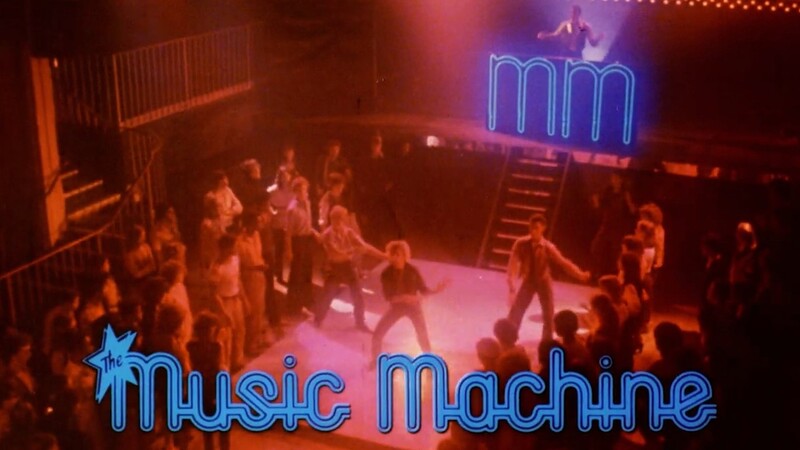
Cinematographer Phil Méheux gives the production far more visual credibility than its thin resources would suggest. Colored lights, mirrors, smoke, reflective clothing, and crowded dance floors create pockets of genuine excitement. The club sequences have texture rather than polish, preserving sweat, awkwardness, and the occasional emptiness surrounding people who came there to be seen. That atmosphere has aged better than the drama. THE MUSIC MACHINE now functions as an unintentional record of clothing, dance, speech, nightlife, and economic frustration at the end of the 1970s. Details that once seemed ordinary carry much of the fascination decades later. Even the movie’s financial struggles have become informative, exposing the distance between the glamour these characters consume and the conditions in which they attempt to reproduce it.
Severin Films’ Blu-ray gives this neglected oddity a more respectful presentation than anyone involved could have reasonably expected. The 4K scan brings clarity to Méheux’s nightclub photography while preserving the rough qualities that suit the production. The interviews with Boulaye, Peters, fellow cast members, choreographer Anthony Van Laast, musician Les Hurdle, and others provide the kind of history the feature can’t communicate on its own. A location tour further connects its fictional ambitions to the London that shaped them.
The extras also help explain why the movie remains appealing despite so many weaknesses. There’s sincerity beneath the imitation. Sharp and his collaborators weren’t merely copying a successful film; they were translating an international craze through British performers, locations, finances, and social conditions. That translation is messy, though the mess gives THE MUSIC MACHINE its personality.
It may not be able to sell Gerry as Britain’s answer to John Travolta, and its story rarely moves with the confidence of its best dancers or music. Still, it captures a room filled with people trying to outrun disappointment before the music stops, which turns out to be enough to keep this imperfect machine running.
Please visit https://linktr.ee/overlyhonestr for more reviews.
You can follow me on Letterboxd, Instagram, Twitter, and YouTube. You can also find my social media accounts on most platforms by searching for 'Overly Honest Reviews'.
I’m always happy to hear from my readers; please don't hesitate to say hello or send me any questions about movies.
[photo courtesy of SEVERIN FILMS]
DISCLAIMER:
At Overly Honest Movie Reviews, we value honesty and transparency. Occasionally, we receive complimentary items for review, including DVDs, Blu-rays, CDs, Vinyl Records, Books, and more. We assure you that these arrangements do not influence our reviews, as we are committed to providing unbiased and sincere evaluations. We aim to help you make informed entertainment choices regardless of our relationship with distributors or producers.
Amazon Affiliate Links:
Additionally, this site contains Amazon affiliate links. If you purchase through these links, we may receive a commission. This affiliate arrangement does not affect our commitment to honest reviews and helps support our site. We appreciate your trust and support as you navigate these links.


Happy
0 %

Sad
0 %

Excited
0 %

Sleepy
0 %

Angry
0 %

Surprise
0 %
 0
0
 0
0



Average Rating