The Grievance Was Already Loaded
Read Time:6 Minute, 24 Second
MOVIE REVIEW
Dead Man's Wire
 –
– 


Genre: Crime, Drama, Thriller
Year Released: 2025, 2026 Blu-ray
Runtime: 1h 45m
Director: Gus Van Sant
Writer: Austin Kolodney
Cast: Bill Skarsgård, Dacre Montgomery, Colman Domingo, Myha’la, Cary Elwes, Al Pacino, Kelly Lynch
Where to Watch: available now, order your copy here: www.moviesunlimited.com or www.amazon.com
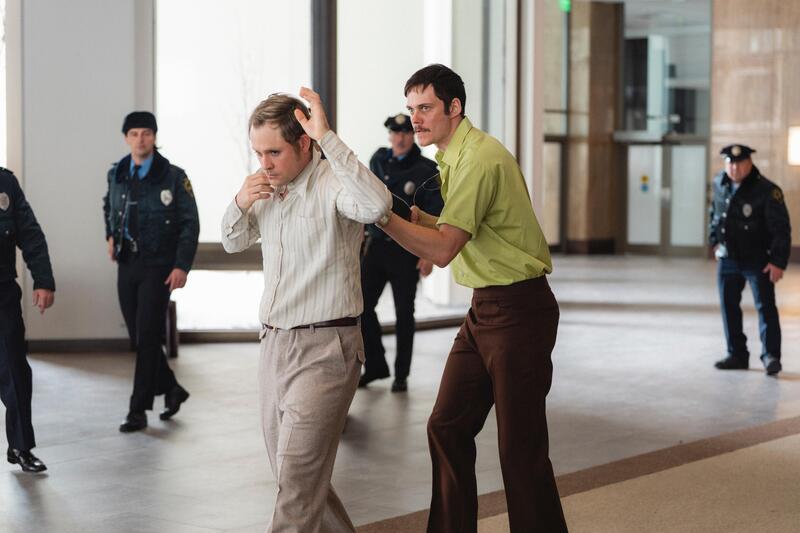
RAVING REVIEW: Tony Kiritsis carries a terrible burden he’s rehearsed until it feels reasonable. He believes an Indianapolis mortgage company has cheated him out of a real estate development, and ordinary channels have failed to deliver the justice he thinks he deserves. His answer is to put a wire around mortgage broker Richard Hall’s neck, attach it to the trigger of a sawed-off shotgun, and turn a financial dispute into a hostage crisis that the entire country can watch. Yep, that accelerated fast, but that’s the point!
That device provides DEAD MAN’S WIRE with the clear danger, although Gus Van Sant is more interested in everything surrounding the weapon. Tony isn’t merely trying to collect money or escape punishment. He wants an audience, an apology, and public acknowledgment that an institution has treated him as disposable. Once television cameras, radio personalities, police officers, attorneys, and spectators become involved, his crime begins functioning as a national broadcast built around one man’s anger.
The comparison to DOG DAY AFTERNOON is unavoidable, particularly once Tony’s improvised plan starts attracting public sympathy. Van Sant isn’t simply remaking that earlier film’s mixture of desperation and spectacle, though. Tony’s grievance comes from a distinctly American conviction that business failure must have been engineered by someone else and that personal humiliation deserves a public correction. The film lets us understand why he feels trapped without accepting the violent conclusion he draws from it.
Bill Skarsgård plays Tony as a man constantly trying to stay one step ahead of his own panic. His exploration moves between careful explanations, sudden threats, wounded objections, and flashes of unexpected humor. The performance could easily have become a collection of eccentric gestures, especially with the period details, sleepless appearance, and volatile behavior. Skarsgård instead gives those details a common source. Tony needs everyone around him to believe that he remains in control because admitting otherwise would collapse the identity he has constructed.
That need for recognition makes him frightening and oddly persuasive at the same time. He can sound reasonable while holding a loaded weapon against another man’s head, then become furious when anyone questions the logic of his position. Skarsgård doesn’t ask us to embrace Tony as an antihero. He shows how quickly grievance can become performance when a person discovers that anger attracts more attention than patience ever did.
Dacre Montgomery has the less showy and, in some ways, more difficult role as Richard Hall. Most of his performance comes through physical restraint. The guarded breathing, the posture, and the constant awareness that even a small movement could kill him. Richard is frightened, humiliated, and sometimes even resentful, but he understands that expressing any of those feelings could provoke the man holding him.
Montgomery never competes with Skarsgård for the scene. He lets Richard’s forced passivity become its own source of tension, particularly when outsiders begin discussing the hostage situation as though Richard were little more than equipment attached to Tony’s protest.
Van Sant and cinematographer Arnaud Potier avoid making 1977 Indianapolis look overly staged or preserved. Offices are plain, streets feel bitterly cold, and Tony’s apartment becomes an increasingly uncomfortable collection of telephones, ashtrays, food containers, and exhaustion.
Colman Domingo brings warmth and hesitation to the radio host who becomes Tony’s chosen connection to the outside world. He recognizes the value of the story, but he also understands that Tony is listening for validation and may interpret almost any response as betrayal. Myha’la’s television reporter approaches the crisis from another direction, pushing against professional limitations while recognizing that the media has begun converting suffering into an irresistible piece of programming. Those characters help the film examine how quickly journalism, entertainment, and negotiation become tangled together. The cameras can discourage violence by giving Tony the visibility he wants, but they also reward him for taking a hostage. Every broadcast expands his importance. Every interview strengthens his belief that he has finally forced the world to listen.
Al Pacino appears briefly as the elder Hall, whose perceived refusal to respect Tony helped ignite the confrontation. The limited screen time keeps the character from becoming a fully developed corporate antagonist. However, Pacino gives him enough pride and irritation to explain why Tony has turned him into something more. Cary Elwes and Kelly Lynch fill out the surrounding world without distracting from the two men physically bound to one another.
The dark humor is often effective, but it occasionally makes the standoff feel safer than it is. Richard’s psychological suffering receives less attention than Tony’s explanations. At the same time, the mortgage dispute itself stays vague enough that viewers can fill the missing space with whatever version of corporate wrongdoing they already believe. (Healthcare would be a great parallel today, #TeamLuigi)
The middle act kind of circles the same negotiations and emotional outbursts. That repetition reflects the reality of a prolonged standoff, though the film doesn’t always find a fresh way to dramatize each new phone call or demand. The media story keeps events moving, but some of its commentary arrives more directly than the scenes between Tony and Richard. The closing use of archival material is especially effective because it removes whatever distance the recreation has created. The shotgun rig, television cameras, and crowds weren’t inventions added to make the story more dramatic. People really gathered to watch a terrified man being marched through frozen Indianapolis streets while his captor explained his grievances to anyone willing to broadcast them.
DEAD MAN’S WIRE understands that Tony’s greatest weapon isn’t the shotgun. It’s his ability to make resentment sound like a shared national injury. Skarsgård and Montgomery maintain an uneasy connection throughout. The result is tense, funny in some ways, and politically provocative, even when its curiosity about Tony comes at Richard’s expense.
Please visit https://linktr.ee/overlyhonestr for more reviews.
You can follow me on Letterboxd, Instagram, Twitter, and YouTube. You can also find my social media accounts on most platforms by searching for 'Overly Honest Reviews'.
I’m always happy to hear from my readers; please don't hesitate to say hello or send me any questions about movies.
[photo courtesy of MOVIES UNLIMITED, ALLIANCE HOME ENTERTAINMENT, ROW K ENTERTAINMENT]
DISCLAIMER:
At Overly Honest Movie Reviews, we value honesty and transparency. Occasionally, we receive complimentary items for review, including DVDs, Blu-rays, CDs, Vinyl Records, Books, and more. We assure you that these arrangements do not influence our reviews, as we are committed to providing unbiased and sincere evaluations. We aim to help you make informed entertainment choices regardless of our relationship with distributors or producers.
Amazon Affiliate Links:
Additionally, this site contains Amazon affiliate links. If you purchase through these links, we may receive a commission. This affiliate arrangement does not affect our commitment to honest reviews and helps support our site. We appreciate your trust and support as you navigate these links.


Happy
0 %

Sad
0 %

Excited
0 %

Sleepy
0 %

Angry
0 %

Surprise
0 %
 0
0
 0
0

Average Rating