Technology Can’t Replace Moral Judgment
Read Time:6 Minute, 33 Second
MOVIE REVIEW
Certain Thomas
 –
– 


Genre: Science Fiction, Drama, Thriller
Year Released: 2026
Runtime: 19m
Director: Henry K. Hwang
Writer: Henry K. Hwang
Cast: Leon Schwendener, Juniper Renee Verdon, Sean Weil, Christopher Chan, Toni Fazio
Where to Watch: shown at the 2026 HollyShorts Film Festival
RAVING REVIEW: A “machine” doesn’t have to hate anyone to ruin a life. It only needs authority, data, and a population trained to interpret its conclusions as truth. CERTAIN THOMAS builds its dystopia around that chillingly ordinary proposition, imagining a society in which mathematical certainty has replaced moral judgment rather than merely assisting it. There’s no unstable computer broadcasting its intention to conquer humanity.
Henry K. Hwang’s short is more interested in people who have voluntarily surrendered the burden of deciding. The system is considered flawless, which allows every official operating beneath it to treat obedience as innocence. When an algorithm produces a savage order, nobody has to accept responsibility. They can point to the calculation and turn their backs on judgment.
Thomas K. (Leon Schwendener) begins as a willing participant in this. He serves as an analyst within a totalitarian state that has reduced governance to classification and enforcement. His uniform places him inside the machinery of power, yet his position also requires him to look closely at the information used to justify its decisions. That proximity eventually creates the doubt the system was designed to prevent.
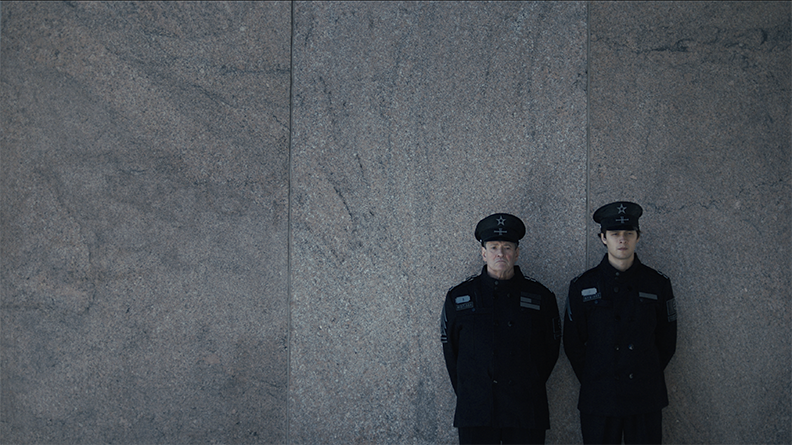
Hwang makes the regime oppressive without relying on enormous crowds or expensive cityscapes; you can look at their uniforms and immediately know what they represent. Martyna Kalata and Grace Musser’s production design favors white corridors, clear insignias, controlled workspaces, and uniforms that diminish individual identity. The environments appear orderly enough to be reassuring at first glance. Their severity becomes more noticeable once Thomas begins recognizing what that order demands from him.
The emptiness matters as much as the symmetry. People move through spaces that seem built to remove privacy, spontaneity, and any sign that a life exists outside its assigned function. Even the regime’s imagery has the impersonal quality of information arranged for immediate recognition. Nothing needs to be comforting or expressive as long as it can be processed.
Frank Yu’s cinematography reinforces that loss of individuality through composed frames and restricted visual space. Thomas is frequently absorbed into the geometry surrounding him rather than presented as someone capable of changing it. His crisis develops through small disruptions in that arrangement, including hesitations, expressions, and moments when his body no longer appears aligned with the institution controlling it.
Schwendener gives those changes patience. Thomas doesn’t transform into a revolutionary the moment he encounters an answer he dislikes. His first instinct is to examine the result, search for an error, and preserve his belief that the system remains sound. That reaction makes sense for someone whose identity depends upon the idea that uncertainty has already been solved.
The character’s spiritual beliefs introduce a standard the algorithm can’t account for. Faith isn’t presented as a technical rival capable of defeating mathematics on its own terms. It represents Thomas’s belief that human worth can’t be calculated solely through probability, efficiency, or usefulness. His conscience becomes dangerous because it recognizes an obligation that exists beyond approved evidence.
CERTAIN THOMAS is strongest when that conflict remains visible in Schwendener’s performance rather than spoken about. His discomfort grows before he has the language or courage to describe it, leaving him caught between institutional certainty and an internal conviction he has probably been taught to suppress. The state has prepared him to recognize faulty numbers. It hasn’t prepared him to consider that a correct calculation might produce an immoral decision.
It would be interesting to see where the story could go with a greater examination of how ordinary life under the regime would have strengthened Thomas’s decision. The short shows the institutional face of algorithmic lifestyle more than its domestic or social effects. Toni Fazio’s Mother and Juniper Renee Verdon’s Leah offer glimpses of the human attachments threatened by a government that recognizes classifications more than relationships.
Sean Weil and Christopher Chan embody the chain of command surrounding him. Their authority is more disturbing when presented as routine than when pushed toward open cruelty. These men don’t need to consider themselves villains because the system has relieved them of interpretation. Their responsibility begins and ends with following the outcome.
Christopher Armstrong’s score adds impact to the film without trying to manufacture constant danger. The music supports the sense that Thomas is slowly becoming aware of something present long before he noticed it. His fear isn’t limited to what his superiors may do once they recognize his hesitation. He must also confront how many previous decisions he accepted because the numbers made resistance seem irrational. The danger comes from assigning those systems an authority they can’t carry in any ethical way. Data can identify patterns, anticipate behavior, and produce conclusions. It can’t experience mercy, guilt, love, or the responsibility of knowing that another person will suffer because of an answer.
Hwang has created enough history, imagery, and ideological conflict to make the society feel larger than the story being told. That scale occasionally leaves CERTAIN THOMAS feeling less like a fully independent narrative than a carefully constructed introduction to the planned feature expansion. The immediate conflict has purpose, but the world surrounding it invites questions the ending can only leave open.
Given a longer runtime could deepen Thomas’s earlier loyalty, clarify the role faith plays in his daily life, and allow Leah and his mother to challenge him as people rather than thematic reminders of what the regime overlooks. It could also examine whether citizens genuinely believe in the algorithm or have simply learned that questioning it is dangerous. Those are different forms of obedience, and separating them would make the state more complicated.
Hwang has already found the right figure through whom to explore those questions. Schwendener presents Thomas as neither fearless nor unusually enlightened. He’s a functionary whose certainty survives until the system demands something his conscience can’t figure out how to excuse. His eventual doubt isn’t weakness. It is the evidence that he remains capable of judging anything for himself.
This Thomas begins with certainty, convinced that the approved answer must also be the right one. CERTAIN THOMAS argues that doubt may be the part of him worth preserving, especially in a society that considers every unanswered question a defect waiting to be removed.
Please visit https://linktr.ee/overlyhonestr for more reviews.
You can follow me on Letterboxd, Instagram, Twitter, and YouTube. My social media accounts can also be found on most platforms by searching for 'Overly Honest Reviews'.
I’m always happy to hear from my readers; please don't hesitate to say hello or send me any questions about movies.
DISCLAIMER:
At Overly Honest Movie Reviews, we value honesty and transparency. Occasionally, we receive complimentary items for review, including DVDs, Blu-rays, CDs, Vinyl Records, Books, and more. We assure you that these arrangements do not influence our reviews, as we are committed to providing unbiased and sincere evaluations. We aim to help you make informed entertainment choices regardless of our relationship with distributors or producers.
Amazon Affiliate Links:
Additionally, this site contains Amazon affiliate links. If you purchase through these links, we may receive a commission. This affiliate arrangement does not affect our commitment to honest reviews and helps support our site. We appreciate your trust and support as you navigate these links.


Happy
0 %

Sad
0 %

Excited
0 %

Sleepy
0 %

Angry
0 %

Surprise
0 %
 0
0
 0
0

Average Rating