Hope Sings Through Hard Times
Read Time:8 Minute, 13 Second
MOVIE REVIEW
Hadestown: The Musical
 –
– 

Genre: Musical, Drama, Fantasy
Year: 2026
Runtime: 2h 21m
Director(s): Brett Sullivan; Rachel Chavkin (stage direction)
Writer(s): Anaïs Mitchell (book, music, and lyrics)
Cast: Reeve Carney, Eva Noblezada, André De Shields, Patrick Page, Amber Gray, Bella Brown, Madeline Charlemagne, Allie Daniel
Where to Watch: available now; order your copy here: www.moviesunlimited.com or www.amazon.com
RAVING REVIEW: A love song doesn’t put food on the table, and HADESTOWN: THE MUSICAL understands the trouble that creates. Orpheus believes in the song he’s writing with a conviction that’s both lovely and frustrating. Eurydice has to consider what happens while he’s occupied with saving the world through music. Their different priorities give this retelling of Greek mythology a recognizable human problem before its journey into the underworld gets underway.
Anaïs Mitchell’s musical places ancient gods and struggling mortals in a setting shaped by American folk music, New Orleans jazz, and industrial labor. Seasons are out of balance, work is scarce, and security comes with conditions. The world looks Depression-era, but its concerns about poverty, power, and the compromises people make to survive are easy to understand. You don’t need a background in mythology to recognize why a promise of warmth and steady employment carries so much weight.
Eva Noblezada makes that pressure real as Eurydice. She gives the character a guarded practicality that keeps the romance from floating away into abstract declarations about love. Eurydice wants affection, but she also needs to eat, and Noblezada allows both needs to exist without making one seem less worthy than the other. Her singing has force and emotional texture, with enough roughness around the edges to suggest someone whose life hasn’t allowed much room for softness.
That distinction matters because Orpheus has the luxury of believing so completely in an idea. Reeve Carney plays him with an openness that conveys innocence, though his fragile delivery and pronounced mannerisms sometimes make him harder to connect with. His high vocal register gives Orpheus a sound that sets him apart from everyone around him. At times, though, that separation becomes a limitation, especially beside performers who communicate complicated feelings with greater ease.
Carney’s approach still plays an important role in the story. Orpheus needs to see possibilities others have stopped considering, and his awkwardness helps explain why he doesn’t always register ordinary demands. The difficulty is maintaining that quality without letting him seem emotionally distant from the person he loves. Noblezada does much of the work of grounding their relationship, while the music supplies the tenderness his characterization occasionally struggles to provide.
The score is the strongest reason to enter this world. Mitchell gives the songs distinct personalities while keeping them connected through recurring melodies, rhythms, and phrases. “Way Down Hadestown” has an inviting momentum that makes the destination sound appealing before its costs become clear. “All I’ve Ever Known” allows the romance to open up, while “Flowers” gives Eurydice space for a more private kind of expression. The music can carry an argument, introduce a community, or reveal loneliness without sounding like it’s performing the same task every time.
That repetition becomes excessive over 141 minutes. Returning to a melody can change its meaning, and the show often uses that technique thoughtfully. At times another statement of an established feeling adds less than the production seems to expect. Orpheus’ recurring melodic passages are especially dependent on the viewer’s response to Carney’s voice. The score remains distinctive and absorbing, though a few sequences linger emotionally longer than they need to.
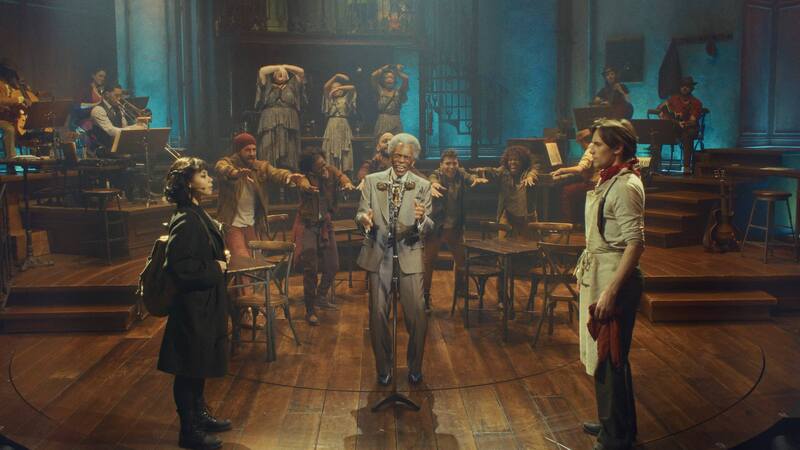
“Wait for Me” demonstrates how fully the music and stagecraft can support each other. The swinging industrial lamps give the journey a physical danger, with light moving through the performance space as the ensemble helps shape the passage. Rachel Chavkin’s stage direction makes relatively simple theatrical materials carry considerable force. The scale comes from coordinated movement, lighting, and the relationship between performers, giving the number a strong sense of purpose without requiring a literal reconstruction of the world it describes.
Brett Sullivan’s filmed presentation opens up details that many theater seats don’t offer. Close views bring facial reactions into focus, and overhead angles reveal the stage's organization from a different perspective. The turntable, entrances, and changing distances between characters remain important to how the story is told. Preserving those relationships is a major responsibility of the capture, particularly in a production where the ensemble’s movement expresses so much about control and collective labor.
The editing doesn’t always give those arrangements enough time to register. A close-up can reveal a feeling while also removing the surrounding action that gives it context, and busier cutting can interrupt the pleasure of watching the choreography unfold. Audience reactions reinforce the live setting, but they occasionally pull attention away from the performers at moments when staying onstage matters more. Sullivan’s choices add intimacy and variety, though more patience with certain wider views would strengthen the experience when it’s allowed.
The performers have plenty to reward that attention. André De Shields guides the production as Hermes with humor, authority, and an ease that makes the storytelling feel welcoming. He knows how to hold a pause and direct attention without seeming to work hard at either. His presence gives the show continuity through its mood shifts, and warmth underlies the knowledge he brings to the telling. Hermes's relationship with the audience makes listening feel like participation.
Patrick Page and Amber Gray bring a different history into the room as Hades and Persephone. Page’s exceptionally low voice gives Hades immediate weight, but the performance also conveys the insecurity behind his appetite for control. He offers protection in terms that preserve his authority, linking his role as ruler to his behavior as a husband. Gray’s Persephone responds with humor, frustration, and a restless energy that makes their marriage feel worn down by years of disappointments.
Gray is particularly effective at allowing pleasure and sadness to coexist. Her liveliness doesn’t erase Persephone’s unhappiness, and the humor carries traces of how she’s learned to endure it. “Our Lady of the Underground” gives her room to command the stage with a looser, more playful energy. Together, she and Page make the older couple’s relationship a substantial part of the drama, with its own desires and failures rather than merely a warning placed beside the younger romance.
The Fates and Workers contribute just as much to the production’s identity. Bella Brown, Madeline Charlemagne, and Allie Daniel give the Fates an unsettling mixture of charm and pressure, making their interventions sound persuasive even when they’re cruel. The Workers’ coordinated movement establishes Hadestown's demands through bodies performing repeated labor. The visible musicians also keep the sound connected to the people producing it, an especially fitting choice for a show so concerned with work and its value.
“Why We Build the Wall” makes the system’s reasoning clear through repetition and response. The song shows how fear can support obedience, with the community participating in an explanation that protects the ruler’s position. Its bluntness suits the moment, although the broader production sometimes explains its economic themes after the staging has already communicated them. The most convincing passages trust a gesture, a working body, or a desperate choice to make the point.
Filmed at London’s Lyric Theatre in 2025, this version reunites the five original Broadway principals while retaining the West End ensemble around them. That preservation has value, especially for viewers who never had access to this combination of performers. The recording also offers a substantial introduction on its own terms, with the songs and relationships providing enough clarity for newcomers. Familiarity with the cast album adds another layer, but it isn’t required to understand the stakes.
HADESTOWN: THE MUSICAL earns its emotional reach through people trying to secure things they can’t fully control. Eurydice wants a life she can survive, Orpheus wants his faith in music to be enough, and Hades tries to make possession stand in for reassurance. The performances give those wants a human scale beneath the gods and theatrical machinery. Its strongest songs leave room for hope while keeping hunger, fear, and doubt within hearing distance, and that tension gives the production something worth returning to.
Please visit https://linktr.ee/overlyhonestr for more reviews.
Follow me on Letterboxd, Instagram, Twitter, and YouTube. You can also find my social media accounts on most platforms by searching for 'Overly Honest Reviews'.
I’m always happy to hear from my readers; please don't hesitate to say hello or send me any movie questions.
[photo courtesy of BLEECKER STREET, MOVIES UNLIMITED, ALLIANCE HOME ENTERTAINMENT]
DISCLAIMER:
At Overly Honest Movie Reviews, we value honesty and transparency. Occasionally, we receive complimentary items for review, including DVDs, Blu-rays, CDs, Vinyl Records, Books, and more. We assure you these arrangements do not influence our reviews, as we are committed to unbiased, sincere evaluations. We aim to help you make informed entertainment choices regardless of our relationship with distributors or producers.
Amazon Affiliate Links:
This site also contains Amazon affiliate links. If you purchase through these links, we may receive a commission. This affiliate arrangement does not affect our commitment to honest reviews and helps support our site. We appreciate your trust and support as you navigate these links.


Happy
0 %

Sad
0 %

Excited
0 %

Sleepy
0 %

Angry
0 %

Surprise
0 %
 0
0
 0
0


Average Rating