She Doesn’t Know It’s Goodbye
Read Time:7 Minute, 9 Second
MOVIE REVIEWS
Little Bug
 –
– 

Genre: Drama, History
Year Released: 2025, 2026
Runtime: 10m
Director: Matt Branston
Writer: Matt Branston
Cast: Martin Freeman, Alexandra Barredo
Where to Watch: shown at the 2026 HollyShorts Film Festival
RAVING REVIEW: Laika (the first dog to orbit the Earth) has no idea what “tomorrow” means. LITTLE BUG makes that imbalance almost unbearable by placing us in her mind to an extent. She sees a man carrying the world on his shoulders, a daughter who doesn’t understand how her father can participate in what is about to happen, and a home offering the affection she has no reason to accept as a farewell. Matt Branston doesn’t need to show the launch to make Laika’s fate present in the story.
The decision to tell much of the short from her perspective is what gives LITTLE BUG the heaviest part to carry. The camera sits back, watches faces, follows movement, and lets conversations happen above and around us. Branston never turns this into a gimmick by reproducing the dog’s viewpoint. Laika is an observer who can hear the argument but can’t grasp its implications, leaving the audience in the uncomfortable position of knowing exactly what she never can.
That distance changes the story. Laika has become an icon of the Space Race, remembered as the first dog to orbit Earth and often reduced to a sentence about scientific progress and sacrifice. LITTLE BUG pushes in the opposite direction. Before the history books, an animal was in the same room with people who knew she wouldn’t be coming back.
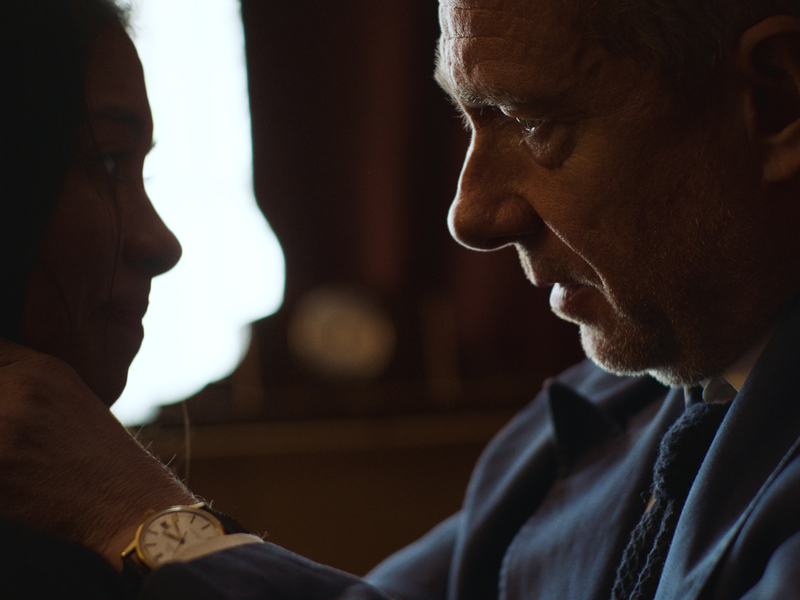
Martin Freeman is well-suited to a film that depends on emotional control, like this, meaning so much. His unnamed scientist isn’t played as a monster trying to justify cruelty, nor does Branston let him escape into the role of a helpless participant simply following orders. Freeman keeps guilt near the surface without turning it into remorse. He knows exactly what Laika's future holds, and taking her home for the evening looks increasingly like an act intended as much for himself as for her.
That gives the short some needed friction. Kindness doesn’t cancel responsibility. Giving Laika a warm room, some well-needed affection, and one peaceful night may be an act of compassion, but the scientist will still send her on a mission with an outcome he understands. LITTLE BUG lets those two truths coexist in the same man without rushing to excuse either.
His daughter Ana has far less patience for those contradictions. Alexandra Barredo brings emotional clarity to the role, questioning choices that her father has already learned to push aside under the pretense of work, duty, and necessity. Their strained relationship existed before Laika was found, but the dog gives Ana a way to confront everything left unresolved between them.
That ultimately becomes an interesting problem for the film. Laika is the reason the story has such an immediate emotional pull, yet portions of LITTLE BUG use her primarily to bring a father and daughter back into the conversation. The family interactions are sincere, and Freeman and Barredo sell the history between them with very little time. Even so, there are moments when Laika begins to feel like a bridge between two human characters in a film whose most powerful perspective is hers.
Ten minutes also means the fracture between father and daughter can only hold so much. Branston provides enough to show that grief and absence have reshaped the household, but the short has to move quickly from separation to vulnerability. A longer version might allow the exploration of Ana’s anger and her father’s emotional retreat to develop with a deeper specificity. Here, the performances often have to supply what the screenplay doesn’t have time to establish.
Freeman is especially effective in those gaps. His ability to make hesitation feel like it changes the world serves a character who appears to have become skilled at compartmentalizing. Scientific achievement, national duty, failure as a parent, and grief have all been broken down into manageable pieces. Bringing Laika into the home makes that impossible to maintain because Ana connects the things he has been keeping apart.
The setting remains contained rather than expansive. LITTLE BUG doesn’t attempt to recreate the Soviet space program on a scale its running time doesn’t require. Much of the story takes place in homes that feel shadowy, confined, and slightly worn. The narrow framing reinforces that, keeping the characters close together even when they’re separated.
Jake Duncan’s cinematography resists making the 1950s setting overly decorative. The image has texture without every prop demanding attention as proof of the period. Light often struggles to enter the frame rather than lighting everything evenly, which suits a story about people unable to say everything they know. Laika’s viewpoint further changes how those rooms feel. Furniture feels larger, doorways feel more imposing, and faces control more meaning than you expect. The effect is especially strong when Ana responds directly to her. There’s no need for dialogue from Laika, exaggerated reactions, or attempts to give her deeper thoughts. Affection becomes physical. Someone kneels toward her. A hand reaches down. She follows because she has been given no reason not to trust them.
That trust gives the story its power, but it depends on a form of betrayal Laika can’t seem to ever completely recognize. Humans understand that an animal can’t consent to being used in an experiment, which is precisely why all responsibility rests with the people making the decision.
Branston doesn’t turn that into an argument against scientific advancement as a whole. The Space Race sits in the background as something larger than this family, full of ambition and genuine discovery. The short instead asks what gets lost when progress is remembered only in terms of achievement. A successful milestone can still contain an act that becomes harder to defend once the victory of triumph is removed.
Charli Mackie’s music contributes to the sadness without overwhelming it, and Nick Smyth’s sound design is particularly important given the restricted visual perspective. Sounds come from outside Laika’s field of view, making the world feel larger than what she can see. That reinforces the helplessness built into the camera placement without constantly reminding us whose eyes we’re borrowing.
The film’s intentions become more obvious near the end. Branston wants the night sky to connect Laika, Ana’s family struggles, and the human desire to send something beyond Earth. It’s an elegant idea, though the short comes close to underlining the connection too clearly. The simpler moments tend to land harder. How long Freeman can hold a look, Ana’s anger, or Laika accepting affection from people who know far more than she does. Those moments are enough.
LITTLE BUG uses an enormous historical event without trying to reproduce its enormous scale. Instead, it takes away the rockets, crowds, and celebration until we’re left in a room on the night before history happens. The achievement is already there. Laika will become famous. The adults know what the next day brings. She only knows that, for one evening, someone brought her home.
Please visit https://linktr.ee/overlyhonestr for more reviews.
You can follow me on Letterboxd, Instagram, Twitter, and YouTube. My social media accounts can also be found on most platforms by searching for 'Overly Honest Reviews'.
I’m always happy to hear from my readers; please don't hesitate to say hello or send me any questions about movies.
[photo courtesy of HONEY BADGER PICTURES]
DISCLAIMER:
At Overly Honest Movie Reviews, we value honesty and transparency. Occasionally, we receive complimentary items for review, including DVDs, Blu-rays, CDs, Vinyl Records, Books, and more. We assure you that these arrangements do not influence our reviews, as we are committed to providing unbiased and sincere evaluations. We aim to help you make informed entertainment choices regardless of our relationship with distributors or producers.
Amazon Affiliate Links:
Additionally, this site contains Amazon affiliate links. If you purchase through these links, we may receive a commission. This affiliate arrangement does not affect our commitment to honest reviews and helps support our site. We appreciate your trust and support as you navigate these links.


Happy
0 %

Sad
0 %

Excited
0 %

Sleepy
0 %

Angry
0 %

Surprise
0 %
 0
0
 0
0

Average Rating