Secrets Don’t Protect the Innocent
Read Time:8 Minute, 0 Second
MOVIE REVIEWS
If I Tell You
 –
– 


Genre: Drama, Mystery
Year Released: 2024, 2026
Runtime: 1h 38m
Director: Tessa Blake
Writers: Tessa Blake, Jennifer Manocherian; based on the novel Closed Doors by Lisa O'Donnell
Cast: Etienne Kellici, Allison Miller, Bill Heck, Carol Kane, Christopher Jackson, Carmela Zumbado, Kennedi Butler, McKenzie Hays
Where to Watch: in select theaters nationwide beginning August 27, 2026
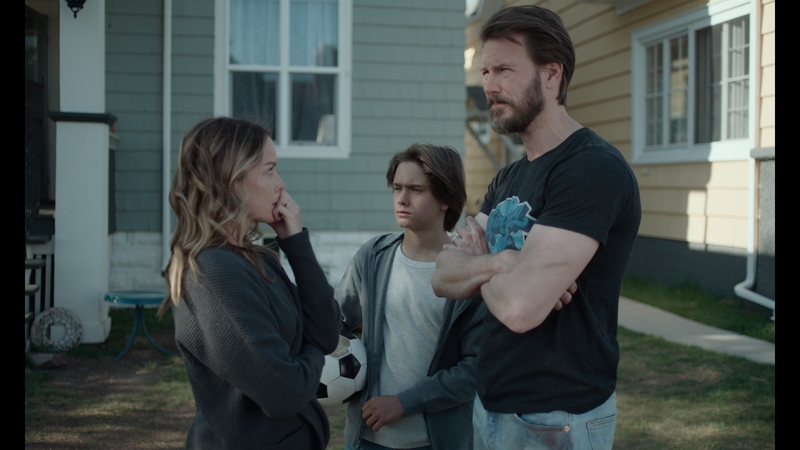
RAVING REVIEW: Michael knows that something happened before anyone tells him it did. His mother, Rosemary, comes home with a bruised face; the adults around him begin choosing their words more carefully; and questions that should have simple answers suddenly lead nowhere. At 12, he’s old enough to recognize when people are hiding something but not old enough to understand why they might believe silence is protecting him. IF I TELL YOU builds suspense inside that uncomfortable gap, letting Michael collect fragments of an adult situation he has neither the experience nor the vocabulary to put together. This film could easily have fit the bill for an ABC Afterschool Special; instead, director/co-writer Tessa Blake takes this story and adds a realism that creates a much deeper impact than I expected.
Adapted with Jennifer Manocherian from Lisa O’Donnell’s novel ‘Closed Doors’, the story has been relocated from the book’s Scottish setting to northern Minnesota, where the Boundary Waters and surrounding communities become more than a backdrop. There’s freedom everywhere Michael looks. Woods to disappear into, water stretching beyond sight, roads leading away from home. Inside his family, however, information has become so tightly controlled. The contrast gives the film a quiet tension that rarely depends on overt danger.
Etienne Kellici carries that viewpoint remarkably well. Michael isn’t written as a child detective who somehow understands adults better than they understand themselves. He gets things wrong. He misreads behavior, jumps to conclusions, listens when he shouldn’t, and keeps pushing after being told to stop. Those mistakes make the character more convincing because his determination grows from fear rather than some supreme insight. Something changed inside a family he once trusted to make sense, and nobody will tell him what.
Kellici is especially good at moving between anxiety and ordinary childhood. Michael can be preoccupied with friends, girls, jokes, or whatever adventure is directly in front of him, only to have the question about Rosemary return to his thoughts and focus without warning. Blake allows those lighter moments to exist rather than making every scene explore the story's seriousness. They remind us what Michael’s life should be occupied with at this age and make the adult crisis intruding upon it feel more disruptive.
Allison Miller has the more difficult role in many ways. Rosemary’s injuries create the mystery, but the character can’t become evidence for Michael to study. Miller gives her a guarded exhaustion that suggests how much effort these normal interactions require. Her refusal to explain what happened is frustrating from Michael’s perspective, though the film never treats disclosure as something she owes on demand. Michael needs reassurance; Rosemary needs control over a painful experience. Both needs are real, and they don’t fit together neatly.
Bill Heck’s Brian benefits from the same uncertainty. Michael studies his father once the household changes, looking for clues in gestures and conversations that previously wouldn’t have meant anything. Heck doesn’t push Brian toward an obvious interpretation, which lets suspicion develop through Michael’s perspective. The screenplay occasionally works too hard to keep several possibilities alive, and a few events feel positioned more for suspense than because the family’s behavior naturally leads there. The ambiguity is most effective when Blake trusts Michael’s limited understanding to create it.
Carol Kane brings warmth and frustration together as Granny, another adult who loves Michael while participating in the effort to keep him away from the truth. It’s a restrained performance by Kane’s standards, and that makes the moments when Granny’s personality breaks through even better. She can comfort Michael, redirect him, and shut down a conversation within the same exchange. Her instinct is to protect the family, but IF I TELL YOU repeatedly questions whether protection built around silence eventually becomes another kind of harm.
The film is particularly sharp in the way it depicts children's interpretations of what adults leave unsaid. A look between two people can become more meaningful than a complete conversation. A door closing feels suspicious. A warning not to ask questions practically guarantees more questions. Adults understand context Michael doesn’t have, yet they underestimate how much he notices. The more they try to control what reaches him, the more he begins constructing explanations on his own.
Carlo Rinaldi’s cinematography makes strong use of the region without romanticizing it. The water, woods, homes, roads, and small-town spaces feel like a real community, and the scenery provides breathing room between increasingly tense encounters. The movie understands the irony of placing a boy surrounded by open country inside a family situation that feels increasingly claustrophobic. Michael can go practically anywhere except into the conversation he most wants to have.
The community around the family adds to the world Michael inhabits. Christopher Jackson and Carmela Zumbado help establish that trouble doesn’t remain private in a small place. People notice things. Changed behavior, unexplained absences, and tension between neighbors. Concern can quickly turn into speculation, and speculation has its own consequences. The film doesn’t explore every relationship in depth, but their presence prevents the family crisis from feeling sealed off in one house.
Blake’s feature debut is at its best when the family is together. Kellici, Miller, Heck, and Kane create the sense that these relationships existed long before the moment we’re watching. There are habits, loyalties, simple and deeper irritations, and forms of affection that don’t need lengthy explanation. The disruption works because the family doesn’t begin broken. They’re people trying to preserve something while disagreeing, sometimes profoundly, about what preservation requires.
Valentin Hadjadj’s score understands that restraint, giving the film a melancholy undercurrent without constantly telling us that we need to worry. There are moments when the music pushes harder than the performances require, though Blake is usually confident enough to let silence do the work. An unanswered question across a kitchen table can be more unsettling here than anything staged as a conventional thriller.
The film also avoids making Michael’s pursuit of the truth naturally heroic. His age gives him a kind of moral clarity, but innocence has limits. He doesn’t always understand what someone else risks by speaking. He believes an answer will restore order because children are taught that knowing what happened is the first step toward fixing it. IF I TELL YOU gradually reveals a harsher reality. One where understanding something doesn’t guarantee that it can be undone.
That realization gives the later acts their impact. The question stops being about what happened to Rosemary and becomes about what everyone chooses to do once the truth can’t be kept outside Michael’s life. Justice, safety, loyalty, family, and trust don’t line up the way he expects. Adults can make decisions out of love and still cause damage. They can protect one person while leaving another confused. They can know the right thing to do and still be afraid to do it.
Kellici keeps Michael grounded through all of that. He doesn’t suddenly become an adult because he learns something painful. He remains a boy who now knows more than he did before, and that difference is enough. Childhood hasn’t vanished, but a certain assumption about adults has.
IF I TELL YOU works because Blake never needs to turn that loss of innocence into a grand declaration. Michael begins with one question and discovers that the answer opens several others. The adults around him have been trying to spare him from pain, but silence has already made him part of it. The truth can’t restore the family to the way things were before everything changed. It can only give them a chance to stop pretending nothing did.
Please visit https://linktr.ee/overlyhonestr for more reviews.
You can follow me on Letterboxd, Instagram, Twitter, and YouTube. My social media accounts can also be found on most platforms by searching for 'Overly Honest Reviews'.
I’m always happy to hear from my readers; please don't hesitate to say hello or send me any questions about movies.
[photo courtesy of SUNCATCHER PRODUCTIONS]
DISCLAIMER:
At Overly Honest Movie Reviews, we value honesty and transparency. Occasionally, we receive complimentary items for review, including DVDs, Blu-rays, CDs, Vinyl Records, Books, and more. We assure you that these arrangements do not influence our reviews, as we are committed to providing unbiased and sincere evaluations. We aim to help you make informed entertainment choices regardless of our relationship with distributors or producers.
Amazon Affiliate Links:
Additionally, this site contains Amazon affiliate links. If you purchase through these links, we may receive a commission. This affiliate arrangement does not affect our commitment to honest reviews and helps support our site. We appreciate your trust and support as you navigate these links.


Happy
0 %

Sad
0 %

Excited
0 %

Sleepy
0 %

Angry
0 %

Surprise
0 %
 0
0
 0
0

Average Rating