Four Films Chart a Fighter’s Rise
Read Time:7 Minute, 48 Second
MOVIE REVIEWS
Reap The Whirlwind: Four Films with Angela Mao (Blu-ray)
 –
– 


Genre: Action, Martial Arts, Adventure, Crime
Year Released: 1971, 1974, 1974, 1976, 2026 Eureka Entertainment Blu-ray
Runtime: 8h 44m
Director(s): Huang Feng
Writer(s): Huang Feng, Ni Kuang, Huangpu Kuan-Hua
Cast: Angela Mao, George Lazenby, Carter Wong, Betty Ting Pei, Hwang In-shik, Chan Sing, Dorian Tan, Kwan Shan, Sammo Hung
Where to Watch: available August 24, 2026, pre-order your copy here: www.eurekavideo.co.uk
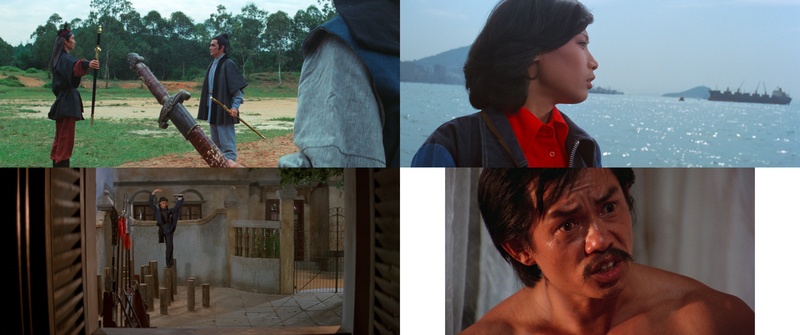
RAVING REVIEW: REAP THE WHIRLWIND: FOUR FILMS WITH ANGELA MAO works particularly well as a snapshot of Angela Mao at the beginning of her career and the rapid development that followed. THE ANGRY RIVER sees her in 1971, still settling into the screen presence that would soon make her one of Hong Kong action cinema’s defining stars, while THE HIMALAYAN arrives only five years later with Mao carrying herself with far greater confidence. That progression gives the collection an identity beyond just putting together four of her films, particularly as director Huang Feng repeatedly finds new settings, characters, and action styles through which Mao can demonstrate how quickly she was growing as a performer.
THE ANGRY RIVER carries some additional historical weight as the first film Golden Harvest put into production. That trivia would mean considerably less if the movie itself couldn’t hold your attention. Mao plays Lan Feng, whose search for a rare herb capable of saving her father sends her through a succession of opponents, alliances, betrayals, and escalating danger. There’s still plenty here that feels attached to the traditions of swordplay adventures that came before it, and the story occasionally functions as little more than transportation between confrontations. Mao is already the reason to keep watching. She doesn’t have to show you her toughness through attitude. There’s a physical certainty in the way she moves that makes the combat convincing before the choreography becomes elaborate. Huang Feng surrounds that with fantasy elements, colorful villains, and increasingly strange obstacles, creating a film that can feel rough around the edges without ever feeling lifeless. THE ANGRY RIVER isn’t the strongest movie in the collection, though seeing Mao at this stage makes everything that follows more interesting.
Nothing quite prepares you for STONER. George Lazenby enters the film as an Australian police officer chasing the source of a dangerous new drug, while Mao plays an agent pursuing the same thing from another direction. Calling the movie unruly would be generous. STONER bounces between police thriller, international action movie, kung fu, drug paranoia, sexual exploitation, and pure 1970s sleaze as though nobody involved saw much reason to choose one. Sometimes that produces exactly the kind of eccentric entertainment that makes forgotten genre movies worth rediscovering. Other stretches simply feel disorganized. Lazenby has the physical presence for the material and can throw himself into a fight, although his character never carries the same command Mao brings to hers. Their combination is fascinating because the movie seems built to sell an international action star while repeatedly demonstrating that its most compelling performer is already standing beside him. Mao cuts through the clutter whenever she comes on screen, and STONER becomes much easier to enjoy once its excesses are accepted rather than resisted.
Those excesses also make it the most dated entry here. The narrative tends to lurch forward rather than develop. There’s a genuine anything-can-happen quality to it, though, and the alternate export cut included by Eureka gives the movie another layer of curiosity. It’s messy, occasionally ridiculous, and impossible to mistake for either of the films surrounding it.
THE TOURNAMENT is where this collection really catches fire. Huang Feng strips away much of the fantasy and international-espionage clutter, giving Mao something else to really hold onto. Traditional Chinese martial arts collide with Muay Thai as family honor, humiliation, competition, and revenge push the story toward increasingly punishing fights. Mao’s Siu Fung feels less like a character who happens to know martial arts and more like someone whose identity has been shaped by discipline. There’s force behind her movements, but equally important is how much personality comes through between them. The fights benefit from that grounding. Impact matters. Losing carries humiliation beyond simply determining who remains standing. Sammo Hung’s presence, both in front of and behind the action, helps give the combat a rougher physical personality, and Mao meets that demand without sacrificing precision. THE TOURNAMENT doesn’t need increasingly elaborate weapons or wild narrative twists to raise the stakes. Watching fighters test one another is enough.
Its nationalistic streak can become a bit heavy, and the story’s notions of honor aren’t exactly subtle. Those qualities belong to the film rather than breaking it, because everything operates at the same heightened emotional temperature. Of these four movies, this is the one that most effectively reduces the distance between story and action. Each fight feels connected to something that matters to the people throwing the punches.
THE HIMALAYAN then changes the surroundings again. The setting opens up, the story becomes more deliberate, and Mao is placed inside a scheme involving marriage, wealth, family power, and betrayal. Chan Sing makes a suitably calculating threat, while Dorian Tan becomes increasingly important to the martial arts side of the story. Compared with THE TOURNAMENT, this one takes considerably longer to reveal exactly what kind of action movie it intends to be. That patience occasionally works against Mao. There are stretches where the film seems oddly comfortable leaving its greatest asset waiting while other characters move the plot into position. Once the conflict takes shape, however, THE HIMALAYAN develops an identity unlike anything else in the collection. The landscapes, architecture, costumes, and a ceremonial atmosphere give the action a distinct visual scale, and the eventual confrontations carry the cumulative weight of everything that came before.
Putting these four movies together also makes Huang Feng’s flexibility easier to appreciate. The basics of martial arts cinema remain present, but the genres keep changing. THE ANGRY RIVER leans toward fantasy adventure. STONER barges into international exploitation. THE TOURNAMENT becomes a bruising examination of competing fighting. THE HIMALAYAN expands into a family intrigue and revenge. His approach isn’t equally successful every time, yet repetition never becomes the collection’s problem.
Mao is the constant without ever seeming trapped inside a version of herself. Her skillset is obviously part of the appeal, but focusing exclusively on athletic ability undersells why she remains so watchable. She can project confidence without turning every character into the same person. THE ANGRY RIVER needs determination, STONER needs someone capable of surviving its insanity, THE TOURNAMENT requires pride and controlled aggression, and THE HIMALAYAN gives her emotional stakes that extend beyond winning another fight.
Eureka’s presentation understands that these films benefit from context. The restorations keep the texture intact while giving the colors, locations, costumes, and fight choreography room to work together. English dub options join the original Mandarin mono tracks, while newly translated subtitles make the original-language presentations the most appealing route through the set. STONER receives both its Hong Kong theatrical and alternate English export versions, which feels appropriate for a movie whose identity was already divided between markets. The supplemental material also treats Huang Feng as more than the name sitting beneath Mao’s. Frank Djeng contributes commentaries for THE ANGRY RIVER, THE TOURNAMENT, and THE HIMALAYAN, while STONER receives separate tracks for its two versions. The Huang Tough interview with Wayne Wong broadens the focus to Feng’s career, and the collector’s booklet situates Mao’s work within history rather than treating her as a novelty among male martial arts stars.
REAP THE WHIRLWIND is worth spending time with. Four nearly identical Angela Mao films would have shown skill. These four show range, experimentation, mistakes, shifting ambitions, and a performer who becomes harder to overlook each time she steps into another fight. The movies may rise and fall around her, but Mao never gives the collection a chance to lose its center.
Please visit https://linktr.ee/overlyhonestr for more reviews.
You can follow me on Letterboxd, Instagram, Twitter, and YouTube. My social media accounts can also be found on most platforms by searching for 'Overly Honest Reviews'.
I’m always happy to hear from my readers; please don't hesitate to say hello or send me any questions about movies.
[photo courtesy of EUREKA ENTERTAINMENT]
DISCLAIMER:
At Overly Honest Movie Reviews, we value honesty and transparency. Occasionally, we receive complimentary items for review, including DVDs, Blu-rays, CDs, Vinyl Records, Books, and more. We assure you that these arrangements do not influence our reviews, as we are committed to providing unbiased and sincere evaluations. We aim to help you make informed entertainment choices regardless of our relationship with distributors or producers.
Amazon Affiliate Links:
Additionally, this site contains Amazon affiliate links. If you purchase through these links, we may receive a commission. This affiliate arrangement does not affect our commitment to honest reviews and helps support our site. We appreciate your trust and support as you navigate these links.


Happy
0 %

Sad
0 %

Excited
0 %

Sleepy
0 %

Angry
0 %

Surprise
0 %
 0
0
 0
0


Average Rating