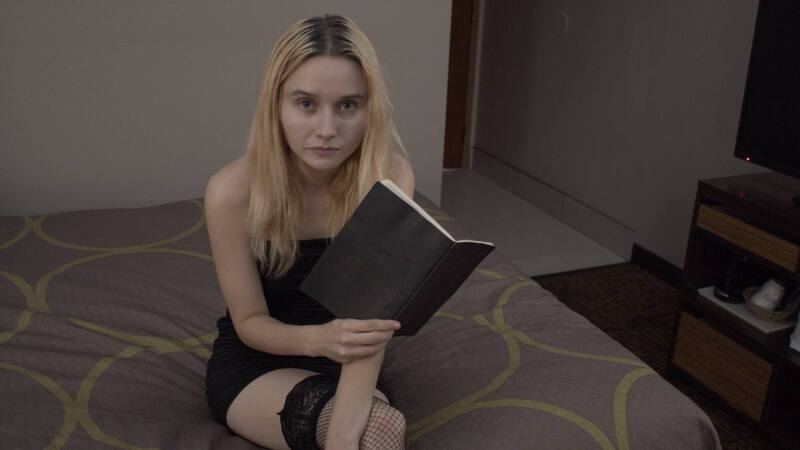
The Sequel Knows You’re Watching
Read Time:7 Minute, 45 Second
MOVIE REVIEW
Looky-Loo: Part II
 –
– 

Genre: Horror, Thriller
Year: 2026
Runtime: 1h 20m
Director: Jason Zink
Writer: Nolan Mihail
Cast: Kansas Bowling, Jessa Jupiter Flux, Julie Kashmanian, Kali Malia Michaels, Siane Wilson
Where to Watch: world premiere of Parts I and II playing as a double feature at Nightmares Film Festival on October 18
RAVING REVIEW: Watching LOOKY-LOO and LOOKY-LOO: PART II back-to-back for my first experience with Jason Zink's strange little nightmare made the difference between them immediately clear. The first movie almost dares you to lose patience, locking the audience behind the eyes of a voyeur whose camera gradually becomes less of a hobby and more of a weapon. PART II doesn't abandon that uncomfortable simplicity, but it finally gives the idea somewhere bigger to go.
That's important because LOOKY-LOO is deliberately limited. Long stretches pass watching, wandering, stalking, and waiting as Zink commits completely to the killer's perspective. It's effective precisely because the camera never provides the distance horror normally offers, though at times its repetition worked against the tension. By the end, however, the movie had established something much more interesting than another anonymous killer with a camera. This guy thinks he's making art.
PART II understands that distinction and runs with it. The murders aren't simply private acts anymore because the first film has escaped into the world, circulated online, and turned its unidentified creator into a grotesque celebrity. News reports discuss him. People argue about him. Internet detectives obsess over his footage. His victims have become content, while the killer discovers that an audience is waiting for whatever he decides to make next.
That shift gives Nolan Mihail's screenplay a nastier edge without forcing the killer to explain himself. He remains largely unknowable, and keeping him that way is the right decision. What changes is his awareness of the people watching. He isn't just documenting his crimes anymore; he's responding to reception, criticism, and fascination, with the camera becoming part weapon, part shield, and part proof that somebody out there is paying attention.
That escalation feels depressingly believable. True crime has created an entire entertainment economy around people doing horrible things, and PART II pokes at the uncomfortable line between examining violence and consuming it. The film doesn't lecture about that distinction, either. It puts us directly behind the camera again and lets the problem become harder to ignore because we're still watching even after understanding exactly whose perspective we're sharing.
That makes the sequel's relationship with its own audience especially interesting. The killer wants attention, but the movie also knows attention is exactly what we're giving him. Every time the camera lingers too long or pushes into another private space, we feel an uneasy awareness that our curiosity helps the whole thing continue. Zink doesn't pretend the viewer is innocent simply because we're sitting on the other side of the screen, and that friction gives PART II more to chew on than a straightforward stalk-and-kill setup.
The title LOOKY-LOO becomes even more appropriate because everyone in this world seems to be watching somebody. The killer watches his victims. The public watches the killer. Commentators watch the public reaction. We watch all of them. That chain of observation turns the movie into something almost circular, where nobody seems able to look away, even when they know they're seeing something awful.
The two films also work better together than I expected. PART I's sparseness makes more sense once PART II builds on it, because the sequel benefits from such a simple baseline. We know what this man looked like when he operated almost entirely on his own, so the effect of outside attention becomes much clearer once it starts reshaping what he's doing.
Zink also finds considerably more variety within the format this time. The first LOOKY-LOO can feel almost aggressively observational, but PART II introduces more outside information and more glimpses of the world reacting to what the killer has created. News broadcasts, public discussion, and the growing mythology surrounding him widen the movie without breaking its point of view. Suddenly this isn't only about somebody spying through windows. It's about what happens when that person realizes strangers are studying every frame he shoots.
The actual stalking remains appropriately miserable to sit through. Zink makes ordinary spaces feel vulnerable because there isn't much separating the killer from the people he's watching, and the mundane details are frequently more unsettling than the violence itself. A door, a window, someone arriving home, or another person going about an ordinary routine carries more tension when we already know someone nearby shouldn't be there.
That patience can still test the viewer, and PART II occasionally pushes a sequence beyond the point where its uneasiness has peaked. Heavy breathing and extended stretches of movement from the killer's perspective are fundamental to the concept. Repetition doesn't automatically create additional tension simply because the camera refuses to cut away. The sequel gives those stretches more purpose than its predecessor, yet moments still emerge where the commitment to the method feels more noticeable than what is happening inside the frame.
Fortunately, Zink seems interested in challenging his own formula rather than becoming trapped by it. PART II gradually introduces circumstances that complicate the killer's control over his own production, and some of the strongest material arrives when reality stops behaving exactly as he expects. That's where the sequel becomes much more than a bloodier recreation of the first movie. His camera may frame the world, but that doesn't necessarily mean he controls everything occurring within it.
The performances have an unusual challenge because so much of the movie depends upon people appearing unaware that they're effectively being watched by both a murderer and an audience. Julie Kashmanian, Jessa Jupiter Flux, Kali Malia Michaels and the rest of the cast have to make ordinary behavior convincing enough for Zink's observational approach to work. When that natural quality holds, the intrusion feels significantly nastier because we're watching someone violate spaces that feel inhabited rather than staged for an incoming horror sequence.
There's also an increasingly pathetic quality to the killer underneath all his attempted control. His violence is horrifying, but PART II doesn't make him impressive simply because he's dangerous. His need to document everything, react to the attention, and shape some grand statement around himself starts exposing a person desperate to make his ugliness mean something. The movie becomes considerably stronger once that insecurity begins sitting beside the menace.
That's also why seeing LOOKY-LOO first ended up mattering more than I expected. PART II technically gives enough information to understand what's happening, but watching the original establishes just how much this character and the filmmaking around him have changed. The progression from isolated voyeur to someone effectively performing for an audience gives the sequel a real reason to exist beyond escalation.
It's an impressive jump for a project that reportedly began in Indiana for less than $5,000. PART II feels more ambitious without suddenly pretending it belongs to a completely different production. Zink keeps the rawness, Mihail adds a stronger narrative framework, and together they expand the world without polishing away the ugliness that made the concept unsettling in the first place.
Most importantly, LOOKY-LOO: PART II understands that the scariest development isn't simply that its killer has become more violent. It's that people watched his first movie, talked about it, passed it around, and made him important. Now he knows he has an audience, and once somebody this desperate to be seen discovers people are actually looking, putting the camera down becomes the last thing he's interested in doing.
Please visit https://linktr.ee/overlyhonestr for more reviews.
You can follow me on Letterboxd, Instagram, Twitter, and YouTube. You can also find my social media accounts on most platforms by searching for 'Overly Honest Reviews'.
I’m always happy to hear from my readers; please don't hesitate to say hello or send me any questions about movies.
[photo courtesy of WEIRD ON TOP PICTURES]
DISCLAIMER:
At Overly Honest Movie Reviews, we value honesty and transparency. Occasionally, we receive complimentary items for review, including DVDs, Blu-rays, CDs, Vinyl Records, Books, and more. We assure you these arrangements do not influence our reviews, as we are committed to unbiased, sincere evaluations. We aim to help you make informed entertainment choices regardless of our relationship with distributors or producers.
Amazon Affiliate Links:
This site also contains Amazon affiliate links. If you purchase through these links, we may receive a commission. This affiliate arrangement does not affect our commitment to honest reviews and helps support our site. We appreciate your trust and support as you navigate these links.


Happy
0 %

Sad
0 %

Excited
0 %

Sleepy
0 %

Angry
0 %

Surprise
0 %
 0
0
 0
0

Average Rating