A Stranger, Smarter Kind of Sequel
Read Time:9 Minute, 15 Second
MOVIE REVIEW
Futureworld
 –
– 


Genre: Science Fiction, Thriller
Year: 1976, 2026 4K
Runtime: 1h 48m
Director: Richard T. Heffron
Writers: Mayo Simon, George Schenck
Cast: Peter Fonda, Blythe Danner, Arthur Hill, Yul Brynner, John P. Ryan, Stuart Margolin
Where to Watch: available October 20, 2026. Pre-order your copy here: www.arrowvideo.com, www.mvdshop.com, or www.amazon.com
RAVING REVIEW: The smartest thing FUTUREWORLD does is refuse to make WESTWORLD again, simply. The original had such a clean premise that repeating it would've been easy. Reopen Delos, something goes wrong with the robots, and let another unstoppable machine start hunting people. Richard T. Heffron's sequel instead asks a more unsettling question. What if the technology is working exactly the way somebody wants it to?
That distinction gives FUTUREWORLD more personality than its reputation suggests. Michael Crichton wasn't involved with the sequel, and the shift is immediately noticeable. The first film's fear came from a system breaking down beyond anyone's control. Here, control itself is the problem.
Two years after the disaster at Delos, the company has spent more than a billion dollars rebuilding its reputation and assuring the public that nothing like the Westworld tragedy can ever happen again. Reporters Chuck Browning and Tracy Ballard are invited to inspect the newly improved resort, partly because Delos knows favorable coverage from skeptical journalists is worth far more than traditional advertising.
Chuck has even more reason to be suspicious. Shortly before the trip, a former Delos employee attempts to give him information and dies before he can explain much beyond the suggestion that something inside the company is wrong. Chuck arrives expecting deception, while Tracy is initially more willing to accept that Delos may genuinely be trying to recover from its past.
Peter Fonda and Blythe Danner make that dynamic considerably more entertaining than the mystery itself occasionally deserves. Fonda gives Chuck the laid-back confidence of someone who enjoys assuming everyone is lying to him, while Danner makes Tracy sharper and more grounded. Their relationship has enough friction to keep the investigation moving even during stretches when the film itself becomes oddly relaxed about uncovering its conspiracy. That relaxed approach is FUTUREWORLD's biggest problem.
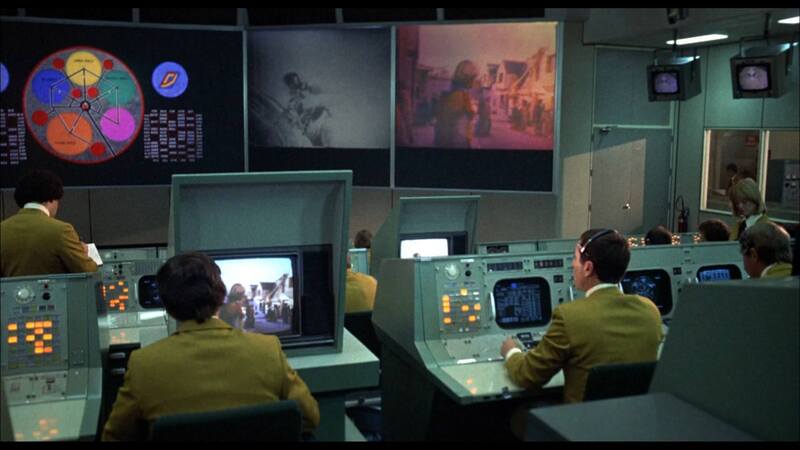
The movie spends much of its first half showing us the redesigned Delos. Futuristic games, elaborate demonstrations, robots, and glimpses of attractions are meant to prove this new resort is safer and more technologically advanced than what came before. Some of this is fascinating purely as 1970s science fiction because the imagined future now looks charmingly mechanical. You can see buttons, machinery, and industrial equipment everywhere. Technology doesn't disappear into smooth glass surfaces, as modern science fiction often imagines. The future requires rooms full of equipment, technicians, cables and blinking controls.
Real-world locations help enormously. Portions of the production were filmed at NASA's Johnson Space Center, and those environments lend the movie a scale and authenticity that would've been difficult to manufacture on the film's budget. Even as the futuristic concepts age, the physical spaces still feel substantial.
The problem is that FUTUREWORLD sometimes mistakes showing off those spaces for building suspense. We know something is wrong almost immediately, yet the investigation takes its time before it gets anywhere concrete. Chuck and Tracy sneak around, notice inconsistencies, and slowly piece together information while the movie keeps postponing the moment when paranoia becomes real danger. Once it finally does, the sequel becomes considerably stronger.
The conspiracy beneath Delos isn't particularly subtle, but it is clever in the way it expands the original concept. The company is no longer merely selling wealthy people carefully controlled fantasies. It has discovered a much more disturbing use for the ability to reproduce human beings perfectly. That's where the film becomes distinctly post-Watergate.
Putting journalists at the center of the story doesn't feel accidental in a 1976 movie. Chuck and Tracy aren't action heroes stumbling into a science-fiction nightmare. They're reporters who assume a powerful corporation is hiding something and decide their job is to keep digging until they understand what it is.
The threat isn't a malfunctioning robot chasing them through hallways. It's an institution that believes secrecy, technology, and influence give it the right to decide how society should function. That idea has aged remarkably well.
In fact, some of FUTUREWORLD's concepts are far more interesting now than its execution made them then. The fear of automation here isn't simply that machines might replace human labor. It's that technology can reproduce people so convincingly that another organization can own, copy, and manipulate identity. The question isn't whether a machine can look human. It's whether somebody else can decide what version of you the world gets to see.
That makes the movie's obsession with doubles more unsettling than some of its action. When Chuck and Tracy eventually encounter versions of themselves, the concept taps into something much more disturbing than another robot uprising. A copy doesn't need to overpower the original if nobody can tell the difference afterward.
Heffron doesn't always exploit that possibility as deeply as he could. FUTUREWORLD periodically approaches genuinely unnerving territory, then backs away into a more conventional chase or fight sequence. The conspiracy is bigger than the suspense it generates.
Arthur Hill's Duffy benefits from that imbalance because calm authority fits the story better than obvious villainy. Delos has rebuilt itself around reassurances. Everyone is told the resort is safe, improved, and carefully monitored, so the people running it have every incentive to seem reasonable.
John P. Ryan's Dr. Schneider is considerably stranger. His presence has an almost detached quality that makes his scenes uncomfortable even before the full scope of what Delos is doing becomes clear. The scientists here don't behave like stereotypical madmen. Their work has simply progressed to the point where they no longer seem particularly troubled by the moral questions surrounding it. The returning Yul Brynner is another matter.
His Gunslinger became the defining image of WESTWORLD, so bringing him back made commercial sense. Unfortunately, the sequel gives him no meaningful role. He appears in a dream sequence involving Tracy, and while seeing Brynner in black again connects to the original, it feels more like an obligation than an organic part of the story.
The irony is amusing because FUTUREWORLD is otherwise surprisingly willing to move away from WESTWORLD. It doesn't need the Gunslinger, and the reminder of how effective Brynner was in the first film briefly highlights what this sequel lacks.
What it does have is Stuart Margolin's Harry, a technician who has developed an attachment to a damaged robot named Clark. Those scenes are quieter than the larger conspiracy, but they introduce an idea the movie never fully explores. These machines may be developing something resembling emotion or personality. Harry treats Clark less like malfunctioning equipment and more like a friend.
That thread almost belongs in another movie, but it's one reason FUTUREWORLD remains interesting even when it's messy. The screenplay overflows with ideas about automation, identity, corporate authority, artificial intelligence, and the increasingly blurry line between human beings and machines. It simply doesn't control all of them well enough. The result is a sequel that's conceptually ambitious and dramatically inconsistent.
Peter Fonda sometimes looks almost too relaxed for someone uncovering a conspiracy that could reshape world politics, but that detachment also fits Chuck's personality. Blythe Danner is the more energetic presence, and her reactions provide some of the urgency the movie otherwise lacks.
Together, they're more enjoyable than their romantic angle. Some of the dialogue reflects attitudes that have aged less gracefully than the science-fiction ideas, particularly when Tracy's competence is undercut so Chuck can remain the dominant figure in their investigation.
The action is also noticeably less effective than the buildup suggests. WESTWORLD had Yul Brynner relentlessly pursuing Richard Benjamin, and that simple chase gave the final stretch tremendous momentum. FUTUREWORLD has a theoretically much larger threat but struggles to create the same physical danger. That's why the movie works better as conspiracy science fiction than as an action thriller.
Its most memorable material isn't anyone running through corridors. It's the realization that Delos doesn't need another catastrophic malfunction because a perfectly functioning system might be worse.
Arrow Video's new limited-edition 4K release arrives at a good moment for reassessment. FUTUREWORLD isn't merely receiving its first global 4K UHD release; the disc includes a new Dolby Vision presentation, restored mono audio, a new commentary, an interview with producer Paul N. Lazarus III, and the 1976 behind-the-scenes short NASA: SCIENCE FACT AND FICTION.
That restoration should be especially interesting for a film built so heavily around physical production design. The retro technology, NASA locations, and underground machinery are a large part of its appeal now, perhaps even more than audiences in 1976 would've expected.
FUTUREWORLD remains a step below WESTWORLD, but not because it simply fails to recreate the first film. If anything, I appreciate that it does the opposite. Crichton's movie asked what happens when technology escapes human control. FUTUREWORLD asks what happens when powerful people gain too much control over technology.
The sequel doesn't always know how to turn that distinction into excitement, and its pacing can be frustratingly slow before the conspiracy finally takes shape. Yet the ideas underneath Delos remain compelling enough that the movie has aged into something stranger and more relevant than a disposable sequel. The future it imagined looks wonderfully dated. The fear underneath it doesn't.
Please visit https://linktr.ee/overlyhonestr for more reviews.
You can follow me on Letterboxd, Instagram, Twitter, and YouTube. You can also find my social media accounts on most platforms by searching for 'Overly Honest Reviews'.
I’m always happy to hear from my readers; please don't hesitate to say hello or send me any movie questions.
[photo courtesy of ARROW VIDEO, MVD ENTERTAINMENT]
DISCLAIMER:
At Overly Honest Movie Reviews, we value honesty and transparency. Occasionally, we receive complimentary items for review, including DVDs, Blu-rays, CDs, Vinyl Records, Books, and more. We assure you these arrangements do not influence our reviews, as we are committed to unbiased, sincere evaluations. We aim to help you make informed entertainment choices regardless of our relationship with distributors or producers.
Amazon Affiliate Links:
This site also contains Amazon affiliate links. If you purchase through these links, we may receive a commission. This affiliate arrangement does not affect our commitment to honest reviews and helps support our site. We appreciate your trust and support as you navigate these links.


Happy
0 %

Sad
0 %

Excited
100 %

Sleepy
0 %

Angry
0 %

Surprise
0 %
 1
1
 0
0

Average Rating