The Unbearable Cost of Belonging
Read Time:7 Minute, 28 Second
MOVIE REVIEW
I Will Be Alright
 –

Genre: Short, Drama
Year Released: 2026
Runtime: 21m
Director(s): Cyrus Neshvad
Writer(s): Cyrus Neshvad, Guillaume Levil
Cast: Tanaz Molaei, Emily Amor, Tom Gaubig, Toufan Manoutcheri, Al Ginter, Jerome Funk, Anne Klein
Where to Watch: shown at the 2026 LA Shorts International Film Festival
RAVING REVIEW: Imagine being sixteen and knowing your entire future could disappear because someone you've never met decides you don't belong. Your friendships, schooling, safety, and whatever little stability you've managed to establish can all become irrelevant with a single administrative decision. That's the reality confronting Laïla in Cyrus Neshvad's I WILL BE ALRIGHT, an extraordinary short film that understands how devastating it is to have so little control over your own existence. It's an extremely personal story, told with remarkable confidence, that brings an enormous issue down to the size of one frightened teenager's world.
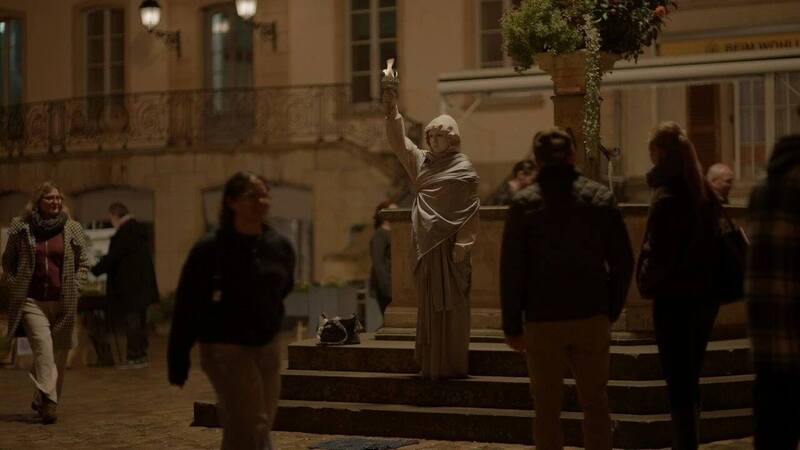
Laïla (Tanaz Molaei) is an Iranian refugee living in Luxembourg, facing the possibility of deportation to the country she escaped. To earn money, she dresses as the Statue of Liberty and stands in public as a recognizable symbol of freedom, even as her own freedom remains conditional. It's an incredibly powerful image, but Neshvad and co-writer Guillaume Levil understand that the contradiction alone won't tell the whole story. They establish the circumstances surrounding this young woman without losing sight of her individuality, allowing the audience to recognize the enormous distance between the freedom a society celebrates and the freedom it actually extends to those seeking protection.
What I found particularly effective about this choice is that the Statue of Liberty isn't simply included as a political statement. Laïla performs an ideal that remains out of reach for her. She has to depend on strangers' generosity while remaining vulnerable to the dangers around her. The costume offers a temporary haven that people recognize and appreciate, but the person underneath it has no assurance that she'll be accepted. It's genuinely upsetting to realize that an audience can admire a representation of liberty without considering the circumstances of the human being standing directly in front of them.
Molaei delivers a performance that deserves considerable recognition. She carries herself with the uncertainty of someone who has learned to stay vigilant, knowing any encounter can have consequences far beyond what most would imagine. Her expressions communicate exhaustion, apprehension, and determination to keep going without needing lengthy explanations of what she's experiencing. It's a demanding role because so much of Laïla's existence depends on what she can’t say, and Molaei makes those limitations feel all too real.
The film also benefits from Emily Amor's role as Nathalie, another young woman whose presence becomes significant. Their performances build a connection that lets the story explore compassion beyond nationality and immigration. Neither character needs to serve as a spokesperson for an entire generation or political position. They're young people facing circumstances that require understanding, and the film respects them enough to recognize that their individual lives matter, independent of the larger issues around them.
Neshvad previously received an Academy Award nomination for THE RED SUITCASE, another short concerned with an Iranian teenager confronting an uncertain future. His connection to these subjects extends beyond just filmmaking. Iranian by origin, he moved to Luxembourg at age five, and questions of cultural identity, displacement, and acceptance have remained central throughout his career. I WILL BE ALRIGHT develops those interests further, demonstrating how effectively he can approach complicated human experiences within a relatively limited runtime.
His direction is particularly impressive in its refusal to overwhelm the audience. The story doesn't require an extended explanation of immigration procedures or a series of speeches establishing which institutions are responsible for Laïla's circumstances. We understand what she stands to lose because we can experience the uncertainty alongside her. This is especially true when films on contemporary political subjects focus so much on explaining their message that they neglect the individuals they supposedly represent.
Guillaume Duchemin's cinematography gives the production a focused identity that significantly contributes to its emotion. The Luxembourg locations provide an interesting contrast between the recognizable surroundings of an established European society and Laïla's position within it. Public spaces and the changing atmosphere take on additional significance when viewed through the perspective of someone who can’t assume she has the right to remain there.
Short filmmaking requires an understanding of what an audience needs and what should remain unspoken. Here, the storytelling allows its characters room to establish a presence while maintaining a clear sense of urgency. The film doesn't feel like a compressed feature, nor an incomplete idea needing further development. It shows a filmmaker who understands the possibilities within these limitations.
One of the greatest strengths of I WILL BE ALRIGHT is its understanding that displacement involves considerably more than physically leaving one country for another. Escaping danger doesn't automatically provide security, and reaching a place that promises protection doesn't guarantee acceptance. Laïla exists between those realities, with her future dependent on circumstances she can’t change. The screenplay examines that uncertainty without reducing her experiences to an argument the audience can easily agree with.
There's also a meaningful distinction between pity and compassion, and Neshvad seems particularly interested in exploring it. Feeling sorry for someone requires very little personal involvement, while recognizing their humanity asks us to consider what we owe one another. The film approaches that question through relationships rather than declarations, finding its strength in the possibility that individual decisions can matter even when circumstances appear impossible to overcome.
Neshvad has continued developing an impressive international career, with his feature debut CHILD also selected as Luxembourg's submission for Best International Feature Film. Having both projects enter the same Academy Awards season speaks to his growing presence as a filmmaker. His ability to communicate through accessible, character-driven storytelling matters far more than any awards campaign.
Perhaps the most impressive aspect of I WILL BE ALRIGHT is how much confidence it places in its audience. He establishes the circumstances, develops the people, and lets the significance of their experiences emerge through the storytelling. The film's emotion comes from seeing these characters as individuals rather than as illustrations of a larger social problem.
I also appreciate that its perspective extends beyond whether someone has the legal right to remain in a particular country. It's concerned with the human need to feel wanted, protected, and recognized by the people around us. Those desires aren't dependent on citizenship, nationality, or the circumstances of someone's arrival. They're fundamental parts of being alive, and denying someone those considerations becomes harder to justify when we're willing to recognize ourselves in their experiences.
I WILL BE ALRIGHT left me thinking about how easily we accept the idea of freedom without considering the responsibilities that accompany it. The Statue of Liberty is recognizable around the world, but the values associated with that image mean very little when they're treated as privileges reserved for particular people. Cyrus Neshvad has created a deeply affecting film that challenges that contradiction through the experiences of a young woman whose wish is simply to have a future. Its emotional impact is substantial, its performances are outstanding, and its message deserves attention far beyond the festival circuit. Twenty-one minutes is a remarkably short time to make someone reconsider what it means to belong somewhere, yet this film does exactly that.
Please visit https://linktr.ee/overlyhonestr for more reviews.
Follow me on Letterboxd, Instagram, Twitter, and YouTube. You can also find my social media accounts on most platforms by searching for 'Overly Honest Reviews'.
I’m always happy to hear from my readers; please don't hesitate to say hello or send me any movie questions.
[photo courtesy of CYNEFILMS]
DISCLAIMER:
At Overly Honest Movie Reviews, we value honesty and transparency. Occasionally, we receive complimentary items for review, including DVDs, Blu-rays, CDs, Vinyl Records, Books, and more. We assure you these arrangements do not influence our reviews, as we are committed to unbiased, sincere evaluations. We aim to help you make informed entertainment choices regardless of our relationship with distributors or producers.
Amazon Affiliate Links:
This site also contains Amazon affiliate links. If you purchase through these links, we may receive a commission. This affiliate arrangement does not affect our commitment to honest reviews and helps support our site. We appreciate your trust and support as you navigate these links.


Happy
0 %

Sad
0 %

Excited
0 %

Sleepy
0 %

Angry
0 %

Surprise
0 %
 0
 0

Average Rating